
For adults with a BMI of 27 or higher, navigating remote weight management can feel like choosing a medical provider from a crowded marketplace with no clear labels. Programs vary widely in clinical depth, pricing, and how much actual physician involvement you get. Some include GLP-1 receptor agonists (medications like Semaglutide or Tirzepatide that reduce appetite and help regulate blood sugar) while others bundle only basic coaching. This guide walks you through every stage, from evaluating program options and preparing your health baseline, to executing your plan with medication and behavioral support, to tracking real progress over time.
Table of Contents
- Understanding remote weight management options and requirements
- Preparing for successful remote weight management
- Executing your remote weight management program with clinical and behavioral support
- Verifying progress and troubleshooting common challenges in remote weight management
- A fresh perspective on remote weight management success
- Explore RenewMD's digital weight management solutions
- Frequently asked questions
Key Takeaways
| Point | Details |
|---|---|
| Know your options | Remote weight management varies widely; understand program clinical oversight, costs, and support before enrolling. |
| Set realistic goals | Aim for steady weight loss of 0.5 to 2 pounds per week for safe and sustainable results. |
| Engage fully | Medication alone isn’t enough—combine with behavioral coaching, nutrition, and consistent habits. |
| Track and adapt | Regularly monitor your progress and communicate with providers to adjust your care plan. |
| Choose clinical partnership | Treat your program as an ongoing clinical relationship, not just a subscription, for lasting success. |
Understanding remote weight management options and requirements
The first step in navigating remote weight management is knowing what you are actually comparing. Virtual weight management programs vary significantly in cost structure and clinical model, and those differences have real consequences for your care.

Some programs charge per visit. For example, program costs vary widely from pay-per-visit models around $49 per appointment to monthly subscriptions ranging from $129 to $149, with medication costs billed separately in most cases. That distinction matters because a low monthly fee can quickly become expensive once you add the cost of compounded or brand-name GLP-1 medication.
Before enrolling in any program, evaluate these core factors:
- Clinical oversight level: Is a licensed physician or nurse practitioner available for synchronous video visits, or does the program rely only on asynchronous messaging?
- State licensing: Confirm that the prescribing provider is licensed in your state. Telehealth regulatory compliance requirements differ by state, and prescribing controlled or monitored medications across state lines requires specific authorizations.
- Medication coverage: Does the price include medication, or is that a separate cost entirely?
- Behavioral support: Is there a nutrition counselor or behavioral coach, or just a provider who manages your prescription?
- Lab testing requirements: Some programs require baseline and follow-up labs. Others do not, which can be a red flag for clinical rigor.
| Feature | Pay-per-visit model | Monthly subscription model | All-inclusive model |
|---|---|---|---|
| Typical cost | ~$49/visit | $129–$149/month | Varies; often bundled |
| Medication included | No | No | Sometimes |
| Video visits | Yes | Varies | Yes |
| Behavioral coaching | Rarely | Sometimes | Often |
| Lab testing | Patient-arranged | Sometimes included | Often included |
| Best for | Infrequent check-ins | Budget-conscious users | Ongoing clinical care |
A medical weight loss telemedicine guide can help you understand the clinical standards to expect before committing to any program. The key takeaway: pay structure alone does not tell you whether a program is medically sound.
Preparing for successful remote weight management
With a clear understanding of program options, you are now ready to prepare yourself and your lifestyle for a productive remote weight management journey. The preparation phase is often skipped, but it directly determines how personalized your early care will be.
Follow these steps before your first clinical visit:
- Gather your medical history. Compile a current medication list, any recent lab results (blood glucose, lipid panel, thyroid function), and a summary of previous weight loss attempts. Providers need this context to prescribe safely.
- Establish a baseline. Record your current weight, waist circumference, and resting heart rate. These numbers give your care team a starting point for tracking progress.
- Set realistic weight loss targets. Aiming for 0.5 to 2 pounds of weight loss per week is the range that research supports as safe and sustainable, preserving muscle while reducing fat.
- Audit your home environment. Clear out processed snacks, stock protein-rich foods, and designate a space for movement. Your environment shapes behavior more than willpower does.
- Identify your support network. Tell at least one household member or close contact about your program. Social accountability correlates with better long-term adherence.
- Schedule your clinical intake. Review what preparing for telehealth visits looks like, including technical setup, what questions to ask, and what information to have ready.
Commitment to lifestyle changes alongside medication is not optional. GLP-1 therapies reduce appetite, but they do not replace the habits that sustain weight loss after dosing ends. Reviewing evidence-based telehealth weight management practices ahead of time helps you approach the program as an active participant, not a passive recipient.
Pro Tip: Begin logging your meals, weight, and daily activity one to two weeks before your first appointment. This pre-program data gives your provider a real behavioral snapshot, making initial coaching far more targeted than generic advice.
Executing your remote weight management program with clinical and behavioral support
Now that you are prepared, focus on how to actively and effectively execute your remote weight management program to achieve your goals.
Digital engagement with GLP-1 pharmacotherapy has been shown to improve weight loss outcomes by increasing accountability and enabling personalized clinical feedback. That finding reinforces what good programs already practice: the medication is one tool, not the entire strategy.
Here is how to make execution work:
- Follow GLP-1 dosing instructions precisely. Medications like Semaglutide typically start at a low dose and escalate gradually to reduce gastrointestinal side effects. Report nausea, vomiting, or constipation promptly so your provider can adjust your titration schedule.
- Prioritize protein intake. Aim for 0.7 to 1.0 grams of protein per pound of body weight per day. This is not a general guideline; it is a clinical strategy to preserve lean muscle mass while in a caloric deficit, which keeps your metabolism from slowing.
- Use weight tracking apps consistently. Regular self-monitoring through digital weight management tools improves adherence. Log your weight at the same time each morning and record meals when possible.
- Engage with behavioral coaching. All-inclusive telehealth weight management programs that pair medication with structured coaching treat obesity as the chronic condition it is.
- Move intentionally, not excessively. Start with 150 minutes of moderate activity per week. Resistance training twice weekly protects muscle and improves insulin sensitivity.
Effective programs combine medication with behavioral support by treating obesity as a chronic disease, not an acute problem with a quick resolution. That framing shifts how you engage with your plan.
| Behavioral component | Role in remote weight management success |
|---|---|
| Protein-focused nutrition | Preserves muscle, supports satiety |
| Digital food logging | Builds awareness of intake patterns |
| Regular weigh-ins | Provides objective feedback, reduces guessing |
| Scheduled provider check-ins | Enables dose adjustments and clinical pivots |
| Behavioral coaching sessions | Addresses emotional eating, habit formation |
| Stress and sleep management | Regulates cortisol, which drives fat storage |
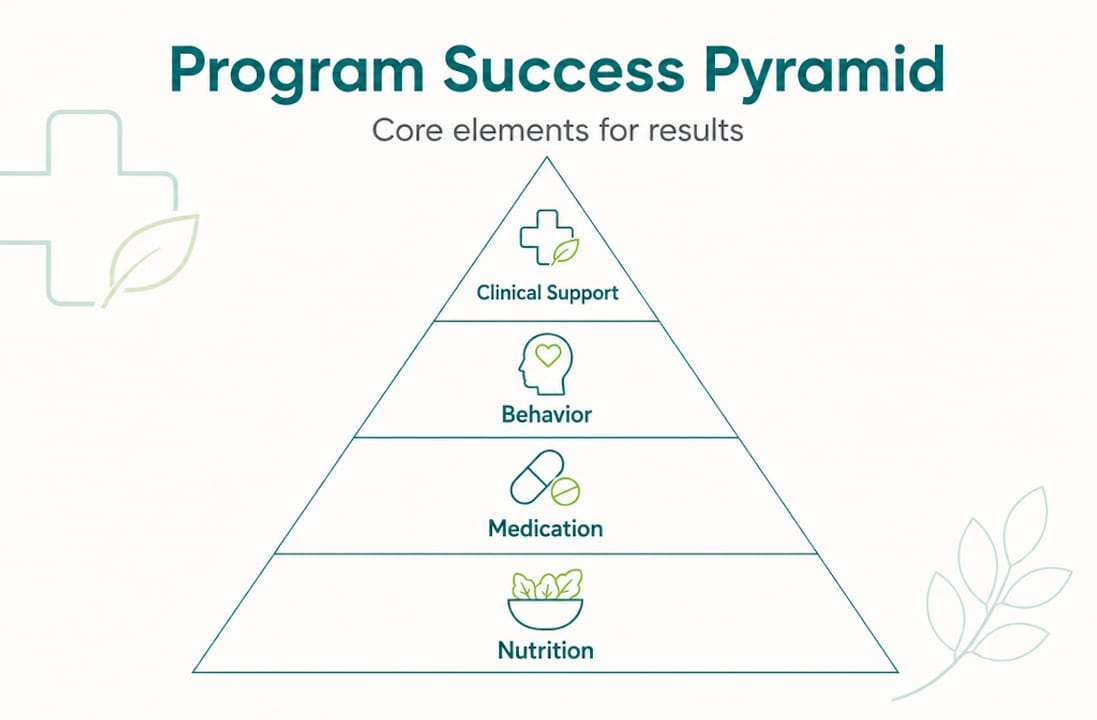
Understanding how provider consultations shape outcomes helps clarify why regular check-ins are not administrative tasks but active components of your care. Each visit is an opportunity to recalibrate your plan with clinical data. Reviewing patient education for GLP-1 success before those visits ensures you use the time productively.
Pro Tip: Establish daily anchors tied to fixed points in your schedule, such as a protein-forward breakfast before your first work task or a 10-minute walk after lunch. These rituals interrupt the schedule drift that remote work creates and reduce the stress-related snacking that erodes healthy eating remotely.
Verifying progress and troubleshooting common challenges in remote weight management
With execution underway, verifying your progress and troubleshooting obstacles keeps your weight management journey on track rather than stalling unnoticed.
Successful remote programs adjust medication doses and care plans based on lab results and patient progress, rather than applying a static protocol to every patient. That responsiveness is what separates a clinically sound program from a prescription delivery service.
Key documentation habits to maintain:
- Weekly weight records at the same time and conditions (morning, after using the restroom, before eating)
- Symptom logs noting any GI discomfort, energy changes, or mood shifts tied to medication adjustments
- Meal and protein records to verify you are meeting daily nutrition targets, not just staying under a calorie ceiling
- Adherence notes documenting any missed doses or behavioral lapses so your provider has accurate context during visits
Knowing how to communicate with telehealth clinicians about these records effectively makes each appointment more productive. Come prepared with specific data points, not vague impressions.
| Common challenge | Likely cause | Recommended response |
|---|---|---|
| Weight plateau (3+ weeks) | Metabolic adaptation, undercounting calories | Review intake logs with provider; consider dose evaluation |
| GI side effects | Dose escalation too fast | Contact provider; slow titration or adjust timing |
| Schedule compliance slip | Work stress, travel disruption | Re-anchor daily rituals; notify coach for accountability reset |
| Motivation drop | Scale not moving, fatigue | Refocus on non-scale metrics; request behavioral coaching session |
| Medication availability | Supply chain or pharmacy delays | Confirm pharmacy status with provider; explore compounded alternatives |
An important mindset adjustment: a single off day is not a setback. It is data. Recovering quickly without overcorrecting (like skipping meals the next day) is a clinical skill that improves over time. Reviewing telehealth compliance standards for your program also ensures you understand your rights when care protocols need to change.
A fresh perspective on remote weight management success
Most guides on managing weight online stop at actionable steps. This one does not, because the steps alone are not what determine outcomes.
Here is the harder truth: many patients approach telehealth weight loss as a subscription for medication rather than an ongoing clinical relationship requiring dose adjustments and care pivots. That framing is the single biggest predictor of regaining weight after stopping medication.
GLP-1 therapies are genuinely effective. But they work by reducing appetite signals long enough for new habits to form. If those habits never form because you relied entirely on the medication, the physiological suppression stops the day you discontinue treatment, and appetite returns. The weight follows.
"A subscription without true clinical adaptation is an empty promise. Real outcomes come from programs that treat you as a patient, not a billing line."
What this means practically: your provider should be adjusting your dose based on your response, not a fixed schedule. Your coach should be addressing your stress patterns, not just recommending generic meal plans. Your program should be evolving with your progress. If it is not, you are not in a clinical relationship. You are in a fulfillment pipeline.
The all-inclusive weight management approach that integrates medication, nutrition guidance, behavioral coaching, and lab-based adjustments is not a premium luxury. It is the minimum standard for treating obesity as the metabolic condition it actually is. When you evaluate programs, measure them against that standard.
Explore RenewMD's digital weight management solutions
If you are ready to move from research to action, RenewMD offers medically supervised telemedicine weight loss programs designed specifically for adults with a BMI of 27 or higher. Every program includes licensed provider consultations, medication delivery from U.S. pharmacies, behavioral support, and transparent pricing with no hidden fees. Whether you are exploring GLP-1 receptor agonists like Semaglutide or Tirzepatide for the first time or looking for a more clinically rigorous alternative to what you have tried before, RenewMD's intake process is fully digital, easy to complete, and built to match your care to your actual health profile. Start your assessment today and connect with a licensed clinician who can evaluate your eligibility and build a plan around your goals.
Frequently asked questions
What types of remote weight management programs are available for adults with BMI 27 or higher?
Programs range from per-visit models to monthly subscriptions, all with varying levels of clinical oversight, behavioral support, and access to GLP-1 medications. Evaluating clinical depth and total cost including medication is essential before enrolling.
How fast should I aim to lose weight for it to be safe and sustainable?
Experts recommend losing 0.5 to 2 pounds per week as the range that protects muscle mass and supports lasting fat loss without triggering metabolic adaptation.
How important is behavioral support alongside GLP-1 medication in remote weight management?
Behavioral support is not supplemental; it is what sustains results after medication ends, since medication paired with behavioral tools treats obesity as a chronic condition rather than a temporary symptom.
What are common challenges when using remote weight management programs and how can I overcome them?
Plateaus, GI side effects, and schedule drift are the most frequent hurdles. Proactive dose adjustments based on progress and consistent communication with your provider resolve most of them before they derail your plan.