

Choosing an online weight loss program feels straightforward until you realize how many unregulated options exist. Patients with a BMI of 27 or higher have more telehealth choices than ever, but not all of them follow the legal and clinical standards that keep you safe. HIPAA-compliant platforms for video visits and electronic health records are just one piece of a much larger compliance picture. Understanding the rules that govern telehealth weight management helps you separate trustworthy care from programs that cut corners at your expense.
Table of Contents
- What does regulatory compliance mean in telehealth?
- Key regulations impacting weight management telehealth
- The truth about online prescriptions and DEA rules
- Safety, quality, and the evolving landscape for patients
- Special compliance concerns: State laws and corporate practice rules
- Editorial perspective: Why real compliance is your only safeguard
- Put safety first: Explore compliant telehealth weight care
- Frequently asked questions
Key Takeaways
| Point | Details |
|---|---|
| Compliance safeguards your care | Strict adherence to federal and state rules ensures safer, more effective telehealth weight management. |
| Know your provider’s credentials | Always verify state licensing, HIPAA policies, and medication sources before starting online treatment. |
| DEA and FDA rules matter | Proper prescribing and medication sourcing follow evolving federal guidelines protecting you from unsafe practices. |
| Telehealth can deliver real results | Evidence shows online programs help patients lose weight and lower BMI, especially with compliant providers. |
| State rules can affect access | Differences in state laws and corporate structures change how and where you can get safe telehealth care. |
What does regulatory compliance mean in telehealth?
Regulatory compliance in telehealth means that a provider follows every federal and state rule governing how care is delivered online. For weight management specifically, this covers patient privacy, provider licensing, prescribing authority, and clinical quality standards. When all of these elements are in place, you receive care that is legally sound and medically safe.
The core compliance requirements in telehealth weight management include:
- Patient privacy: HIPAA compliance requires secure platforms for all video, audio, and electronic health records. Providers cannot use unsecured apps or share your data without consent.
- Provider licensing: Providers must hold a license in your state (the originating site) and in their own state (the distant site). Many states now offer cross-state licensing compacts to make this easier.
- Prescribing laws: Providers must follow DEA rules for controlled substances and state-specific prescribing guidelines.
- Clinical standards: Informed consent, proper documentation, and follow-up care must meet the same standards as in-person visits.
Weight management telehealth carries special risks that make compliance even more critical. GLP-1 receptor agonists, the class of medications that includes semaglutide and tirzepatide, have become enormously popular. Their rise has also attracted providers who operate outside legal boundaries, offering prescriptions without proper evaluations or medications from unverified sources. Learning about GLP-1 telehealth access in your state is a practical first step toward identifying who is actually qualified to treat you.
Pro Tip: Before starting any telehealth weight loss program, ask the provider directly which state they are licensed in and whether they are licensed in your state. A compliant provider will answer this question immediately and clearly.
Key regulations impacting weight management telehealth
Several overlapping federal and state frameworks shape what a compliant telehealth weight loss program looks like. Each layer adds a specific protection for patients.
Federal frameworks include:
- HIPAA: Governs how your health data is collected, stored, and shared.
- DEA prescribing rules: Control how providers can prescribe medications, including GLP-1 agents.
- FDA medication standards: Determine which medications are approved, and which compounded versions are permitted under specific conditions.
State-level rules add another layer. Providers must meet each state's scope of practice requirements and standard of care definitions. States like California, Texas, and Florida have eased some in-person requirements for GLP-1 prescribing, but telehealth still must meet the same standard of care as in-person visits, including informed consent, identity verification, thorough documentation, and follow-ups every one to three months initially.
One of the most important distinctions patients need to understand is the difference between FDA-approved and compounded GLP-1 medications. The FDA has taken action against telehealth firms that marketed compounded versions of semaglutide as equivalent to brand-name drugs. Compounded GLP-1 medications are not FDA-reviewed for safety or effectiveness. Understanding the full picture of compounded vs. commercial GLP-1s is essential before you agree to any treatment plan.
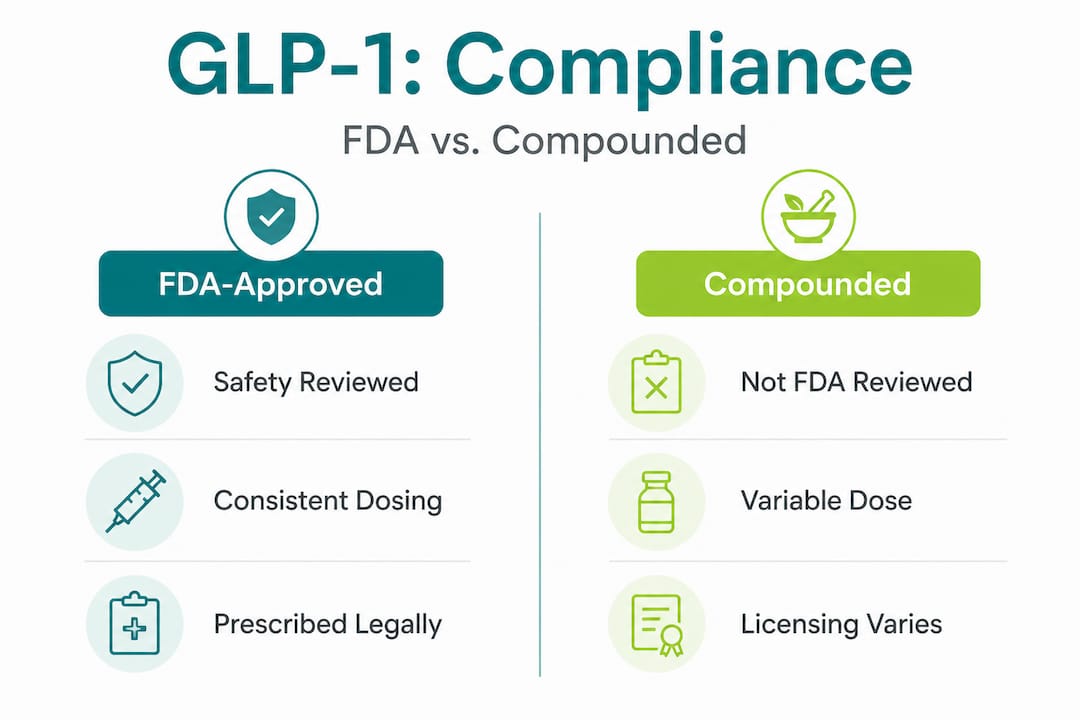
Here is a clear comparison of what trusted and questionable telehealth programs typically look like:
| Feature | Compliant program | Questionable program |
|---|---|---|
| Provider licensing | Licensed in your state | Licensing unclear or unavailable |
| Medication sourcing | FDA-approved or disclosed compounded | Unspecified or "equivalent" claims |
| Privacy platform | HIPAA-compliant | Standard video apps or email |
| Informed consent | Written, documented | Verbal only or skipped |
| Follow-up care | Scheduled at 1 to 3 months | No follow-up offered |
| Lab testing | Included or recommended | Not mentioned |
Patients exploring modern GLP-1 care should also be aware that telehealth logistics around scheduling and follow-up are regulated activities, not optional conveniences. Programs that skip follow-up appointments are not just cutting costs; they are operating outside clinical standards.
The truth about online prescriptions and DEA rules
Online prescriptions for weight management medications operate under a specific set of DEA rules that have changed significantly in recent years. Understanding these rules protects you from providers who may be operating outside their legal authority.
DEA flexibilities extended through December 31, 2026 allow providers to prescribe Schedule II through Schedule V controlled substances via telehealth without an initial in-person exam, provided certain conditions are met. These conditions are not optional. Every compliant provider must follow them.
The required safeguards for a legal online prescription include:
- Audio-video encounter: The visit must include real-time video and audio, not just a questionnaire or text chat.
- Prescription Drug Monitoring Program (PDMP) check: Providers must verify your prescription history through the state PDMP database.
- State-specific restrictions: Some states add requirements beyond the federal minimum, such as mandatory waiting periods or additional documentation.
- Informed consent: You must be clearly informed about the medication, its risks, and alternatives before a prescription is issued.
- Documentation: The clinical encounter must be fully documented in a compliant electronic health record.
What happens after 2026 is genuinely uncertain. Post-2026 rules are still pending, and if the flexibilities expire without replacement regulations, patients may need an initial in-person exam before receiving controlled substance prescriptions online. Staying informed about state licensing for telehealth will help you adapt if rules shift.
Reviewing state compliance strategies for 2026 gives a clearer picture of how providers are preparing for potential regulatory changes. Patients who choose programs with strong compliance infrastructure are better protected regardless of how the rules evolve.
Pro Tip: If a telehealth provider offers you a GLP-1 prescription after only a text-based intake form, that is a red flag. A compliant provider will always conduct a live audio-video visit before prescribing.
Safety, quality, and the evolving landscape for patients
Regulatory compliance is not just a legal formality. It directly determines the quality and safety of the care you receive. When compliance is ignored, patients face real risks: data breaches, improper prescriptions, and exposure to medications that have not been reviewed for safety.

Compliance prevents the most serious harms in weight management telehealth, including GLP-1 side effects like gastrointestinal complications and pancreatitis that can go undetected without proper clinical oversight. A provider who skips follow-up visits or fails to review your labs is not just inconvenient; they are creating conditions where serious adverse events can be missed.
The evidence for well-structured telehealth weight programs is encouraging. Telehealth nursing interventions for patients with BMI over 25 produce an average weight loss of 2.59 kilograms and a 1.05 BMI reduction compared to traditional care, with pilot programs showing a 2.7% BMI drop. These results come from structured, supervised programs, not from unmonitored online prescriptions.
"Telehealth weight management programs that follow clinical and regulatory standards consistently outperform unsupervised approaches in both safety and measurable outcomes."
When evaluating a telehealth program, use this checklist to assess compliance:
- Does the provider hold an active license in your state?
- Is the platform HIPAA-compliant with documented privacy policies?
- Does the program include a live audio-video visit before prescribing?
- Are medications clearly identified as FDA-approved or compounded, with full disclosure?
- Is follow-up care scheduled and included in the program?
- Does the program offer lab testing as part of the treatment plan?
- Is informed consent documented in writing?
Programs that meet all of these criteria are operating within the regulatory framework designed to protect you. Exploring telehealth care standards for weight management gives you a concrete benchmark for comparison.
Special compliance concerns: State laws and corporate practice rules
Beyond federal regulations, state-level rules introduce another layer of complexity that affects how telehealth weight loss programs are structured and where they can operate.
Several states, including California, Texas, and New York, enforce what is known as the Corporate Practice of Medicine (CPOM) doctrine. This rule prohibits non-physician entities, such as corporations or private equity groups, from controlling the clinical decisions of licensed physicians. In practical terms, it means that a telehealth company cannot direct a doctor's prescribing decisions or override clinical judgment for business reasons.
To operate legally in CPOM states, compliant telehealth providers use a structure called the Management Services Organization and Professional Corporation (MSO-PC) model. Under this arrangement:
- A physician-owned professional corporation (PC) employs the clinical staff and makes all medical decisions.
- A separate management services organization (MSO) handles non-clinical operations like billing, technology, and marketing.
- The two entities operate under a formal services agreement that keeps clinical authority with the physicians.
This structure matters to you as a patient because it determines whether your provider's clinical decisions are truly independent. Programs that operate in CPOM states without this structure may be violating state law, which creates legal and clinical risks for everyone involved.
GLP-1 access by state varies significantly based on these corporate practice rules, licensing compacts, and state-specific prescribing requirements. Patients in California or Texas may find that fewer telehealth programs are available to them, not because of a lack of demand, but because fewer programs have invested in the legal infrastructure required to operate there compliantly. Reviewing CPOM compliance in telemedicine helps clarify how these structures work in practice.
Editorial perspective: Why real compliance is your only safeguard
Here is something that rarely gets said plainly in telehealth marketing: compliance is not a feature. It is the minimum standard for safe care. When a program advertises "easy prescriptions" or "no in-person visit required" without explaining the clinical and legal safeguards behind those claims, that should make you pause.
The telehealth weight loss market has grown faster than regulators can monitor it. That growth has attracted both excellent, patient-centered programs and opportunistic providers who prioritize volume over safety. The difference between them is almost entirely about compliance.
Patients sometimes assume that if a program is available online and accepts their payment, it must be legitimate. That assumption is wrong and potentially dangerous. A provider who cannot explain their state licensing, skips informed consent, or pushes compounded semaglutide quality claims without disclosing FDA status is operating outside the rules designed to protect you.
The most important shift patients can make is to treat compliance questions the same way they would treat clinical questions. Ask your provider directly: Are you licensed in my state? Is this medication FDA-approved? What follow-up care is included? A provider who cannot answer these questions clearly is not a provider you should trust with your health.
The regulatory landscape will keep evolving, especially as DEA rules shift post-2026 and the FDA continues addressing compounded GLP-1 medications. Patients who understand the rules are not just better informed; they are genuinely better protected. Compliance is not bureaucratic overhead. It is the infrastructure that makes safe, effective weight management care possible.
Put safety first: Explore compliant telehealth weight care
Understanding regulatory compliance is the first step. Finding a program that actually meets those standards is the next one. RenewMD.clinic is built around fully compliant, evidence-based weight management care for patients with a BMI of 27 or higher. Every program includes licensed U.S. clinician consultations, HIPAA-secure processes, lab testing, and transparent medication sourcing through accredited pharmacies. There are no hidden fees and no shortcuts on clinical standards. Learn about GLP-1 telehealth access by state to see what is available where you live, and explore what the future of telehealth weight management looks like when safety and compliance lead the way.
Frequently asked questions
How do I know if a telehealth provider is compliant?
Check for active state licensing in your state, clear privacy policies, written consent forms, and transparent disclosure of whether medications are FDA-approved or compounded. A compliant provider will provide this information without hesitation.
Are compounded GLP-1 medications safe for weight loss?
Compounded GLP-1 medications are not FDA-reviewed for safety or effectiveness, and patients should receive full risk disclosure and confirmation that the pharmacy source is legitimate and accredited before agreeing to treatment.
What happens if DEA telehealth flexibilities end after 2026?
If the current DEA flexibilities expire without replacement rules, patients seeking controlled substance prescriptions online may be required to complete an initial in-person exam, which could significantly limit access to telehealth-based weight management care.
Do telehealth programs for weight loss really work?
Yes. Structured telehealth interventions for patients with BMI over 25 show an average weight loss of 2.59 kilograms and a 1.05 BMI reduction compared to traditional care, with the strongest results coming from supervised, clinically managed programs.
Can I get a prescription for GLP-1 meds if I live in a different state?
Providers must be licensed in both your state and their own state before prescribing; some states participate in cross-state licensing compacts, but patients should confirm their specific state's rules before enrolling in any telehealth program.