

Weight management is rarely as simple as cutting calories or taking a single medication. For adults with a BMI of 27 or higher, the real challenge is finding a program that addresses the full picture: the medical, the nutritional, the behavioral, and the logistical. All-inclusive weight management programs, delivered through telehealth, are changing what that picture looks like. They combine GLP-1 receptor agonist therapies like Semaglutide and Tirzepatide with nutrition coaching, behavioral support, and ongoing clinical oversight, all accessible from home. This article explains how these programs work, what the evidence shows, and what to look for when choosing one.
Table of Contents
- Defining all-inclusive weight management
- Telehealth and modern medical weight care
- GLP-1 therapies: The medical foundation
- Lifestyle integration: Avoiding pitfalls and maximizing results
- Weighing perspectives: Medical vs. weight-inclusive care
- Beyond checklists: What truly makes weight management all-inclusive
- Ready to take the next step?
- Frequently asked questions
Key Takeaways
| Point | Details |
|---|---|
| Truly comprehensive care | All-inclusive weight management integrates medical, nutritional, and behavioral support under one program. |
| Telehealth advantage | Modern programs use telehealth to deliver medical oversight, prescriptions, and coaching directly to you. |
| GLP-1s as foundation | GLP-1 medications play a key role in effective, medically supervised weight loss today. |
| Lifestyle still matters | Sustainable results require diet, exercise, and regular check-ins alongside medication. |
| Personalization counts | Authentic all-inclusive care adapts to your evolving needs and life changes for lasting results. |
Defining all-inclusive weight management
With the foundation laid, let's clarify what "all-inclusive" really means in today's weight management landscape.
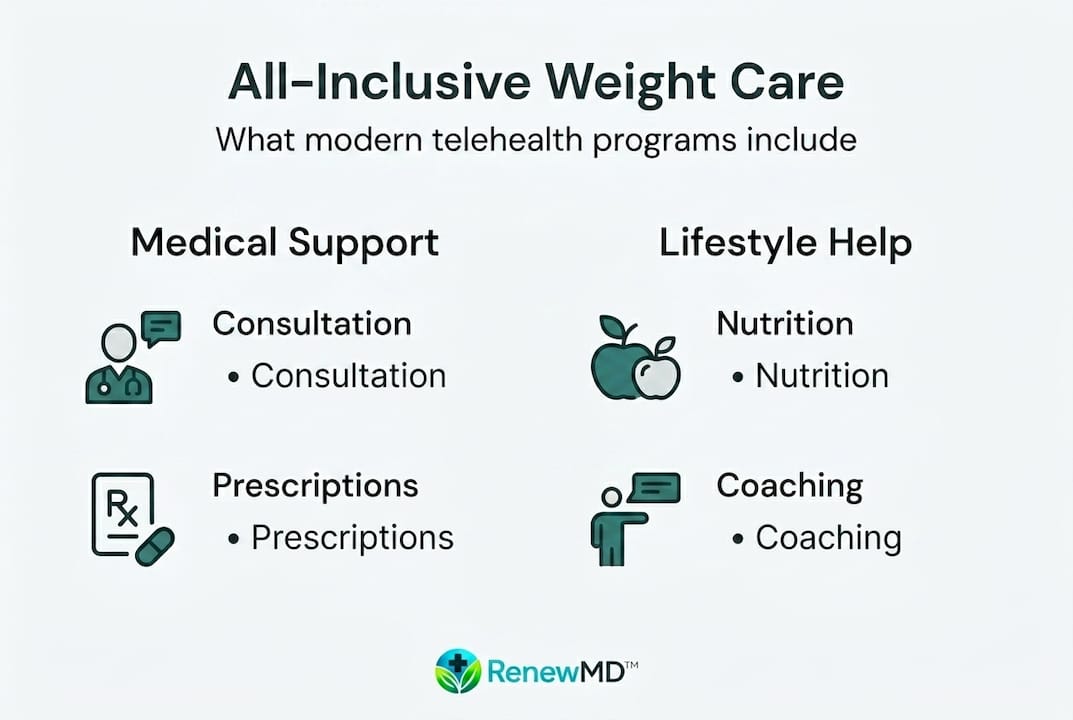
All-inclusive weight management is a coordinated care model that bundles medical, nutritional, behavioral, and pharmaceutical support into one integrated program. Rather than visiting a separate doctor, dietitian, and therapist, patients receive all of these services through a single platform, often without leaving home. This approach removes the fragmentation that makes traditional weight care difficult to sustain.
The core components of a well-designed all-inclusive program typically include:
- Virtual medical consultations with licensed clinicians who evaluate your health history, current medications, and weight-related conditions
- GLP-1 prescription management, including Semaglutide or Tirzepatide, with dosing adjustments based on your response
- Lab testing and health monitoring to track metabolic markers, kidney function, and other safety indicators
- Nutrition coaching tailored to your dietary needs and medication side effects
- Behavioral and lifestyle coaching to address eating patterns, stress responses, and long-term habit formation
- Integrated pharmacy delivery so medications arrive at your door without additional coordination
Comprehensive weight management approaches that combine these elements consistently outperform single-intervention strategies because they address weight at multiple levels simultaneously.
"All-inclusive programs are not just about convenience. They are about clinical coherence, ensuring that every part of your care plan works together rather than in isolation."
Major telehealth providers have recognized this need. Amazon One Medical's GLP-1 program offers virtual consultations, GLP-1 prescriptions, integrated pharmacy delivery, nutrition coaching, and primary care oversight for related health conditions, setting a clear benchmark for what integrated care can look like at scale.
The key distinction between all-inclusive and traditional care is continuity. In a standard clinical setting, you might see your prescribing physician once a quarter and your dietitian separately, if at all. All-inclusive programs are designed so that each provider has visibility into your full care plan, allowing them to respond to changes quickly and consistently.
Telehealth and modern medical weight care
Now that you know what all-inclusive care means, see how telehealth delivers it efficiently and effectively.
Telehealth has fundamentally changed who can access medically supervised weight management. Geography, work schedules, and transportation barriers no longer prevent someone from receiving the same quality of care available in major urban medical centers. For people managing obesity-related conditions like type 2 diabetes, hypertension, or sleep apnea, this accessibility is clinically significant.

| Feature | Telehealth programs | Traditional clinics |
|---|---|---|
| Visit frequency | Flexible, on-demand | Scheduled, often quarterly |
| Service integration | Single platform, coordinated | Often fragmented across providers |
| Medication delivery | Shipped to your door | Pharmacy pickup required |
| Coaching access | Ongoing, asynchronous | Appointment-dependent |
| Geographic reach | Nationwide | Local only |
| Privacy | High, home-based | In-person, waiting rooms |
Programs like Amazon One Medical demonstrate that telehealth can deliver GLP-1 prescriptions, pharmacy integration, nutrition coaching, and primary care oversight for comorbidities at a national scale, making this level of care far more accessible than it was even five years ago.
Primary care integration is especially important. When a GLP-1 medication causes nausea or affects your appetite significantly, you need a clinician who can adjust your dosing, recommend dietary modifications, and rule out other causes, all within the same care team. Telehealth platforms that include this layer of oversight reduce the risk of patients discontinuing treatment prematurely due to manageable side effects.
Telehealth weight management is also proving particularly valuable for rural populations, where access to obesity medicine specialists has historically been limited. The future of telemedicine weight care points toward even greater personalization, with AI-assisted monitoring and real-time coaching becoming more common.
Pro Tip: When evaluating a telehealth weight management program, ask specifically whether your prescribing clinician has visibility into your coaching notes and lab results. True integration means your entire care team is working from the same information, not operating in separate silos.
GLP-1 therapies: The medical foundation
Central to many all-inclusive programs are new medications, especially GLP-1s, shaping real outcomes.
GLP-1 receptor agonists work by mimicking a hormone your gut naturally releases after eating. They signal satiety to the brain, slow gastric emptying, and reduce appetite. For people with a BMI of 27 or higher, particularly those with at least one weight-related condition, these medications represent a meaningful clinical tool when used as part of a supervised program.
The outcomes data is increasingly robust. A recent GLP-1 meta-analysis reported average body weight reductions of approximately 9% at three months, 5% at six months, and 4% at twelve months, with significant fat mass reduction and modest lean mass loss. Real-world data from the same analysis showed an average 8.5% weight loss at three months, suggesting that clinical trial results translate reasonably well to everyday practice.
| Timepoint | Average weight loss (clinical) | Real-world estimate |
|---|---|---|
| 3 months | ~9% body weight | ~8.5% |
| 6 months | ~5% body weight | Variable |
| 12 months | ~4% body weight | Variable |
These numbers represent averages. Individual results depend on starting weight, medication adherence, dosing, and lifestyle factors. That variability is exactly why personalized dosing and ongoing monitoring matter so much.
Key benefits associated with GLP-1 therapy in supervised programs include:
- Significant fat mass reduction, particularly visceral fat, which is linked to cardiovascular and metabolic risk
- Improved glycemic control in people with prediabetes or type 2 diabetes
- Reduced blood pressure and lipid levels in some patients
- Appetite regulation that makes behavioral changes easier to sustain
For a detailed look at how different agents compare, GLP-1 efficacy comparison data shows meaningful differences between Semaglutide and Tirzepatide in terms of weight loss magnitude and side effect profiles. Research is also expanding into GLP-1 and mental health, with early findings suggesting potential benefits for mood and cognitive function.
Amazon One Medical emphasizes primary care integration to manage side effects and comorbidities holistically, reinforcing that GLP-1 therapy is most effective when it exists within a broader clinical framework, not as a standalone prescription.
Pro Tip: If you are starting a GLP-1 medication, ask your provider about a slow titration schedule. Gradual dose increases significantly reduce gastrointestinal side effects and improve long-term adherence.
Lifestyle integration: Avoiding pitfalls and maximizing results
Medication alone is rarely enough. Here's how the most effective programs combine lifestyle and medical care.
GLP-1 medications reduce appetite effectively, but they do not independently preserve muscle mass or build sustainable habits. Without intentional lifestyle integration, patients risk losing lean muscle along with fat, which can slow metabolism and make weight regain more likely after treatment ends.
The most common pitfalls in medically supervised weight management include:
- Under-nutrition: Reduced appetite from GLP-1s can lead to insufficient calorie and protein intake, which accelerates muscle loss and increases fatigue.
- Inadequate protein intake: Muscle preservation requires consistent high-protein intake throughout treatment. Most clinicians recommend a minimum of 1.2 to 1.6 grams of protein per kilogram of body weight daily.
- Skipping resistance training: Cardio alone does not protect muscle. Resistance training, even two to three sessions per week, significantly reduces lean mass loss during caloric restriction.
- Psychological burnout: Rapid early weight loss can create unrealistic expectations. When progress slows, patients without behavioral support are more likely to disengage from their program entirely.
- Stopping medication abruptly: Muscle loss prevention with GLP-1s requires planning for the long term. Physiological mechanisms drive weight regain when medications are discontinued without a maintenance strategy in place.
"Muscle preservation requires a high-protein diet and resistance training throughout treatment. Lifelong or long-term use is often necessary due to the body's physiological drive to regain weight. Integrating lifestyle changes helps avoid malnutrition and other complications." — Expert insight from a physician specializing in weight loss and maintenance, via Reddit AMA
Behavioral coaching in all-inclusive programs addresses these risks proactively. Coaches help patients identify emotional eating triggers, build sustainable meal patterns, and set realistic expectations for each phase of treatment. Regular check-ins, whether weekly or biweekly, create accountability without adding clinical burden.
Nutrition support is equally important. Many all-inclusive programs include registered dietitian access, meal planning guidance, and education on reading nutrition labels, managing social eating situations, and adapting food choices as your appetite changes on medication.
Weighing perspectives: Medical vs. weight-inclusive care
Finally, it's important to recognize that not every path or philosophy fits everyone. Let's explore a key debate.
Not all healthcare providers approach weight management the same way. A growing movement known as Health at Every Size (HAES) challenges the assumption that BMI reduction is the primary goal of healthcare for larger-bodied individuals. Understanding this perspective helps you make a more informed decision about the type of care that aligns with your values and health goals.
Weight-inclusive care, as described in research comparing HAES and weight-centric models, promotes health behaviors and well-being independent of weight outcomes. Its key arguments include:
- Reduced weight stigma: Focusing on health behaviors rather than the number on the scale reduces shame and improves patient engagement with healthcare.
- Mental health support: Weight-inclusive approaches are associated with lower rates of disordered eating and improved body image.
- Sustainable behavior change: Emphasizing enjoyable movement and satisfying nutrition rather than restriction may produce more durable lifestyle habits.
- Critique of BMI as a metric: BMI does not account for muscle mass, fat distribution, or metabolic health, making it an imprecise proxy for overall health.
"Weight-inclusive care does not ignore health. It reframes the goal from weight loss to health promotion, arguing that the two are not always synonymous."
Medical weight management programs, by contrast, prioritize measurable clinical outcomes. For people managing type 2 diabetes, severe hypertension, or sleep apnea, reducing body weight by even 5 to 10% produces significant improvements in these conditions. GLP-1 therapies make that level of weight reduction achievable for many patients who have not responded to lifestyle changes alone.
The most thoughtful programs today attempt to bridge these perspectives. They use GLP-1 medications and clinical monitoring to achieve meaningful health improvements while also incorporating patient-centered communication, anti-stigma practices, and behavioral support that respects each person's relationship with their body and food.
Beyond checklists: What truly makes weight management all-inclusive
Having seen the main models and debates, here's a sharper perspective based on real-world care.
The term "all-inclusive" is increasingly used as a marketing label. Many programs can list coaching, prescriptions, and check-ins on a brochure. Far fewer deliver care that genuinely adapts to each patient as their needs evolve over months and years.
What separates authentic all-inclusive care from a bundled service package is personalization and continuity. A program that adjusts your GLP-1 dosing based on your lab results, modifies your nutrition plan when your appetite changes, and checks in after a stressful life event is fundamentally different from one that sends a welcome kit and a monthly prescription refill.
Real personalization also means acknowledging that weight management is not linear. Plateaus, medication side effects, and life disruptions are normal. Programs that treat these as failures rather than expected variables tend to lose patients at exactly the moments when support matters most.
Calm, holistic GLP-1 care that incorporates stress management and mental well-being alongside medical treatment reflects this understanding. The goal is not to optimize a checklist of services. It is to remain a consistent, responsive clinical partner throughout a patient's journey, however long and nonlinear that journey turns out to be.
Ready to take the next step?
If you're considering taking action based on what you've learned, here's how to get started with expert care.
RenewMD.clinic offers fully integrated, medically supervised weight management programs built around GLP-1 therapies like Semaglutide and Tirzepatide. Every program includes licensed clinician consultations, lab testing, medication delivery, and ongoing coaching, with transparent pricing and no hidden fees.
Whether you're exploring modern GLP-1 weight care for the first time or want to compare GLP-1 effectiveness before committing to a plan, RenewMD.clinic provides the educational resources and clinical support to help you make a confident, informed decision. Start your intake today and connect with a licensed U.S. clinician who will build a plan around your specific health profile.
Frequently asked questions
What services are typically included in all-inclusive weight management programs?
They usually include medical assessments, prescription medications like GLP-1s, nutrition coaching, behavioral counseling, routine monitoring, and often primary care integration. Platforms like Amazon One Medical have demonstrated this model at scale with virtual consultations and pharmacy delivery built into a single program.
How much weight loss can I expect from GLP-1 medications in these programs?
Clinical studies show an average 9% weight loss at 3 months, 5% at 6 months, and 4% at 12 months with GLP-1s, though individual results vary based on dosing, adherence, and lifestyle factors.
Why is nutritional and behavioral support needed alongside GLP-1 medications?
Combining medication with diet, exercise, and behavioral support prevents muscle loss and helps sustain results long term, since muscle preservation requires high-protein intake and resistance training throughout treatment.
Is all-inclusive weight management available everywhere?
With telehealth programs, access is available across most U.S. states, making it significantly more accessible than traditional in-person clinics. Integrated telehealth delivery removes geographic barriers for patients in rural and underserved areas.
What are some alternative views to weight-centric management?
Weight-inclusive models like Health at Every Size focus on health and well-being without emphasizing weight loss, aiming to reduce stigma and support mental health. Research comparing these approaches highlights both the benefits and limitations of each model for different patient populations.