
Getting a GLP-1 receptor agonist prescription, such as Semaglutide or Tirzepatide, is only the first step in your weight management journey. The quality of your ongoing dialogue with your telehealth clinician often determines whether you stay safe, remain adherent to your medication plan, and ultimately reach your goals. Many patients find their concerns go unaddressed, guidance feels unclear, or key health details are missed during video visits, and those gaps can quietly erode both safety and results. This guide walks you through a practical, evidence-based approach to preparing, conducting, and verifying your telehealth communications so every session works harder for your health.
Table of Contents
- Preparing for your telehealth visit
- Building trust and rapport with your clinician
- Patient-centered communication and shared decisions
- Navigating treatment discussions and confidentiality
- Verifying outcomes and ongoing communication
- Our perspective: What most telehealth guides miss about effective communication
- Ready to maximize your telehealth weight care?
- Frequently asked questions
Key Takeaways
| Point | Details |
|---|---|
| Prepare before each visit | Check technology, organize questions, and secure your privacy to ensure a smooth telehealth session. |
| Build rapport intentionally | Casual conversation, active listening, and empathy foster trust and safety during the virtual encounter. |
| Insist on shared decision-making | Voice your needs, discuss alternatives, and request involvement to improve adherence and outcomes. |
| Track ongoing outcomes | Measuring results and scheduling check-ins keeps your telehealth weight care evidence-based. |
| Have a backup for tech issues | Plan secondary access and clarify privacy safeguards to avoid disruptions and protect confidentiality. |
Preparing for your telehealth visit
Once you understand the importance of clear communication, it's time to set yourself up for success before the session even begins.
Preparation is the single most controllable factor in a productive telehealth visit. A session derailed by audio problems or a clinician who doesn't have your updated medication list wastes time and creates risk. Telehealth programs should support communication mechanics and logistics, including preparing both patients and clinicians, using reliable technology, maintaining clear communication, and providing accessible technical support to maintain quality of interaction.
Technology and environment checklist:
- Test your device's camera and microphone at least 30 minutes before the visit
- Confirm your internet connection is stable (a wired connection is more reliable than Wi-Fi)
- Close unnecessary browser tabs and apps to prevent lag or freezing
- Choose a private room where others cannot see or hear your conversation
- Have your phone nearby as a backup in case your video connection drops
- Charge your device fully or keep it plugged in during the session
Organizing your medical history and medication questions before the visit is equally important. For GLP-1 therapy specifically, be ready to report your current injection or oral dosing schedule, any gastrointestinal side effects such as nausea or vomiting, changes in appetite or weight since your last visit, and any new medications or supplements you've started. Clinicians need precise details to make safe dosing adjustments.
Review these visit preparation tips to build a structured pre-visit routine that keeps every session focused and efficient.
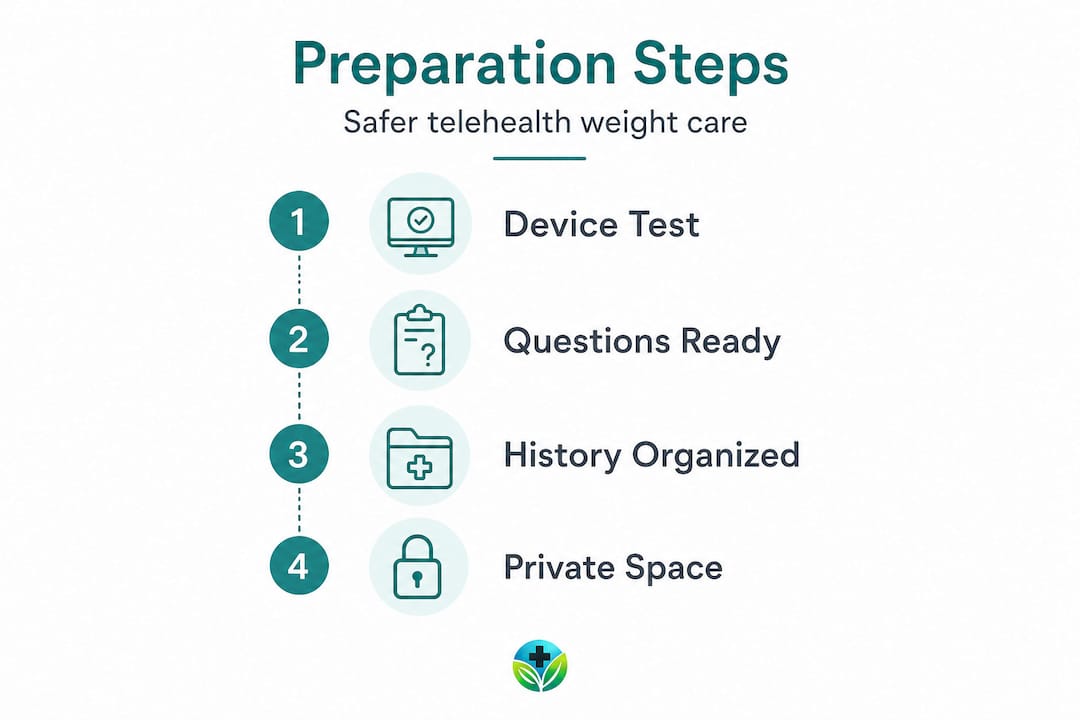
| Preparation task | Why it matters | When to complete |
|---|---|---|
| Device and camera test | Prevents technical disruptions | 30 minutes before visit |
| Medical history review | Gives clinician accurate baseline | Evening before visit |
| Question list written | Ensures nothing important is skipped | Day before visit |
| Privacy space confirmed | Protects confidentiality | Morning of visit |
| Backup phone ready | Allows continuity if video fails | Before visit starts |
Pro Tip: Write your top three questions or concerns on paper before the session. Patients who arrive with written questions consistently cover more ground and feel more satisfied with their visit outcomes.
Building trust and rapport with your clinician
With your technology and space ready, focus next on how to connect with your clinician so you both understand treatment priorities.
Trust is not a soft concept in telehealth weight care. It directly affects how honestly you share symptoms, how carefully you follow guidance, and how likely you are to continue treatment. Effective telehealth communication starts with building trust using strategies such as casual rapport, active listening, and expressing empathy. These approaches matter whether you are on your first visit or your twelfth.
A brief casual exchange at the start of the session, such as asking your clinician to confirm they can see and hear you clearly, does more than fix technical glitches. It establishes a conversational rhythm. From there, open-ended questions like "What do you want to focus on today given what I've reported?" invite collaborative dialogue rather than a one-sided clinical monologue.
Active listening on your part means doing more than staying quiet. It means confirming what you heard. Repeating a key instruction back to your clinician, such as "So you're recommending I increase my dose in two weeks if the nausea settles?" gives them the chance to correct any misunderstanding immediately.
"A patient who feels heard is far more likely to report side effects honestly and follow through on treatment adjustments. That openness is the foundation of safe telehealth weight care."
Comparison of rapport-building tactics: telehealth vs. in-person visits
| Tactic | In-person visit | Telehealth visit |
|---|---|---|
| Eye contact | Direct, natural | Look into camera, not the screen |
| Nonverbal cues | Full body language visible | Facial expressions carry more weight |
| Casual conversation | Occurs naturally in waiting room | Needs intentional opening exchange |
| Confirming instructions | Easy to clarify on the spot | Use verbal confirmation and repeat-back |
| Empathy signals | Touch, posture, proximity | Clear vocal tone, nodding, affirming phrases |
Pro Tip: Ask your clinician to explain recommendations in plain language and confirm your understanding before the session ends. Something as simple as "Can you say that one more time in simpler terms?" is both reasonable and professionally expected.
Patient-centered communication and shared decisions
Once rapport is established, it's essential to ensure your personal needs and priorities are recognized by your clinician.
Patient-centered communication means the visit is shaped around your values, concerns, and goals, not just a clinical checklist. Shared decision-making, addressing patients' needs and values, and displaying empathy can improve trust and medication adherence in telehealth settings. For GLP-1 therapy, this matters because dosing schedules, injection methods, and side effect tolerance vary significantly from person to person.
Steps to advocate effectively during your telehealth visit:
- State your primary concern early: "Before we review my vitals, I want to make sure we discuss the nausea I've been experiencing this week."
- Ask about alternatives: "Are there other dosing schedules or formulations that might reduce side effects for me?"
- Request involvement in decisions: "What are the pros and cons of increasing my dose now versus waiting another month?"
- Clarify the reasoning: "Can you help me understand why this change is recommended at this stage?"
- Confirm the plan: "So the agreed next step is to stay at the current dose for two more weeks and check in via the portal if symptoms worsen?"
These steps are not confrontational. They are the standard of good medical care. Clinicians who specialize in telehealth weight management expect engaged patients, and those conversations produce better outcomes.
Understanding how GLP-1 education benefits patient outcomes reinforces why asking informed questions matters so much during these sessions.
Research callout: Real-world data from JAMA Network Open confirm that patient-centered telehealth communication improves both trust and medication adherence, two factors that directly influence how consistently GLP-1 therapy produces results.
Pro Tip: If your communication needs are consistently unmet after two or three visits, it is entirely appropriate to request a different clinician or ask your platform about escalation pathways. The issue is rarely telehealth itself. It is the specific provider fit.
Navigating treatment discussions and confidentiality
Now that your intentions are clear, ensure your privacy and treatment details are handled securely every step of your telehealth journey.
Agenda setting means actively shaping what the visit covers, rather than waiting for your clinician to drive the entire session. Updated professional guidance emphasizes agenda-setting, empathy, active listening, confidentiality safeguards, and practical guidance for how telehealth changes communication dynamics, especially between synchronous video and non-synchronous audio or messaging formats.
When you start the session with "I have three things I want to cover today," you are not being demanding. You are modeling what effective patient-clinician collaboration looks like. Clinicians appreciate structured agendas because they make time management easier and reduce the chance of critical topics being left out.
Key confidentiality practices to protect yourself:
- Always use a private device that you own and control
- Avoid shared computers in public spaces such as libraries or workplaces
- Use headphones to prevent others from hearing the clinician's voice
- Confirm your platform uses encrypted, HIPAA-compliant (Health Insurance Portability and Accountability Act) video technology
- Ask your clinician what happens to session notes and where they are stored
Understanding telehealth compliance standards provides important context for knowing what your provider is legally required to protect on your behalf.
"Before every telehealth visit, treat your environment like a medical exam room: close the door, put on headphones, and confirm no one else can hear. These small steps prevent confidentiality lapses that most patients never anticipate."
The difference between synchronous video visits and asynchronous messaging also changes what you share and when. Time-sensitive concerns, such as chest pain, severe nausea, or an allergic reaction, should always be raised through a live video or phone session rather than a portal message that may not be reviewed for hours.
Verifying outcomes and ongoing communication
With your privacy and agenda secured, ensure your efforts translate into real-world improvements and sustained results.
Good communication doesn't end when the visit does. Telehealth weight management that combines GLP-1 receptor agonists with behavioral support requires structured, ongoing tracking to verify that the clinical plan is actually working. Real-world data show measurable improvements in weight and blood pressure over approximately six months in telehealth programs that pair GLP-1 therapy with behavioral coaching, underscoring why structured ongoing communication matters as much as the prescription itself.
Outcome benchmarks for GLP-1 plus telehealth behavioral programs:
| Metric | Baseline | 3-month mark | 6-month mark |
|---|---|---|---|
| Body weight | Starting weight | 3 to 5% reduction typical | 7 to 10%+ reduction with adherence |
| Blood pressure (systolic) | Varies by individual | Modest decline expected | Meaningful reduction in many patients |
| GI side effects | Often present at initiation | Typically improving | Largely resolved at stable dose |
| Medication adherence | Variable | Improves with engagement | High with structured communication |
You can explore what virtual weight management looks like in practice, including how tracking and check-ins are structured within a full program.
Signs that your telehealth communication is working effectively:
- You feel confident explaining your side effects and concerns in each session
- Your clinician adjusts recommendations based on what you report
- You understand the reasoning behind every dosing or lifestyle change
- Your weight and health markers are trending in the expected direction
- You leave each visit with a clear, written plan for the next period
- You know exactly how to reach your care team between visits
For a broader view of how structured programs integrate these elements, the modern telehealth overview explains how all-inclusive platforms are designed to support both clinical and communication outcomes.
Pro Tip: Request a written summary or visit note after each session. Having a record of what was discussed, what was changed, and what to watch for gives you a reference point between appointments and keeps communication continuous rather than episodic.
Our perspective: What most telehealth guides miss about effective communication
Having covered the steps and safeguards, let's highlight real-world pitfalls and actionable solutions many guides overlook.
Most telehealth communication guides stay focused on etiquette and technology. They tell you to test your camera, be on time, and ask questions. That advice is necessary, but it stops well short of the real barriers patients face.
The most overlooked truth is that technology failures and environment lapses don't just create inconvenience. They fracture the clinical session entirely. When you spend the first ten minutes troubleshooting audio or switching devices, you lose the cognitive and emotional momentum needed to discuss something as personal as weight, medication side effects, or treatment goals. If technology fails or privacy is compromised, expect reduced ability to communicate effectively. A backup plan, whether phone access or a pre-confirmed quiet space, prevents the session from becoming purely technical troubleshooting.
The second overlooked reality is that not every clinician is the right fit, and that's acceptable. Patient-centered communication effects in telehealth are beneficial on average, but dissatisfaction occurs in specific populations and with certain clinician pairings. Staying with a clinician whose communication style doesn't match your needs is not persistence. It's a risk to adherence and safety. Requesting a different provider is a legitimate, medically sound decision.
The broader point is that telehealth best practices are not about perfecting a visit format. They are about recognizing that effective weight care depends as much on the relationship and communication quality as on the medication itself.
Ready to maximize your telehealth weight care?
With practical strategies and real-world perspective, it's time to find a provider and approach that supports your weight goals.
RenewMD.clinic connects you with licensed U.S. clinicians who are trained in the kind of structured, patient-centered communication that makes GLP-1 therapy safer and more effective. Every program includes provider consultations, lab testing, medication delivery, and behavioral coaching, designed so that nothing falls through the gaps between visits. Whether you are exploring your options or ready to begin, the telemedicine weight care guide explains exactly what an all-inclusive program covers. You can also review the GLP-1 overview to understand how Semaglutide and Tirzepatide work before your first conversation with a clinician. When you're ready to take the first step, start your GLP-1 journey with a platform built around transparency, safety, and ongoing support.
Frequently asked questions
What does effective telehealth communication look like for GLP-1 weight care?
Effective communication includes trust-building, active listening, empathy, and patient-centered decision-making, which together support GLP-1 therapy adherence and clearer understanding of each step in your treatment plan.
What should I do if my telehealth session has technology issues?
Always prepare a backup plan before your visit, including phone access and equipment testing, so that technology disruptions don't replace clinical dialogue with troubleshooting.
How can I ensure my privacy and confidentiality during telehealth visits?
Use a private device in a closed room, wear headphones, and confirm your provider uses HIPAA-compliant technology that meets confidentiality safeguards for telehealth sessions.
What results should I expect from structured telehealth communication for weight management?
Evidence shows that GLP-1 programs with behavioral support produce meaningful weight loss and blood pressure improvements over approximately six months when combined with structured, ongoing communication.
What should I do if I feel misunderstood or dissatisfied with telehealth communication?
It is reasonable and appropriate to request a different clinician or escalation pathway, as communication dissatisfaction in telehealth reflects provider fit rather than a limitation of remote care itself.