

Many people assume telehealth weight loss means downloading an app, logging meals, and watching the scale on their own. That assumption misses something critical. The real engine behind effective, medically supervised weight loss via telehealth is the licensed provider consultation, where your medical history, lab results, and individual risk factors get the attention they deserve. This article explains exactly how provider consultations work, what happens during each stage, and why the evidence consistently shows that clinician involvement produces better outcomes than automation alone.
Table of Contents
- Provider consultations: The clinical hub for telehealth weight loss
- Personalized nutrition care: From assessment to ongoing support
- Medical safety, eligibility, and medication management in telehealth
- Why provider coaching works better than automation alone
- Why provider consultation is the missing piece in telehealth weight care
- Next steps: Start your medically supervised telehealth weight loss journey
- Frequently asked questions
Key Takeaways
| Point | Details |
|---|---|
| Consultations are essential | Provider consults drive safe, effective telehealth weight loss via medical review and personalized action. |
| Personalized nutrition planning | Telehealth enables dietitians and clinicians to deliver customized dietary and medical plans for better outcomes. |
| Safety and medication management | Ongoing provider oversight ensures eligibility, lab checks, and safe medication use throughout your weight loss journey. |
| Multicomponent models outperform apps | Evidence favors provider-led, coached telehealth models over automation alone for adults with higher BMI or medical risks. |
Provider consultations: The clinical hub for telehealth weight loss
After previewing the importance of provider consultations, let's look at how they actually drive your telehealth weight loss experience from the very first visit forward.

Provider consultations in telehealth weight-loss care serve as the clinical hub for the entire treatment process. They gather your medical history, assess your eligibility and safety, create a personalized care plan, order and review labs, prescribe or titrate (adjust the dose of) medications when appropriate, and conduct follow-ups with the flexibility to escalate care if needed. Think of the provider consultation as the control center that keeps every moving part coordinated.
The process typically unfolds across several structured steps:
- Medical history intake: Your provider reviews current conditions, prior weight loss attempts, family history, and any medications you take.
- Eligibility and safety assessment: Using your BMI, blood pressure, bloodwork, and other data, the provider determines which interventions are appropriate and safe for you.
- Personalized care plan design: A plan is built around your specific situation, not a generic template.
- Lab ordering and review: Blood panels help identify thyroid issues, metabolic markers, lipid levels, and other factors that directly affect your weight management strategy.
- Medication decisions: If GLP-1 receptor agonists such as Semaglutide or Tirzepatide are appropriate, the provider initiates, adjusts, or titrates the prescription.
- Ongoing follow-ups: Regular check-ins allow dose adjustments, side effect management, and goal realignment.
"Provider consultations are where medical judgment meets individual circumstance. They are not a formality. They are the reason a telehealth weight loss program is safe and personalized rather than generic."
Pro Tip: Always share your complete medication list during the intake consultation, including supplements. Many interactions between GLP-1 medications and common drugs, such as blood thinners or thyroid medications, are only caught when your provider has the full picture.
Learning what to expect in your first telehealth consultation and preparing for telehealth visits ahead of time can significantly reduce anxiety and improve the quality of information you share with your provider.
Personalized nutrition care: From assessment to ongoing support
Once your clinical history is established, personalized nutrition care becomes the foundation of a sustainable telehealth weight loss journey. This is where the provider consultation evolves from a one-time clinical intake into a continuous, medically guided relationship.
U.S. Department of Health and Human Services guidance on telehealth nutrition care confirms that nutrition professionals, including registered dietitians, can deliver full medical nutrition therapy (MNT), ongoing counseling, and outcome monitoring through telehealth. MNT refers to the use of specific nutritional interventions, grounded in your medical diagnosis and lab values, to treat or manage a health condition. It is not the same as generic diet advice.
Empirical clinical trials demonstrate that telehealth-based MNT delivered by clinicians improves dietary outcomes and can be effectively repeated over time, with measurable results tracked across follow-up periods. That last point matters: repeated contact with a clinician, not a single visit, is what drives lasting change.
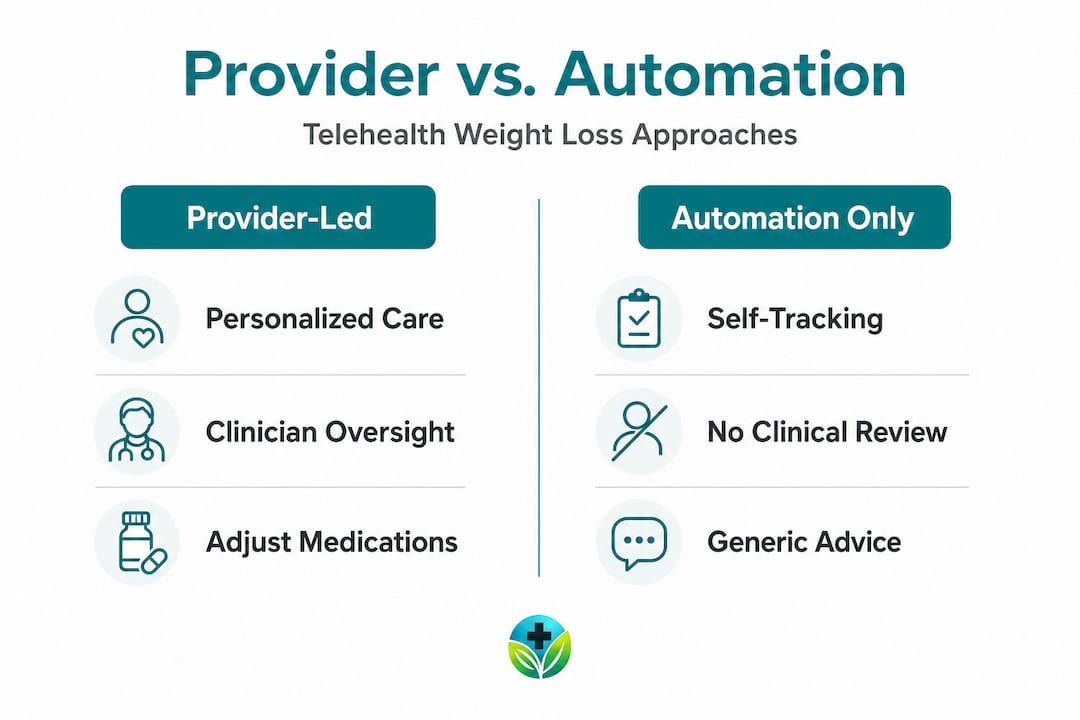
Here is how telehealth provider consultations compare to purely automated apps:
| Feature | Telehealth provider consultations | Automated apps only |
|---|---|---|
| Medical history review | Yes, full clinical intake | No |
| Personalized dietary plan | Yes, based on labs and conditions | No, generic templates |
| Medication prescribing | Yes, if clinically appropriate | No |
| Lab ordering and review | Yes | No |
| Ongoing human follow-up | Yes, scheduled check-ins | No |
| Side effect monitoring | Yes | No |
| Dose adjustments | Yes, by licensed provider | No |
| Accountability coaching | Yes, with a real clinician | Limited, automated only |
The advantages of ongoing counseling with a real provider extend beyond what a table can capture. Key benefits include:
- Accountability: Regular scheduled visits create a structured commitment that self-tracking apps cannot replicate.
- Real-time adjustments: If you experience side effects, plateau in weight loss, or have a change in your health status, your provider can modify the plan immediately.
- Outcome tracking: Providers compare your results against clinical benchmarks, not just personal goals.
- Behavioral support: Counseling addresses emotional eating patterns, motivation challenges, and barriers that an algorithm cannot recognize.
Exploring telemedicine nutrition planning in depth reveals just how far virtual nutrition care has advanced in terms of both clinical rigor and accessibility. If you want to understand the full scope of what a program should include, reviewing all-inclusive telehealth weight care is a useful starting point.
Medical safety, eligibility, and medication management in telehealth
While nutrition care is foundational, medical safety and medication management are where provider involvement becomes truly indispensable. This is the layer of telehealth weight loss that automated tools simply cannot provide.
Provider consultations are essential for reviewing laboratory results, conducting safety assessments, and prescribing or adjusting medications in a way that is specific to your current health profile. For adults with a BMI of 27 or higher, especially those managing comorbidities like type 2 diabetes, hypertension, or fatty liver disease, this medical layer is not optional. It is the difference between a treatment that helps and one that causes harm.
Meta-analytic evidence on nursing-led telemedicine interventions for adults with BMI greater than 25 shows measurable average reductions of 2.59 kg in body weight, 1.05 points in BMI, and 2.52 cm in waist circumference compared to traditional approaches. These are clinically meaningful numbers, especially when compounded over time with consistent follow-up.
A typical safety protocol in a provider-led telehealth weight loss program follows these steps:
- Initial clinical assessment: The provider reviews your BMI, relevant health history, and any contraindications to GLP-1 medications such as personal or family history of thyroid cancer or pancreatitis.
- Lab panel review: Blood glucose, HbA1c (a measure of average blood sugar over roughly three months), thyroid function, lipids, and kidney markers are assessed.
- Medication initiation: If appropriate, GLP-1 receptor agonists are prescribed at a starting dose, with clear patient education on expected effects and side effects.
- Titration schedule: Doses are gradually increased based on your tolerance and response, typically reviewed at four to eight week intervals.
- Ongoing follow-up and escalation: If side effects are severe or weight loss stalls, the provider adjusts the plan, switches medications, or coordinates additional care.
Understanding the role of regulatory compliance in telehealth helps clarify why licensed provider involvement at every stage is not just best practice, it is a legal and ethical requirement. For more on what supervised GLP-1 supervision in telehealth looks like in practice, that resource offers detailed guidance.
Why provider coaching works better than automation alone
This leads to a crucial distinction: not all telehealth approaches are equal, and the provider-driven model consistently outperforms fully automated programs for adults with complex medical needs.
Evidence from the Community Preventive Services Task Force confirms that technology-delivered obesity management works best as a multicomponent, coached or clinician-supported approach, rather than a purely automated stand-alone intervention. Counseling and coaching via telehealth expands access while supporting meaningful behavior change in ways that automated systems alone cannot achieve.
Separately, reviews of stand-alone digital lifestyle interventions suggest that when no synchronous (real-time) human support is included, the magnitude of benefit depends heavily on patient engagement and can fall short for individuals with significant medical complexity or comorbidities.
Here is how the outcomes compare across different intervention models:
| Intervention type | Average weight loss | Adherence rate | Patient satisfaction |
|---|---|---|---|
| Multicomponent telehealth with provider coaching | High (clinically significant) | High | High |
| Telehealth with limited check-ins | Moderate | Moderate | Moderate |
| Automated app only | Low to moderate | Low over time | Variable |
| In-person clinical program | High | Moderate (access barriers) | High |
The table above illustrates a pattern seen across multiple research reviews: adding a real clinician to the process consistently lifts outcomes across all three dimensions. Satisfaction matters beyond patient comfort. It predicts adherence, and adherence predicts results.
Pro Tip: If your medical history includes two or more chronic conditions or you are considering GLP-1 medications, insist on synchronous (live, two-way) provider support rather than a program that relies entirely on automated messages and tracking dashboards. The clinical complexity of your situation genuinely requires a human decision-maker.
For deeper reading on what the research says about evidence-based telehealth strategies and how modern GLP-1 care insights are being integrated into behavioral support, both resources are worth exploring.
Why provider consultation is the missing piece in telehealth weight care
From all this evidence, here is a perspective that goes further than what most articles will tell you.
The weight loss app industry has built an enormous market around the idea that self-monitoring creates behavior change. Track your steps, log your meals, and the data will motivate you. For some people with straightforward goals and no significant health issues, that framing holds partial truth. But for adults with a BMI of 27 or higher, especially those managing metabolic conditions, that framing is incomplete in a way that can be genuinely harmful.
Here is what self-tracking apps miss: they have no mechanism for clinical judgment. They cannot read your lab values, recognize a contraindication, or identify that your fatigue is a medication side effect rather than a motivation deficit. They cannot titrate your Semaglutide dose. They cannot catch the early signs of pancreatitis or adjust your plan when your thyroid levels shift. They are data collection tools, not clinical decision-making systems.
The deeper issue is that the weight loss category gets marketed as a lifestyle issue when, for many people, it is a medical one. Obesity is recognized by major medical bodies as a chronic disease with biological drivers, including hormonal dysregulation, altered gut-brain signaling, and genetic predisposition. Treating it with an app is like treating hypertension with a blood pressure monitor and no medication review. The tool is useful for tracking, but it does not replace the clinical intervention.
Evidence consistently favors multicomponent approaches with technology-supported coaching or clinician involvement, particularly for patients with medical risk, comorbidities, or medication needs. That is not a subtle academic preference. It is a clear signal that the clinical layer is doing real, measurable work that automation cannot replicate.
The most effective telehealth programs are not the ones with the sleekest app. They are the ones with the most qualified providers, the clearest protocols, and the most consistent follow-up. Provider consultation is not a premium add-on to a weight loss program. It is the program. Everything else, the tracking, the coaching tools, the meal logging, serves the clinical relationship rather than replacing it.
For anyone questioning whether that level of oversight is really necessary, the telehealth weight loss evidence answers that clearly: yes, especially for populations with complex medical needs.
Next steps: Start your medically supervised telehealth weight loss journey
Now that you understand why provider consultations truly matter, the next step is connecting with a program that actually delivers on that standard. RenewMD.clinic offers fully integrated, all-inclusive telehealth weight management programs built around licensed U.S. clinicians. Every plan includes provider consultations, lab testing, medication management, and ongoing coaching, with no hidden fees. If you are ready to learn more about how the process works, the telemedicine weight loss guide is a clear starting point. You can also explore digital tools for weight care that support, rather than replace, clinical oversight. When you are ready to take action, start your weight loss journey with a team of providers who are accountable to your results, not just your engagement metrics.
Frequently asked questions
How do telehealth provider consultations differ from automated weight loss apps?
Provider consultations offer full medical review, personalized planning, lab oversight, and ongoing clinical adjustments, which purely automated apps lack. Apps can support tracking but cannot make clinical decisions or prescribe medications.
Can medications for weight loss be prescribed through telehealth consultations?
Yes, eligible patients can receive GLP-1 prescriptions and dose titration through telehealth after a thorough safety review. Providers assess eligibility and prescribe or adjust medications as part of the clinical consultation process.
Is telehealth-based medical nutrition therapy effective for weight loss?
Clinical trials show that telehealth-delivered medical nutrition therapy improves dietary outcomes and supports measurable weight loss, particularly when delivered across multiple follow-up visits by qualified clinicians.
Do I need ongoing consultations or is a one-off telehealth visit enough?
A single visit establishes a starting point, but multicomponent coached approaches with repeated clinical contact consistently outperform one-time evaluations in weight loss outcomes, adherence, and safety monitoring.