
Health coaching is defined as a collaborative, client-centered partnership where a trained coach helps you identify personal health goals and build the action plans to reach them. Unlike a doctor's visit, the focus is not on diagnosis or prescription. The coach's role is to activate your own motivation and problem-solving skills. Nearly 75% of VA healthcare system patients have two or more chronic conditions, which shows just how broad the need for this kind of behavioral support really is. The National Board for Health and Wellness Coaching (NBHWC) sets the credentialing standard for the field through its NBC-HWC certification, grounding the practice in evidence-based methods like motivational interviewing.
What is health coaching and how does it differ from other support?
Health coaching is a structured, goal-oriented practice that sits between clinical care and everyday behavior change. A physician tells you what to do. A health coach helps you figure out how to actually do it, and more importantly, why it matters to you personally. That distinction is the foundation of the entire model.
Coaching differs from mentoring and advising by avoiding direct instructions. A mentor shares their own experience. An advisor tells you what they think is best. A health coach asks questions that help you reach your own conclusions. This approach builds intrinsic motivation, which research consistently shows produces more lasting behavior change than external direction.

Health coaching also differs from therapy. Therapy typically addresses past trauma, mental health diagnoses, or psychological disorders. Health coaching focuses on present behavior and future goals. If you want to understand when therapy fits better than coaching, the distinction comes down to clinical need versus behavioral support.
The health coaching definition, as recognized by the NBHWC, centers on patient empowerment. Coaches do not diagnose or prescribe and rely entirely on client-driven solutions. That boundary is not a limitation. It is the mechanism that puts you in charge of your own health.
What key skills and techniques define effective health coaching?
Effective health coaches draw from a specific set of behavioral and communication frameworks. These are not soft skills. They are evidence-based methods with documented outcomes in clinical and wellness settings.
The core techniques include:
- Motivational interviewing: A conversational method that helps clients explore their own reasons for change, reducing resistance and building commitment.
- Cognitive behavioral techniques: Tools borrowed from cognitive behavioral therapy that help clients identify thought patterns that block healthy behavior.
- Appreciative inquiry: A strength-based approach that focuses on what is already working in a client's life rather than what is broken.
- Goal setting and action planning: Structured frameworks for breaking large health goals into specific, measurable steps.
- Active listening and reflection: The coach mirrors back what the client says to deepen self-awareness and clarify priorities.
Health coaching applies multiple psychological and behavioral theories integrated with performance coaching skills to guide patients through sustained behavioral change. This is not a single-method practice. A skilled coach adapts their approach to the individual in front of them.
Pro Tip: When evaluating a health coach, ask them directly which behavioral frameworks they use. A qualified coach should name specific methods like motivational interviewing or cognitive behavioral techniques, not just describe themselves as "supportive."
One common misconception is that a health coach will hand you a meal plan or exercise schedule. That is not coaching. That is prescribing. Professional health coaching involves focused conversations that help clients discover personal solutions rather than receive direct answers. The coach facilitates. You do the work.
How does health coaching work, and what outcomes can clients expect?
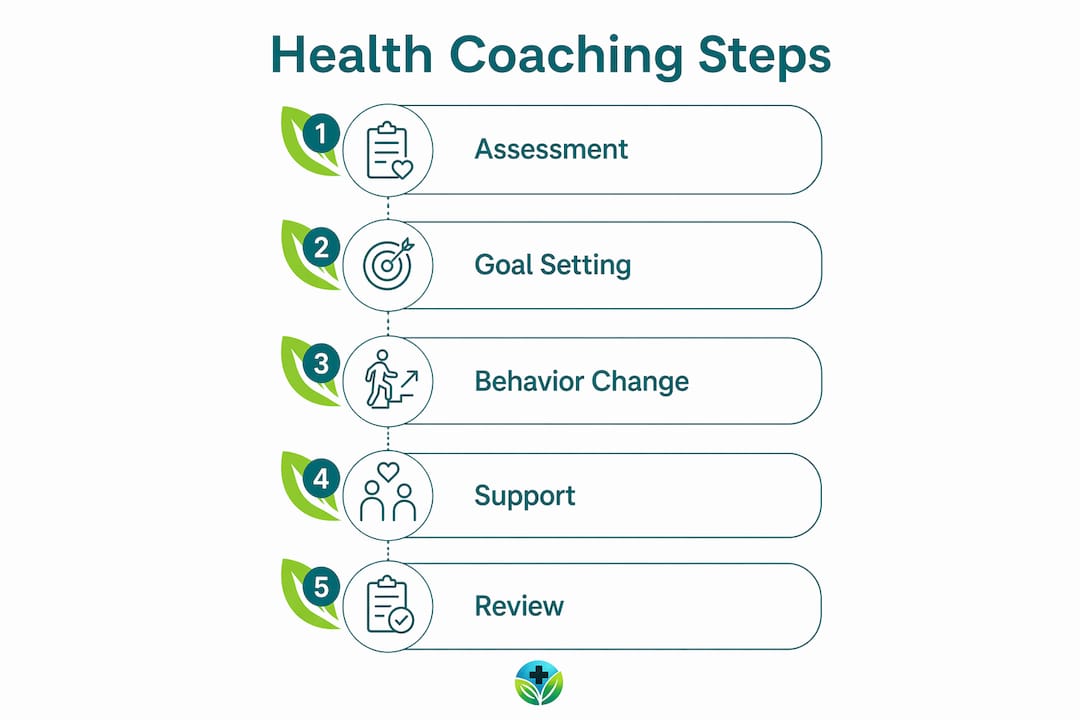
The coaching process follows a clear structure, even though the content of each session is personalized. Understanding the process helps you get more from it.
- Initial assessment: The coach learns about your health history, current behaviors, personal values, and what you want to change. This session sets the foundation for everything that follows.
- Goal identification: Together, you define specific, realistic health goals that align with your values. Goals you choose yourself are far more motivating than goals assigned to you.
- Action planning: The coach helps you break each goal into concrete weekly actions. These are small enough to be achievable and specific enough to measure.
- Ongoing sessions: Regular check-ins, typically weekly or biweekly, review progress, address obstacles, and adjust the plan as needed.
- Between-session work: The real change happens outside the coaching call. You implement the plan, track your behavior, and bring observations back to the next session.
Patient activation and engagement are predictive of effective self-management, which health coaching directly targets through tailored, non-judgmental support. Activation means you move from passive recipient of care to active manager of your own health. That shift is the measurable outcome coaching aims to produce.
The research on effectiveness is strong in several areas. A meta-analysis of 15 studies involving 4,254 patients found health coaching improves physical activity, diet quality, and stress management. The same analysis found coaching has limited effect on smoking cessation compared to standard care. That finding matters. Coaching is not a universal solution, and knowing its boundaries helps you use it correctly.
A 2025 study reported that 96.8% of participant feedback on structured health coaching was positive, with significant improvements in patient activation and self-management. That level of satisfaction reflects the value patients place on being heard and supported without judgment.
Coaching also connects directly to chronic weight management strategies, where behavioral support alongside medical treatment produces better long-term outcomes than either approach alone.
Who should consider health coaching, and how do you find a qualified coach?
Health coaching is most effective for people who already have a general direction but struggle to follow through consistently. You do not need a diagnosis to benefit. You need a goal and a willingness to engage.
Ideal candidates include:
- People managing chronic conditions like type 2 diabetes, hypertension, or obesity who want to improve daily habits alongside medical treatment.
- Individuals seeking sustainable weight loss who have tried restrictive diets without lasting success.
- Anyone dealing with high stress, poor sleep, or low energy who wants structured support for lifestyle change.
- People who feel stuck between knowing what they should do and actually doing it.
Finding a qualified coach requires checking credentials. The NBC-HWC credential requires education and passing a rigorous exam, making it the clearest signal of evidence-based training in the field. Coaches without formal credentialing may still be helpful, but you have no guarantee they are using validated methods.
Pro Tip: Search the NBHWC directory at nbhwc.org to verify a coach's certification before your first session. Certification status is publicly listed and takes under a minute to confirm.
Health coaching fills the gap between medical advice and daily behavioral change by providing accountability and motivation tailored to your values. A coach does not replace your primary care provider. They work alongside your clinical team to help you act on the guidance your doctor has already given you.
When vetting a coach, ask about their training, the frameworks they use, and how they handle situations outside their scope. A qualified coach will refer you back to a clinician for anything medical. That boundary is a sign of professionalism, not limitation.
What to expect from a typical health coaching experience?
A health coaching experience is structured but not rigid. Sessions usually run 30–60 minutes and follow a consistent format that keeps the focus on your progress.
A typical session includes:
- Check-in on the previous week: What did you do? What got in the way? What surprised you?
- Reflection and insight building: The coach uses open-ended questions to help you understand your own patterns.
- Problem-solving: If an obstacle came up, you work together to find a realistic solution that fits your life.
- Goal review and adjustment: Plans change. The coach helps you adapt without losing momentum.
- Commitment for the next week: You leave each session with a clear, self-chosen action to complete before the next call.
Successful health coaching promotes patient autonomy by treating the client as the expert in their own life. The coach does not tell you what to eat or how to exercise. They ask what you are willing to try and help you build on that.
Common coaching topics include nutrition habits, physical activity, stress management, sleep quality, and motivation. In telehealth settings, coaching support in telemedicine follows the same client-centered model but adds the convenience of remote access, which increases consistency for many patients.
The most important thing to understand about the coaching experience is that your effort between sessions determines your results. The coach provides structure and accountability. You provide the action.
Key Takeaways
Health coaching is most effective when clients treat it as a behavioral practice, not a passive service. The evidence is clear: structured coaching improves physical activity, diet, and stress management in patients who actively engage with the process.
| Point | Details |
|---|---|
| Health coaching definition | A collaborative, client-centered practice focused on empowering behavior change through evidence-based techniques. |
| Core techniques | Motivational interviewing, cognitive behavioral tools, goal setting, and active listening drive lasting results. |
| Proven outcomes | Research across 4,254 patients shows improvements in physical activity, diet, and stress management. |
| Credential to look for | The NBC-HWC certification confirms a coach uses validated, evidence-based behavioral frameworks. |
| Coaching vs. clinical care | Coaching complements your medical team. It does not replace diagnosis, prescriptions, or clinical treatment. |
Why I think most people misunderstand what health coaching actually does
After years of observing how people approach behavior change, the pattern is consistent. Most people come to health coaching expecting to be told what to do. They want a plan handed to them. When the coach asks questions instead of giving answers, they feel frustrated.
That frustration is the moment coaching either works or fails. The clients who push through it and start doing the self-reflection tend to see real, lasting change. The ones who keep waiting for instructions rarely do. The model is not broken. The expectation is.
The research on patient autonomy and empowerment confirms this. Behavior change that comes from within lasts longer than behavior change imposed from outside. A coach's job is to help you find your own reasons, not to supply them.
The future of health coaching is clearly moving toward integration with clinical care, particularly in chronic disease management and medically supervised weight loss. That integration works best when patients understand the coach's role before the first session. Go in knowing that you are the expert on your own life. The coach is there to help you use that expertise more effectively.
— Raymond
Renewmd's approach to coaching-supported weight management
Renewmd combines medical oversight with structured coaching support to address weight management from both a clinical and behavioral angle. The platform connects patients with licensed U.S. clinicians who provide evidence-based treatment using GLP-1 receptor agonists like Semaglutide and Tirzepatide, alongside the accountability tools that make those treatments more effective long-term. Behavioral support and medical care work better together than either does alone. If you are ready to move from information to action, Renewmd's digital weight management tools give you a clear starting point. You can also review how the process works and take the first step toward a medically supervised program built around your goals.
FAQ
What is the health coaching definition used by credentialing bodies?
The NBHWC defines health coaching as a client-centered, collaborative process that uses evidence-based behavioral techniques to help individuals set and achieve personal health goals. It is distinct from clinical care and does not include diagnosis or prescription.
How does health coaching work in practice?
Sessions typically run 30–60 minutes and follow a structured format: reviewing the previous week, identifying obstacles, adjusting goals, and setting a specific action for the coming week. The client drives the content; the coach provides the framework.
What are the main benefits of health coaching?
Research across 4,254 patients shows health coaching improves physical activity, diet quality, and stress management. Patient satisfaction is also high, with a 2025 study reporting 96.8% positive feedback from participants in structured coaching programs.
Is health coaching the same as therapy?
No. Therapy addresses mental health diagnoses and past psychological experiences. Health coaching focuses on present behavior and future health goals. If clinical mental health support is needed, a qualified coach will refer you to a licensed therapist.
How do I find a qualified health coach?
Look for the NBC-HWC credential, which requires formal education and a rigorous exam. The NBHWC maintains a public directory where you can verify any coach's certification status before committing to a program.