
Remote medical care, the clinical term for which is telehealth or telemedicine, connects patients to licensed healthcare providers through video, messaging, and digital monitoring tools without requiring an in-person visit. Telehealth utilization has risen to 86.9% as of early 2026, a figure that reflects a genuine shift in how Americans access treatment. Platforms like Teladoc and programs like Blue Shield of California's Virtual Blue have demonstrated that virtual care delivers measurable outcomes across primary care, mental health, and chronic disease management. For anyone weighing their remote healthcare options, the evidence now supports telehealth as a clinically sound, cost-effective choice for a broad range of health needs.
Why choose remote medical care over traditional visits?
The core advantages of telehealth fall into four categories: convenience, cost, access, and clinical outcomes. Each is supported by recent data, not just patient preference surveys.
Convenience and time savings are the most immediate benefits. You schedule a video visit around your workday, skip the commute, and avoid waiting rooms. For patients managing chronic conditions like type 2 diabetes or hypertension, this means consistent follow-up appointments actually happen rather than being postponed due to scheduling friction.

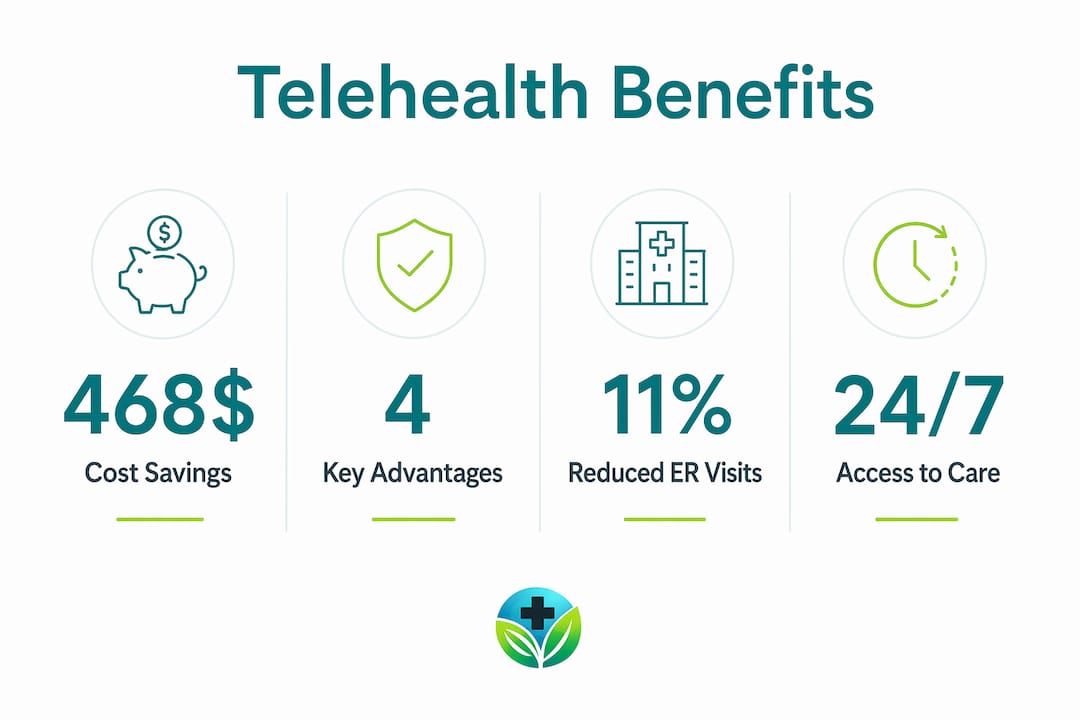
Cost reduction is measurable and significant. Virtual-first programs deliver $468 lower costs per member annually and reduce emergency claims by 11%. That figure comes from Blue Shield of California's analysis of its Virtual Blue program. Lower costs per encounter translate directly to lower out-of-pocket expenses for patients with high-deductible plans.
Access for underserved populations is where telehealth has the clearest public health impact. Remote visits eliminate transportation barriers for patients with mobility limitations, caregiving responsibilities, or limited access to specialists in rural areas. A patient in a rural county can consult a board-certified endocrinologist the same day a patient in a major city can, something that was logistically impossible a decade ago. You can read more about how this plays out in practice through Renewmd's coverage of telehealth in rural areas.
Chronic disease management improves with consistent virtual engagement. The American Medical Association identifies telehealth as essential for chronic disease adherence, noting fewer acute escalations among patients who use it regularly. This matters most for conditions like obesity, cardiovascular disease, and mental health disorders, where continuity of care directly affects outcomes.
- No commute or waiting room exposure to contagious illness
- Flexible scheduling including evenings and weekends
- Reduced emergency department utilization by 28% when telehealth is used early
- Lower annual costs averaging $468 per member in virtual-first programs
- Broader specialist access regardless of geographic location
- Higher treatment adherence for chronic conditions
Pro Tip: If you are managing a chronic condition, schedule your telehealth follow-ups at the same time each month before you leave each appointment. Consistent scheduling is the single most effective way to maintain adherence.
What are the real limitations of virtual care?
Telehealth is not a replacement for every clinical encounter, and understanding where it fits prevents frustration and delays in care. The limitations are specific and predictable, not a general quality deficit.
Physical examination remains the primary constraint. A provider cannot auscultate lung sounds, palpate an abdomen, or assess a wound through a screen. Conditions requiring imaging, blood draws, or hands-on assessment still require an in-person visit. This is not a flaw in telehealth design. It is an honest boundary that well-run platforms communicate clearly.
Technology access and digital literacy present real barriers for some patients, particularly older adults or those without reliable broadband. A 2026 survey found that a meaningful share of patients over 65 still prefer phone-based visits over video. Platforms that offer asynchronous options, such as secure messaging or photo uploads, partially address this gap.
The most persistent misconception is that virtual care is clinically inferior. Virtual providers follow the same evidence-based protocols as in-person clinicians and are subject to the same licensing and credentialing requirements. Sanford Health's clinical team has addressed this directly:
"Virtual care providers are the same highly qualified clinicians as in-person providers. They follow evidence-based protocols and can order diagnostics, labs, and referrals just as they would in a clinic setting."
Many diagnoses and prescriptions are handled remotely through secure platforms, with physical exams required only for selected acute presentations. When a virtual visit reveals a need for in-person evaluation, a well-integrated platform handles the referral without disrupting the care relationship.
- Not suitable remotely: Suspected fractures, severe abdominal pain, chest pain requiring EKG, wound care requiring debridement
- Well-suited for remote care: Medication management, mental health therapy, dermatology consultations, chronic disease monitoring, weight management
- Partial fit: Minor acute infections where photo uploads and symptom history are sufficient for diagnosis
How does remote medical care work in practice?
A typical telehealth encounter moves through a structured process that mirrors in-person care more closely than most patients expect.
Step 1: Digital intake. You complete a symptom questionnaire and, depending on the condition, upload photos or recent lab results. Remote triage using symptom and photo uploads is now standard practice on integrated platforms before a video or phone appointment is scheduled. This step alone resolves a significant share of straightforward requests.
Step 2: Provider consultation. A licensed clinician reviews your intake data and conducts a video or asynchronous visit. The provider assesses symptoms, reviews history, and determines a care plan. For weight management, this includes reviewing metabolic labs, discussing GLP-1 receptor agonist options like Semaglutide or Tirzepatide, and setting dosing protocols.
Step 3: Diagnostics and prescriptions. Clinicians assess symptoms and refer for labs or in-person visits when necessary. Lab orders are sent electronically to a facility near you. Prescriptions are transmitted to a pharmacy, or in the case of platforms like Renewmd, medications are shipped directly to your door.
Step 4: Follow-up and coaching. Integrated platforms include scheduled check-ins, health coaching, and asynchronous messaging between appointments. This ongoing support structure is what separates a one-time virtual visit from a true care model.
| Modality | Best use case | Example platforms |
|---|---|---|
| Video visit | Diagnosis, medication review, mental health | Teladoc, BetterHelp, Renewmd |
| Asynchronous messaging | Prescription refills, follow-up questions | Most integrated telehealth platforms |
| Photo upload | Dermatology, wound assessment, rash evaluation | Dermatology-specific telehealth services |
| Remote monitoring | Blood pressure, glucose, weight tracking | Chronic disease management programs |
Asynchronous remote care tools can replace video calls for many non-acute conditions, making care faster and more accessible for patients with limited availability. Mental health services delivered through platforms like BetterHelp have demonstrated high satisfaction and broader reach due to reduced stigma and flexible scheduling. For a detailed look at how this process applies to weight management specifically, Renewmd's guide on telehealth consultation for weight management walks through each step.
Pro Tip: Before your first video visit, test your camera and microphone, have your medication list ready, and write down your top two or three concerns. Providers can cover more ground when patients arrive prepared.
How to choose the right remote care option for your needs
Selecting a telehealth service requires matching the platform's capabilities to your specific health situation. Not all platforms are built the same way.
Assess your condition type first. Chronic conditions like obesity, diabetes, anxiety, and hypertension are well-suited to ongoing virtual care programs. Minor acute issues like sinus infections or UTIs fit well with on-demand telehealth services. Complex or undifferentiated symptoms that have not been evaluated in person should start with a primary care provider, whether virtual or in-person.
Evaluate the platform's clinical infrastructure. A quality telehealth service employs licensed clinicians, uses secure and HIPAA-compliant technology, and has a clear process for referring patients to in-person care when needed. Ask whether the platform can order labs, handle prescription management, and provide follow-up support between appointments. Renewmd's approach to medication delivery in telehealth illustrates what a fully integrated model looks like in practice.
Verify insurance coverage before enrolling. Many major insurers now cover telehealth visits at parity with in-person care. Blue Shield of California's Virtual Blue program is one example of a payer-integrated virtual care model that covers primary care, mental health, and specialist consultations. Confirm your plan's telehealth benefits before your first appointment to avoid unexpected costs.
- Confirm the provider is licensed in your state
- Check whether the platform uses board-certified clinicians or nurse practitioners
- Ask about response time for asynchronous messages
- Verify that lab orders and referrals are handled within the platform
- Review the privacy policy and data security certifications
Pro Tip: Prepare a written summary of your current medications, recent lab results, and any symptoms you have experienced in the past 30 days. Uploading this before your first visit significantly reduces intake time and helps the provider make faster, more accurate decisions.
Key takeaways
Remote medical care is most effective when matched to the right condition type, delivered through a clinically integrated platform, and supported by consistent follow-up.
| Point | Details |
|---|---|
| Telehealth reduces costs measurably | Virtual-first programs lower annual costs by $468 per member and cut emergency claims by 11%. |
| Chronic conditions benefit most | Consistent telehealth engagement improves adherence and reduces acute escalations for conditions like obesity and diabetes. |
| Physical exams remain necessary for select cases | Fractures, severe acute presentations, and hands-on diagnostics still require in-person evaluation. |
| Platform quality varies significantly | Choose services with licensed clinicians, HIPAA compliance, lab ordering, and integrated follow-up support. |
| Asynchronous tools expand access | Messaging and photo uploads resolve many non-acute issues faster than scheduling a video visit. |
Why telehealth is no longer optional for modern healthcare
I have spent years reviewing how patients interact with the healthcare system, and the pattern that stands out most is not about technology. It is about friction. The patients who fall out of care, who miss follow-ups, who end up in emergency departments for manageable conditions, are almost always the ones for whom getting to a clinic is genuinely hard. Not impossible. Just hard enough that it keeps not happening.
Telehealth removes that friction. Not for every situation, and not as a substitute for clinical judgment, but as a structural fix for the gap between when care is needed and when it actually occurs. The American Medical Association now frames telehealth as an essential ongoing care model, not a temporary workaround. That framing matters because it shifts the conversation from "is this as good as in-person care?" to "how do we build systems where both modalities work together?"
What I find most underappreciated is the role of asynchronous care. Most people picture telehealth as a video call. But a secure message to your provider with a photo of a rash, or a quick check-in about a medication side effect, often delivers faster and more useful care than scheduling a 15-minute appointment. Platforms that integrate these tools alongside video visits are the ones producing the best outcomes.
The patients I see benefiting most from virtual care are not the ones with the simplest problems. They are the ones managing complex, ongoing conditions who finally have a care model that fits their actual lives. That is not a minor convenience. It is a clinical outcome.
— Raymond
Start your telehealth journey with Renewmd
For individuals exploring remote medical care for weight management, Renewmd offers a fully integrated telehealth program built around GLP-1 receptor agonists like Semaglutide and Tirzepatide. The process covers everything from your initial provider consultation to lab testing, medication delivery, and ongoing coaching, all through licensed U.S. clinicians. There are no hidden fees, no complicated billing, and no in-person visits required to get started. If you are ready to access medically supervised weight care from home, begin your GLP-1 program with Renewmd today. You can also explore evidence-based telehealth weight strategies to understand what the clinical process looks like before you enroll.
FAQ
What conditions can be treated through remote medical care?
Telehealth is effective for primary care, mental health, chronic disease management, dermatology, and weight management. Conditions requiring physical examination, imaging, or hands-on procedures still require in-person visits.
Is remote medical care as effective as in-person treatment?
For a broad range of conditions, yes. Virtual providers follow evidence-based clinical protocols and can order labs, diagnostics, and referrals just as in-person clinicians do.
How much does telehealth cost compared to in-person visits?
Virtual-first programs have been shown to reduce annual healthcare costs by an average of $468 per member, with 11% fewer emergency claims. Many insurers now cover telehealth at parity with in-person care.
How do I prepare for my first telehealth appointment?
Gather your current medication list, recent lab results, and a written summary of your symptoms before the visit. Renewmd's guide on preparing for telehealth visits covers the full preparation process.
Is my health information secure during a remote visit?
Reputable telehealth platforms use HIPAA-compliant technology to protect patient data. Before enrolling, confirm the platform's security certifications and review its privacy policy to verify compliance.