
Remote healthcare is more than scheduling a video call with your doctor. It covers a broad spectrum of services, from clinical consultations and diagnostic monitoring to mental health support and chronic disease management, all delivered without requiring you to set foot in a clinic. Understanding what is remote healthcare means recognizing that it includes telehealth, telemedicine, and remote patient monitoring as distinct but related categories. This guide breaks down each one clearly, explains the technology behind them, and gives you practical guidance on how to use these services safely and effectively.
Table of Contents
- Key takeaways
- What is remote healthcare, telehealth, and telemedicine
- How remote healthcare technology works
- Benefits of remote healthcare and common use cases
- Challenges and limits of remote healthcare
- How to access and use remote healthcare effectively
- My perspective on where remote healthcare is heading
- How Renewmd brings remote healthcare to weight management
- FAQ
Key takeaways
| Point | Details |
|---|---|
| Remote healthcare is broad | It covers telehealth, telemedicine, and remote patient monitoring — not just video visits. |
| Terminology matters | Telehealth is the umbrella term; telemedicine refers specifically to clinical services like diagnosis and treatment. |
| RPM is data-driven care | Remote patient monitoring uses FDA-cleared devices to transmit your vitals directly to your provider. |
| Access is unequal | Broadband gaps and digital literacy barriers limit equitable access, especially in rural communities. |
| Preparation improves outcomes | Patients who arrive at virtual visits prepared with their medical history and symptoms get better care. |
What is remote healthcare, telehealth, and telemedicine
People use these terms interchangeably, but they describe different things. Getting the definitions right helps you understand what to expect from any given remote health service.
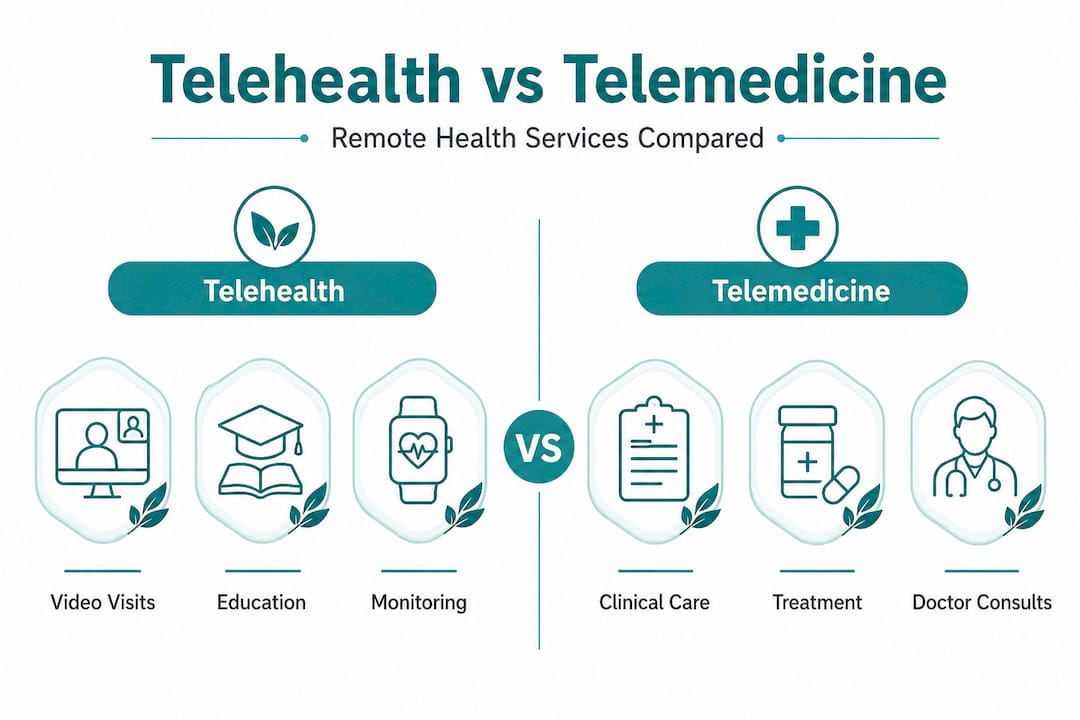
According to AMA definitions, telehealth is the umbrella term covering both clinical and non-clinical services delivered remotely. That includes patient education, provider training, administrative functions, and direct medical care. Telemedicine sits inside that umbrella and refers specifically to the clinical side — diagnosing conditions, prescribing treatments, and managing ongoing care remotely.
Remote patient monitoring (RPM) is a data-driven subset that uses physical devices to track your health outside of clinical settings. According to CMS guidelines, common RPM tools include blood pressure cuffs, continuous glucose meters, pulse oximeters, and wearable ECG monitors. These devices collect your vital signs and transmit the data to your provider, allowing them to identify changes before they become serious problems.
Telehealth also splits into two delivery modes worth knowing:
- Synchronous telehealth: Real-time interaction between patient and provider via video or audio call
- Asynchronous telehealth: Store-and-forward communication where you send clinical data, images, or messages for a provider to review later
Here is a quick comparison to keep the categories clear:
| Term | Scope | Examples |
|---|---|---|
| Telehealth | Broadest category | Video visits, RPM, patient education, provider training |
| Telemedicine | Clinical services only | Diagnosis, prescriptions, follow-ups |
| Remote patient monitoring | Device-based data transmission | Blood pressure tracking, glucose monitoring |
How remote healthcare technology works
The definition of remote healthcare only makes sense when you understand what actually powers it. Most remote health services rely on technology you already own.
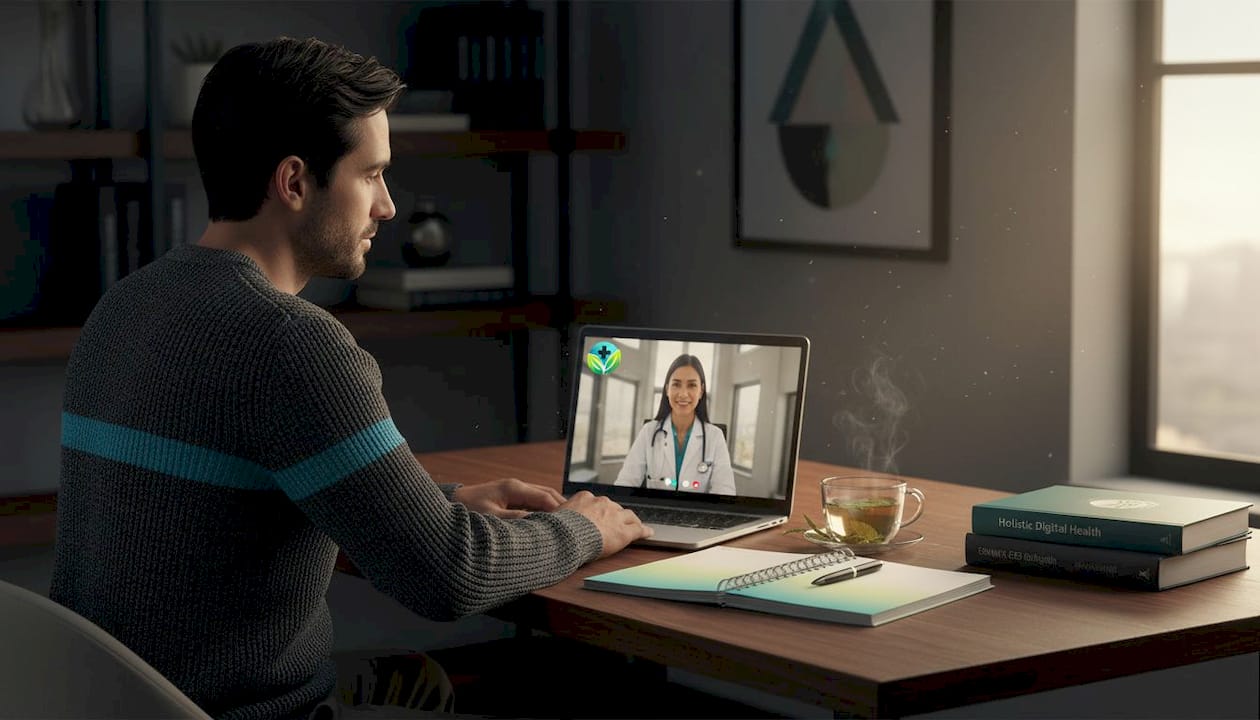
A standard telehealth visit uses a smartphone, tablet, or computer with a camera and microphone. You connect through a HIPAA-compliant video platform, and your provider sees and hears you in real time. Some platforms integrate directly with electronic health records, allowing your provider to pull up your history during the call. Others use secure messaging apps where you can send symptom descriptions, photos, or lab results asynchronously.
Key technologies enabling remote health services include:
- Video conferencing platforms built for clinical use
- Mobile health apps that track symptoms, medications, and vitals
- Wearable devices that continuously monitor heart rate, oxygen levels, or activity
- Connected medical devices that push data to provider dashboards
- AI-assisted triage tools that help route patients to appropriate care levels
Broadband quality directly affects care quality. A stable internet connection makes the difference between a productive visit and a frustrating, fragmented one. That said, audio-only telehealth remains a critical access option. Roughly 26% of Medicare beneficiaries lack video-capable devices or reliable broadband, making phone-based visits an important lifeline rather than an inferior workaround.
Pro Tip: Before your first telehealth appointment, test your camera and microphone at least 15 minutes early. Log into the platform using the same device you plan to use during the visit. Small technical issues resolved in advance make a real difference in visit quality.
Benefits of remote healthcare and common use cases
The practical benefits of remote health services extend well beyond convenience. For many people, accessing virtual healthcare is the difference between receiving care and going without it entirely.
Telehealth adoption has demonstrated measurable clinical impact: remote care reduces hospitalizations for related conditions by 89%, and in 2020, 92% of patients received care from home. That is not a marginal improvement. It signals a genuine shift in how healthcare is being delivered at scale.
The populations who benefit most from remote health services are those historically underserved by traditional care models:
- Rural residents who live hours from the nearest specialist
- Elderly patients with limited mobility or transportation options
- Individuals managing chronic conditions like type 2 diabetes, hypertension, or COPD
- People with mental health needs who face stigma, waitlists, or geographic barriers to in-person therapy
- Working adults who cannot take half a day off for a routine follow-up
Beyond access, the benefits of telemedicine include meaningful cost reduction. Longitudinal data shows telehealth is cost-neutral or cost-saving because it substitutes for more expensive emergency room visits and urgent care encounters. Patients avoid travel costs too, which is not a trivial consideration for those managing chronic illness over years.
On the clinical side, remote patient monitoring services have changed how providers manage chronic conditions. A patient with poorly controlled hypertension can transmit daily blood pressure readings from home. Their physician spots a pattern, adjusts the medication, and prevents a potential cardiac event — all without the patient ever leaving their house. That kind of proactive management was not practical at scale before RPM.
Challenges and limits of remote healthcare
A balanced view of remote health services requires acknowledging what they cannot do and where current barriers persist.
The digital divide is the most significant structural challenge. Broadband access and digital literacy gaps are the primary barriers to equitable telehealth access. In rural and low-income communities, poor internet infrastructure combined with limited experience using digital tools can make remote care inaccessible for those who need it most.
Remote healthcare is also not a complete replacement for in-person care. Research shows that in large telehealth networks, the majority of visits supplement care rather than replace necessary in-person encounters. Hybrid models, where patients use telehealth for routine management and visit clinics for physical exams or procedures, represent the most clinically appropriate approach for most people.
Other challenges worth understanding:
- Safety gaps: Some conditions require physical examination. A provider cannot hear your lungs over video or detect an abdominal mass through a screen.
- Missed emergencies: Patients experiencing serious symptoms sometimes delay seeking in-person or emergency care because they started with a telehealth visit.
- Data privacy: Remote healthcare involves transmitting sensitive medical information, and not all platforms offer equivalent security standards.
- Regulatory complexity: Telehealth licensing rules vary by state, and reimbursement policies differ across payers, creating access inconsistencies.
Pro Tip: If your symptoms are worsening rapidly, involve chest pain, difficulty breathing, or loss of consciousness, skip the telehealth platform entirely. Call 911 or go directly to an emergency room. Remote healthcare serves non-emergency and chronic care well; it was never designed to replace acute emergency response.
How to access and use remote healthcare effectively
Getting started with telehealth does not require technical expertise. Here is a practical walkthrough of what the process typically looks like.
- Choose a platform appropriate for your need. General telehealth platforms handle urgent care and primary care visits. Specialty platforms, like those focused on GLP-1 telehealth access or mental health, offer more targeted clinical support.
- Set up your account before your appointment. Most platforms ask for insurance information, photo ID, and basic medical history during enrollment. Complete these steps in advance so your visit focuses on your health, not paperwork.
- Prepare your medical information. Bring a current medication list, relevant symptom history, any recent lab results, and specific questions you want answered. Patients who prepare their history and medications before virtual visits get more out of each session. Reviewing how to prepare for a virtual visit beforehand can make a noticeable difference.
- Test your technology. Confirm your internet connection, camera, and microphone are working. Find a private, well-lit space where you can speak freely.
- Communicate clearly during the visit. Describe symptoms specifically — duration, severity, triggering factors. Do not assume your provider has context they may not have. Effective communication with telehealth clinicians is a skill that improves care outcomes.
- Understand your follow-up instructions. Before the visit ends, confirm next steps, prescription details, and when to seek in-person care if your condition changes.
- For RPM programs: Understand that owning the device is not enough. Data must be transmitted to your provider on at least two days per 30-day period to meet clinical management criteria and support reimbursement eligibility.
My perspective on where remote healthcare is heading
I've spent considerable time observing how remote healthcare is reshaping patient care, and the most persistent misconception I encounter is that telehealth is a second-tier option. It is not. What I've seen is that a well-prepared patient in a focused 20-minute video visit often gets more personalized attention than a rushed 10-minute in-person appointment where half the time goes to logistics.
That said, I think the field oversells itself when it implies virtual care can stand alone. Telehealth works best as part of a hybrid model where providers use it deliberately to supplement, not replace, hands-on clinical care. The patients I've seen benefit most are those managing chronic conditions with consistent monitoring, not those using it reactively for acute problems they probably should have addressed differently.
The digital divide concerns me more than most people acknowledge. Expanding broadband and digital literacy is not a secondary issue. If remote healthcare remains structurally inaccessible to low-income, elderly, and rural populations, it will deepen health inequity rather than resolve it.
My overall view is cautiously optimistic. The rapid expansion during COVID-19 proved that patients and providers can adapt quickly when they need to. The technology has outpaced the policy frameworks meant to govern it, which creates short-term friction. But the trajectory is toward more integrated, more equitable, and more data-informed remote care. That is worth building toward.
— Raymond
How Renewmd brings remote healthcare to weight management
If you are exploring remote health services specifically for medically supervised weight management, Renewmd offers a fully integrated telehealth program built around GLP-1 receptor agonists like Semaglutide and Tirzepatide. The entire process, from clinical intake through provider consultation, lab testing, medication delivery, and ongoing coaching, happens remotely through licensed U.S. clinicians and pharmacies.
There are no hidden fees or confusing billing tiers. The medical weight loss telemedicine guide on the Renewmd site explains exactly how the process works and what clinical criteria apply. For those ready to take the first step, the telehealth and virtual weight care page details available services and support tools. To begin your enrollment and connect with a licensed provider, visit Renewmd's start page.
FAQ
What is the definition of remote healthcare?
Remote healthcare refers to the delivery of health services, consultations, monitoring, and education through digital communication technologies, without requiring in-person visits. It includes telehealth, telemedicine, and remote patient monitoring as distinct service categories.
What is the difference between telehealth vs telemedicine?
Telehealth is the broader category that includes any health service delivered remotely, both clinical and non-clinical. Telemedicine refers specifically to clinical services such as diagnosis, prescribing, and treatment management conducted remotely.
How does remote patient monitoring work?
Remote patient monitoring uses FDA-cleared devices — such as blood pressure cuffs, glucose meters, and pulse oximeters — to collect your vital signs at home and transmit that data to your provider. Data must be transmitted on at least two days per month for clinical management to qualify under standard program criteria.
What are the main challenges of remote healthcare?
The primary challenges include broadband and digital literacy gaps that limit access, the inability to perform physical examinations remotely, data privacy considerations, and varying reimbursement policies across states and insurance payers.
Who benefits most from accessing virtual healthcare?
Patients in rural areas, elderly individuals with mobility limitations, and those managing chronic conditions like diabetes or hypertension tend to benefit most from remote health services, as they gain consistent provider access without the burden of travel.