
Digital healthcare intake is the electronic collection of patient demographics, medical history, insurance details, and consent information through secure, HIPAA-compliant digital forms that integrate directly with healthcare systems. The industry standard term for this process is digital patient intake, and it replaces the paper clipboard that once defined every waiting room in America. For telehealth patients especially, understanding how this process works clarifies what to expect before your first virtual appointment and why platforms like Renewmd use it as the foundation of safe, efficient care.
What is digital healthcare intake and how does it work?
Digital healthcare intake is defined as the pre-visit collection of patient data through web-based or app-based forms delivered via SMS or email before an appointment. The process begins the moment you book a visit. A secure link arrives on your phone or in your inbox, directing you to a form that captures everything a clinician needs before the consultation begins.
The workflow follows a clear sequence:
- Appointment booking triggers form delivery. The system sends a digital intake link immediately after scheduling, typically via SMS. SMS open rates reach 98%, making text delivery far more reliable than email for reaching patients before their visit.
- Dynamic forms adapt to your answers. Unlike static paper forms, conversational AI increases engagement by asking follow-up questions based on what you've already entered. If you indicate a history of hypertension, the form asks relevant follow-up questions automatically.
- Data flows into the electronic health record (EHR). The most effective platforms use bidirectional FHIR R4 API integration to update structured EHR fields in real time. One-way integrations, by contrast, often deliver your data as a static PDF that staff must re-enter manually.
- Insurance eligibility is verified automatically. The system cross-checks your coverage in real time, flagging issues before the appointment rather than after.
- Security protocols protect your data throughout. Encryption, audit trails, and patient authentication replace the physical risks of paper forms, which can be lost, misfiled, or read by unauthorized staff.
Pro Tip: Send your intake form as soon as you receive the link. Completing it 24–72 hours before your appointment gives the clinical team time to review your information and flag any concerns before you connect.
What are the benefits of digital intake for patients and providers?

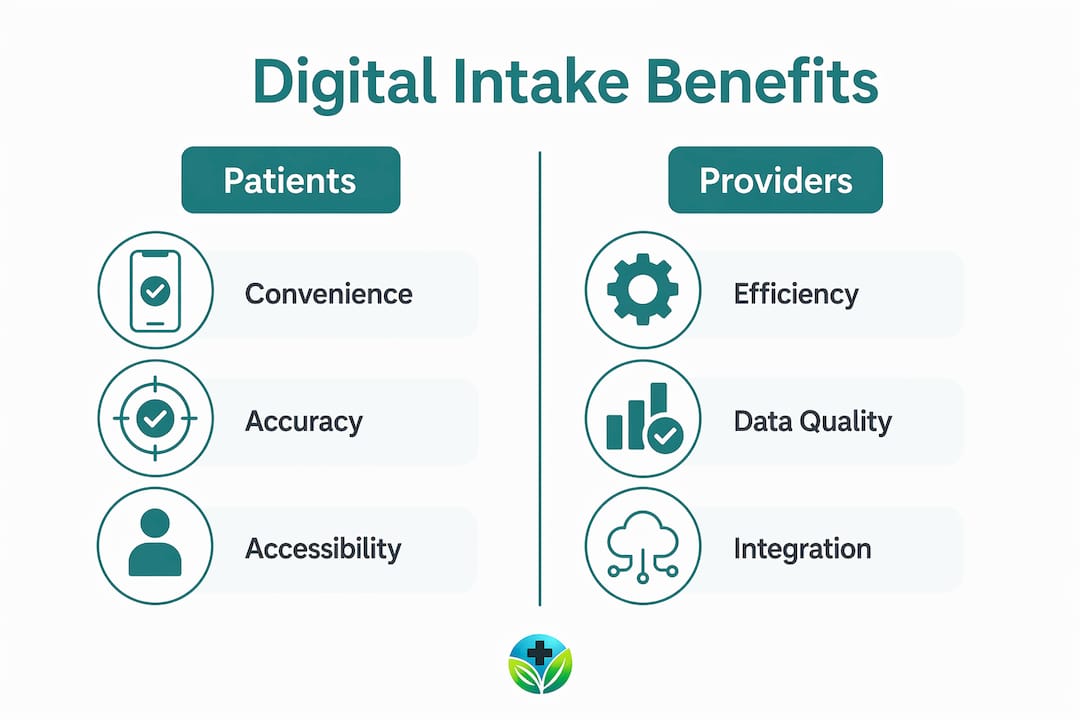
Digital patient intake delivers measurable improvements on both sides of the care relationship. For patients, the most immediate benefit is time. New patient check-in drops from 25 minutes to 5–7 minutes with digital intake. Returning patients check in in roughly 2 minutes. That time savings compounds across every visit.
For healthcare organizations, the operational gains are equally significant:
- Fewer data errors. Manual transcription carries an error rate of approximately 20%. Digital intake systems reduce that rate to less than 1%, which directly reduces billing mistakes and clinical misunderstandings.
- Lower claim rejection rates. Organizations running real-time eligibility checks at intake see a 70–90% decrease in rejected insurance claims. Fewer rejections mean faster reimbursement and less administrative rework.
- Reduced no-show rates. Patients who complete digital intake forms before appointments are psychologically more committed to attending. Some platforms embed rescheduling options within the form itself, making it easy for patients to adjust rather than simply not show up.
- Staff time recovered. Digital intake frees an estimated 6–12 minutes of staff time per patient by eliminating manual data entry. In a busy telehealth practice, that adds up to hours each day.
- Better privacy protection. Paper forms create physical HIPAA risks. Digital forms with encryption and access controls reduce those risks substantially, which matters for patient engagement and compliance across the care continuum.
The accessibility benefits are also real. Well-designed digital intake platforms offer multilingual support and mobile optimization, removing barriers for patients who struggle with English or who lack access to a desktop computer.
Digital intake methods compared: paper, basic digital, and AI-driven
Not all digital intake systems are equal. The differences between a scanned paper form, a basic online form, and an AI-driven intake platform affect everything from data quality to patient experience.
| Feature | Paper forms | Basic digital forms | AI-driven intake |
|---|---|---|---|
| Data accuracy | Low (manual transcription) | Moderate (direct entry) | High (validated, adaptive) |
| EHR integration | None | One-way PDF attachment | Bidirectional API sync |
| Patient experience | Slow, in-office only | Convenient, static | Personalized, conversational |
| Staff workload | High | Moderate | Low |
| Insurance verification | Manual | Semi-automated | Fully automated |
| Security | Physical risk | Encrypted | Encrypted with audit trails |
Paper forms remain common in smaller practices, but they carry the highest risk of data loss, transcription error, and HIPAA exposure. Basic digital forms solve the convenience problem but often deliver data as PDFs rather than updating discrete EHR fields. That means staff still re-enter information manually, which defeats much of the efficiency gain.
AI-driven intake platforms represent the current standard for telehealth. These systems ask personalized follow-up questions, pre-populate forms for returning patients using existing EHR data, and trigger downstream clinical workflows automatically. Practices integrating intake within scheduling, billing, and charting software cut onboarding time by 50–70%. That level of integration also means forms automatically update SOAP notes and capture legally binding digital consent with audit trails.
Pro Tip: When evaluating a telehealth platform, ask specifically whether its intake system uses bidirectional EHR integration or one-way PDF delivery. The answer tells you a great deal about how much manual work still happens behind the scenes.
Best practices for completing and using digital intake effectively
Getting the most from the digital patient intake process requires a few deliberate steps on both the patient and provider side.
For patients:
- Complete your intake form as soon as you receive the link. Motivation is highest right after booking, and early completion gives your care team more preparation time.
- Use a simple identity verification method. Most platforms verify identity through date of birth rather than a complex login. This keeps the process fast without compromising security.
- Review your medication list and insurance card before starting. Having this information ready reduces the time to complete the form and improves accuracy.
- Understand that your answers may trigger follow-up questions. This is intentional. Adaptive forms gather more relevant clinical detail than static checklists.
For providers and telehealth platforms:
- Send intake forms immediately upon booking. Sending forms right after scheduling maximizes completion rates by capturing patient motivation at its peak.
- Choose platforms with SMS delivery as the primary channel. The 98% open rate for SMS far outperforms email for patient engagement.
- Select systems with full EHR integration, not PDF attachments. This is the single most important technical decision in digital intake adoption.
- Use intake data to trigger clinical workflows automatically. A well-integrated system updates problem lists, flags clinical risks, and prepares the clinician before the visit begins. The clinical intake process is the foundation of personalized care, not just an administrative step.
- Confirm that your platform meets HIPAA requirements for telehealth privacy protection, including encrypted data transmission and role-based access controls.
Key Takeaways
Digital healthcare intake is the most direct way to reduce errors, cut wait times, and improve care quality before a patient ever speaks with a clinician.
| Point | Details |
|---|---|
| Definition | Digital intake electronically collects patient data through HIPAA-compliant forms before appointments. |
| Time savings | New patient check-in drops from 25 minutes to 5–7 minutes with digital intake systems. |
| Accuracy gains | Digital intake reduces data entry errors from roughly 20% to less than 1%. |
| Claim rejections | Real-time eligibility checks at intake reduce rejected insurance claims by 70–90%. |
| Integration matters | Bidirectional EHR integration prevents manual re-entry and supports automated clinical workflows. |
Why digital intake is reshaping telehealth, not just replacing paper
I've watched the digital patient intake space evolve from basic web forms to genuinely intelligent clinical tools, and the shift is more significant than most patients realize. The move from static forms to conversational AI intake is not a cosmetic upgrade. It changes what clinicians know before they say hello.
The challenge I see most often is the gap between what platforms promise and what their integration actually delivers. A system that sends data as a PDF is not truly integrated. It just moves the manual work from the patient to the staff. Real bidirectional EHR syncing, built on FHIR R4 APIs, is what separates a modern intake platform from a digitized clipboard.
What I find most compelling about advanced digital intake is its role as a risk management tool. When a system flags a clinical inconsistency before a visit, it gives the clinician a chance to prepare a better response. That is not just efficiency. That is safer care. The administrative benefits get most of the attention, but the clinical safety benefits deserve equal weight.
The future of digital intake is more personalization and less friction. Platforms will increasingly pre-populate forms using prior visit data, ask only the questions that are clinically relevant for that specific patient, and route information to the right team member automatically. For telehealth, where the entire relationship begins digitally, intake quality is care quality.
— Raymond
How Renewmd uses digital intake to start your weight care right
Renewmd builds its entire telehealth weight management process around a fully integrated digital intake experience. When you begin a program using Semaglutide or Tirzepatide through Renewmd, your intake form captures the clinical detail that licensed U.S. clinicians need to personalize your treatment from day one. There is no paper, no manual re-entry, and no waiting room. The process moves from intake to provider consultation to medication delivery without unnecessary delays. If you are ready to start medically supervised weight care through a platform that treats intake as the first clinical step rather than an administrative hurdle, Renewmd is designed for exactly that. Begin your intake today and see how a structured digital process supports better outcomes.
FAQ
What is a digital health intake form?
A digital health intake form is a secure, web-based questionnaire that collects patient demographics, medical history, insurance information, and consent before a healthcare appointment. It replaces paper forms and integrates directly with electronic health records.
How does digital intake differ from paper intake?
Digital intake captures data electronically, reduces transcription errors from roughly 20% to less than 1%, and enables real-time insurance verification. Paper intake requires manual data entry, carries physical HIPAA risks, and cannot trigger automated clinical workflows.
Is digital intake HIPAA compliant?
Yes, when implemented correctly. HIPAA-compliant digital intake platforms use encryption, audit trails, and patient authentication to protect health information, which provides stronger privacy protection than paper-based methods.
How long does digital intake take to complete?
Most patients complete digital intake forms in 5–7 minutes for a new visit and approximately 2 minutes for a return visit, compared to 25 minutes for traditional paper-based check-in.
Why does telehealth use digital intake instead of in-office forms?
Telehealth platforms use digital intake because the entire care relationship occurs remotely. Collecting clinical information before the virtual visit allows clinicians to review patient history, verify insurance, and prepare personalized care plans before the appointment begins.