

When you share a health concern through a video call, your first instinct might be to wonder who else could be listening. Understanding how telehealth protects privacy matters more than ever as virtual care becomes a routine part of managing your health. The good news: telehealth is not a privacy gray zone. Federal law applies to it just as firmly as it does to any in-person clinic visit, and reputable platforms layer technical controls on top of those legal requirements to keep your personal health information secure.
Table of Contents
- Key takeaways
- How telehealth protects privacy under federal law
- Technical safeguards that secure your virtual visit
- Administrative and physical protections behind the scenes
- How to maintain privacy in telehealth visits
- Clearing up common telehealth privacy misconceptions
- My perspective: privacy is a shared responsibility
- Confidential weight care at Renewmd
- FAQ
Key takeaways
| Point | Details |
|---|---|
| HIPAA applies fully to telehealth | Federal privacy and security rules cover virtual visits exactly as they cover in-person care for covered entities. |
| Encryption protects data in transit | Video streams and messages are converted to unreadable code that only authorized parties can access. |
| Patients share responsibility | Your choice of device, location, and network directly affects how private your virtual visit actually is. |
| Vendors must sign legal agreements | Business Associate Agreements bind telehealth platforms to HIPAA standards, but providers must verify compliance. |
| Encryption alone is not enough | Full HIPAA compliance also requires access controls, audit logging, and ongoing risk assessments. |
How telehealth protects privacy under federal law
Many people assume that virtual care exists in some loosely regulated space where privacy rules are softer. That assumption is incorrect. The HIPAA Privacy and Security Rules apply fully to telehealth services when the provider qualifies as a covered entity under the law. That means your doctor, therapist, or clinician delivering care through a video platform is held to the same legal standards as one seeing you in a physical office.
HIPAA's framework for telehealth rests on three interlocking rules:
- The Privacy Rule governs how providers may use and disclose your protected health information (PHI). It establishes your rights to access your records and to request restrictions on how your data is shared.
- The Security Rule focuses specifically on electronic PHI (ePHI) and demands administrative, physical, and technical safeguards to protect it wherever it is stored, processed, or transmitted.
- The Breach Notification Rule requires covered entities to notify affected individuals within 60 days of discovering a breach involving unsecured PHI. Large breaches must also be reported to the Department of Health and Human Services and published publicly.
The Office for Civil Rights within HHS actively enforces all three rules in telehealth contexts, meaning non-compliant platforms face real financial penalties.
One layer that often goes unnoticed is the Business Associate Agreement, or BAA. When a telehealth provider uses a third-party video platform or cloud storage vendor, that vendor touches your ePHI. A BAA is a legally binding contract requiring that vendor to uphold HIPAA safeguards. Critically, covered entities retain liability if they fail to verify their vendors actually honor those agreements. A signed BAA without verified compliance is not a shield.
State laws add another layer. Several states impose privacy requirements beyond HIPAA, including stricter rules around mental health records, substance use data, and minors' access rights. If you live in California, Texas, or New York, your state may grant you additional protections specific to telehealth. Providers operating across state lines are responsible for meeting the higher standard in each jurisdiction where they treat patients.
Technical safeguards that secure your virtual visit
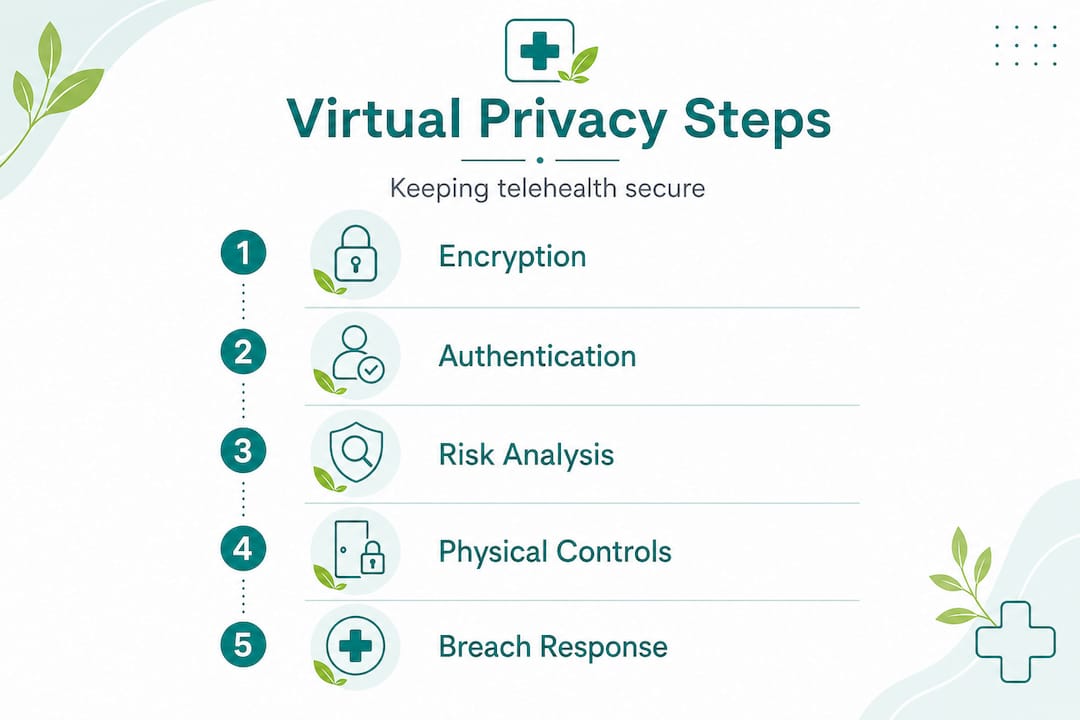
Understanding the role of privacy in telehealth requires looking at what actually happens to your data during a video call. The technology is more protective than most patients realize. When you connect with a clinician through a compliant telehealth platform, your visit is encrypted, converting everything transmitted into a form that is unreadable to anyone intercepting the connection.
The specific technical safeguards that HIPAA's Security Rule requires include:
- Access controls: Each user must have a unique ID and password. Systems must include automatic logoff features so an unattended device does not expose a session.
- Audit controls: Platforms must log who accessed what data and when. These logs allow administrators to detect unauthorized access and support investigations if a breach occurs.
- Integrity controls: Mechanisms verify that ePHI has not been altered or destroyed improperly during transmission or storage.
- Transmission security: Communications must use encryption standards strong enough to protect data in transit. Industry-standard protocols include TLS (Transport Layer Security) for data in motion and AES-256 encryption for data at rest.
Telehealth also increases the number of systems that handle your ePHI, from intake forms to scheduling software to pharmacy integrations. That broader surface area makes access controls and audit logs as critical as the encryption itself. A platform can encrypt its video streams perfectly and still fail compliance if its audit logging is absent or its access controls are weak.
Pro Tip: Before your first telehealth visit, ask the provider or platform whether they use end-to-end encryption and whether they have signed BAAs with all third-party vendors they use. A trustworthy platform will answer both questions without hesitation.
Administrative and physical protections behind the scenes
The visible technology of telehealth represents only part of the privacy picture. Behind every compliant platform is a set of organizational policies and physical protections that most patients never see but benefit from every time they log on.

HIPAA's Security Rule requires providers to conduct formal risk analyses, designate a Security Officer responsible for ongoing compliance, and train every employee with access to ePHI. That training is not a one-time checkbox. It must be updated as new threats emerge and as the platform's technology changes.
Physical safeguards address the devices themselves. Workstations used by clinical staff must be positioned and secured to prevent unauthorized viewing. Portable devices used by clinicians who work remotely must have encryption and remote wipe capabilities so that a lost laptop does not become a data breach. These requirements apply whether a clinician is seeing patients from a clinic office or from home.
When something does go wrong, breach notification protocols govern the response. The platform must have an incident response plan that identifies the breach, assesses its scope, and triggers notification to affected patients within the required window. The speed and transparency of that response are themselves indicators of how seriously a platform treats its privacy obligations.
The balance between security and usability also matters here. Overly complex authentication systems can drive patients, particularly older adults or those with disabilities, toward less secure workarounds. Well-designed telehealth platforms account for this by offering accessible authentication options without lowering the security threshold.
How to maintain privacy in telehealth visits
All the technical and legal protections in the world cannot fully compensate for choices made on your end. Patient actions such as using shared devices or being in non-private environments are among the most common causes of telehealth privacy failures. The good news is that a few deliberate habits close most of those gaps.
Here are the steps to protect your own privacy during a virtual visit:
- Choose a private physical space. Close the door, move away from common areas, and consider what can be seen or heard through windows. Others in your home or nearby should not be able to overhear clinical details.
- Use your personal device. Avoid conducting telehealth visits on shared computers or tablets. Shared devices may have browser autofill, saved passwords, or cached data that could expose your information to the next user.
- Connect through a secure network. Use your home Wi-Fi rather than public networks in coffee shops or libraries. Public Wi-Fi is significantly easier to intercept.
- Use earbuds or headphones. The American Heart Association recommends earbuds specifically because they keep audio from being heard by anyone nearby, even in a room you believe is private.
- Log out completely after every visit. Close the browser tab and log out of the patient portal. Do not rely on the session timing out on its own.
Good preparation before the visit extends your privacy protection too. Reviewing what you want to discuss in advance and preparing for your telehealth visit thoughtfully means you spend less time searching through sensitive documents during the call itself.
Pro Tip: If you are discussing sensitive topics such as weight management, mental health, or medications, consider scheduling your appointment at a time when your home will be unoccupied. The quieter your environment, the more freely you can communicate with your clinician.
Clearing up common telehealth privacy misconceptions
Privacy in virtual healthcare is frequently misunderstood, sometimes in ways that leave patients more vulnerable than they realize. The table below clarifies some of the most persistent misconceptions alongside the accurate picture.
| Misconception | Accurate understanding |
|---|---|
| Encryption alone means HIPAA compliance | Encryption is necessary but insufficient; full compliance also requires access controls, audit logs, and risk analysis. |
| A signed BAA means the vendor is compliant | Providers must actively verify vendor controls; a BAA creates obligation but does not guarantee actual compliance. |
| Patient consent removes provider HIPAA duties | Consent to telehealth does not waive the provider's obligations under HIPAA's Privacy or Security Rules. |
| Consumer video apps are HIPAA-compliant by default | Apps like FaceTime or standard Zoom fall outside HIPAA jurisdiction unless specifically configured and covered by a BAA. |
| Telehealth is less private than in-person care | When properly implemented, telehealth privacy measures can equal or exceed those of a standard clinic office. |
The distinction between a consumer app and a compliant telehealth platform is particularly worth understanding. Many patients, and even some providers, assume that any encrypted video call qualifies. That is not accurate. The platform must be specifically designed or configured for healthcare use, and the vendor must have a signed BAA with the covered entity.
My perspective: privacy is a shared responsibility
I've spent years reviewing how telehealth platforms approach privacy, and what stands out most is how often patients treat it as entirely the provider's problem. In my experience, that assumption leads to the most common and preventable breaches.
The provider side of telehealth privacy is well-regulated. HIPAA enforcement is real, and reputable platforms take it seriously. What I've observed, though, is that endpoint exposure is the privacy risk patients consistently underestimate. A clinician can do everything right on their end and still have a patient's health information overheard by a family member or cached on a shared tablet.
What I've learned from watching this space is that asking questions matters. Patients who ask their providers about telehealth regulatory compliance before their first visit signal that they are engaged and deserve a straight answer. Providers who cannot clearly explain their encryption standards or BAA arrangements are worth scrutinizing. Privacy in virtual healthcare is a shared responsibility, and the patients who treat it that way are consistently better protected than those who assume the technology handles everything.
— Raymond
Confidential weight care at Renewmd
Renewmd was built around the principle that patients seeking medically supervised weight loss deserve privacy protections they can actually trust, not vague assurances. Every aspect of the platform adheres to HIPAA's Privacy, Security, and Breach Notification Rules. The telehealth weight care services at Renewmd use encrypted video consultations, and all third-party vendors involved in medication delivery, lab testing, and coaching operate under signed Business Associate Agreements.
Renewmd also provides patients with clear guidance on how to protect their own privacy during virtual visits, because the team understands that confidentiality depends on both sides of the screen. Whether you are discussing Semaglutide, Tirzepatide, or your broader health history, your information stays between you and your licensed clinician. If you are ready to take the next step, you can begin your weight care journey through a process designed to be private, clinically sound, and straightforward from intake through medication delivery.
FAQ
Does HIPAA apply to telehealth visits?
Yes. HIPAA's Privacy, Security, and Breach Notification Rules apply fully to telehealth providers who qualify as covered entities, meaning your virtual visit carries the same legal protections as an in-person appointment.
What encryption do telehealth platforms use?
Compliant telehealth platforms use TLS encryption for data transmitted during video sessions and AES-256 encryption for data stored on their systems, converting your health information into a form that is unreadable to unauthorized parties.
Can a consumer app like FaceTime be used for telehealth?
Standard consumer apps fall outside HIPAA jurisdiction unless specifically configured for healthcare use and covered by a Business Associate Agreement. Using them for clinical visits without those safeguards creates real privacy risk.
How can I protect my privacy during a telehealth visit?
Use a personal device on a secure home network, find a private room, wear earbuds, and log out completely after each session. These steps address the patient-side privacy risks that platform encryption cannot cover.
What is a Business Associate Agreement and why does it matter?
A Business Associate Agreement is a legally binding contract requiring any vendor that handles your electronic health information to meet HIPAA standards. Without one, a telehealth vendor is not accountable under federal law for how it handles your data.