
Transparent healthcare billing is the practice of making medical service costs clear and accessible to patients before and after treatment, so they can understand, compare, and prepare for expenses without encountering surprise charges. The industry standard term for this practice is price transparency, and it is now a federal mandate enforced by the Centers for Medicare and Medicaid Services (CMS). Since 2021, CMS has required hospitals and health plans to publicly disclose pricing data in formats patients can actually use. The goal is direct: reduce unexpected bills, give patients real decision-making power, and rebuild trust in a system that has historically kept pricing opaque. Understanding how this works protects your wallet and your rights.
What is transparent healthcare billing and why does it matter?
Transparent healthcare billing gives patients accessible pricing information so they can estimate costs before receiving care and clearly see their financial responsibility after a claim is processed. This matters because medical billing in the United States has long operated as a one-sided system, where providers set prices patients rarely see until after treatment. CMS's Health Plan Price Transparency rule changed that by mandating health plans to post pricing details in stages beginning in 2022, covering everything from negotiated rates to out-of-pocket cost estimates.
The core goals of healthcare billing transparency are three-fold. First, it reduces surprise billing by requiring upfront disclosure of what a service costs. Second, it enables informed decision-making, so you can compare prices across providers before scheduling a procedure. Third, it builds trust between patients and the healthcare system by replacing guesswork with documented, verifiable numbers.

BillFlash reports that 89% of patients want to know their bills in advance, and medical practices that adopt transparency tools see measurable revenue increases. That statistic reflects a clear demand: patients are ready to engage with their costs, and the system is slowly catching up.
What regulations enforce healthcare billing transparency?
The legal framework behind healthcare billing transparency has expanded significantly since 2021. Two primary rules govern this space: the CMS Hospital Price Transparency rule and the Transparency in Coverage regulations.
- Hospital Price Transparency rule (effective January 2021): Requires all hospitals to post a machine-readable file containing gross charges, payer-specific negotiated rates, discounted cash prices, and de-identified minimum and maximum negotiated charges for all items and services.
- Transparency in Coverage rule (effective 2022-2023): Requires health insurers and employer-sponsored plans to disclose in-network provider rates, out-of-network allowed amounts, and prescription drug pricing through machine-readable files and consumer-facing cost-estimation tools.
- CMS 2026 final rule updates: Hospitals must now post actual median and percentile allowed amounts in their machine-readable files and include signed attestations confirming the accuracy of that data.
The 2026 updates are particularly significant. Hospitals use EDI 835 Electronic Remittance Advice data to calculate these median and percentile charges across 12 to 15 month lookback periods, which produces statistically meaningful pricing rather than theoretical list prices. This shift from gross charges to actual transaction-based data makes the numbers far more useful to patients comparing real-world costs.
On the legislative side, the 2026 Transparency in Billing Act aims to enhance billing clarity further, though the American Hospital Association has raised concerns about administrative burden. That tension between data transparency and operational feasibility is real, and it explains why compliance rates have varied across hospital systems.
Pro Tip: If you want to check whether a specific hospital has posted its required price transparency file, search the hospital's website for "chargemaster" or "price transparency" along with the hospital name. CMS also maintains compliance monitoring data you can reference.
How to read your medical bill versus your Explanation of Benefits
Understanding the difference between a medical bill and an Explanation of Benefits (EOB) is one of the most practical skills in managing your healthcare costs. Patients frequently confuse the two, which leads to double payments, missed disputes, and unnecessary stress.
A medical bill is a payment request sent directly from your provider or hospital. It states what you owe after insurance has processed the claim. An Explanation of Benefits is a summary document sent by your health insurer, not your provider, that explains how a claim was processed. The EOB is not a bill. It does not demand payment. It shows you what was billed, what the insurer allowed, what the insurer paid, and what portion remains your responsibility.
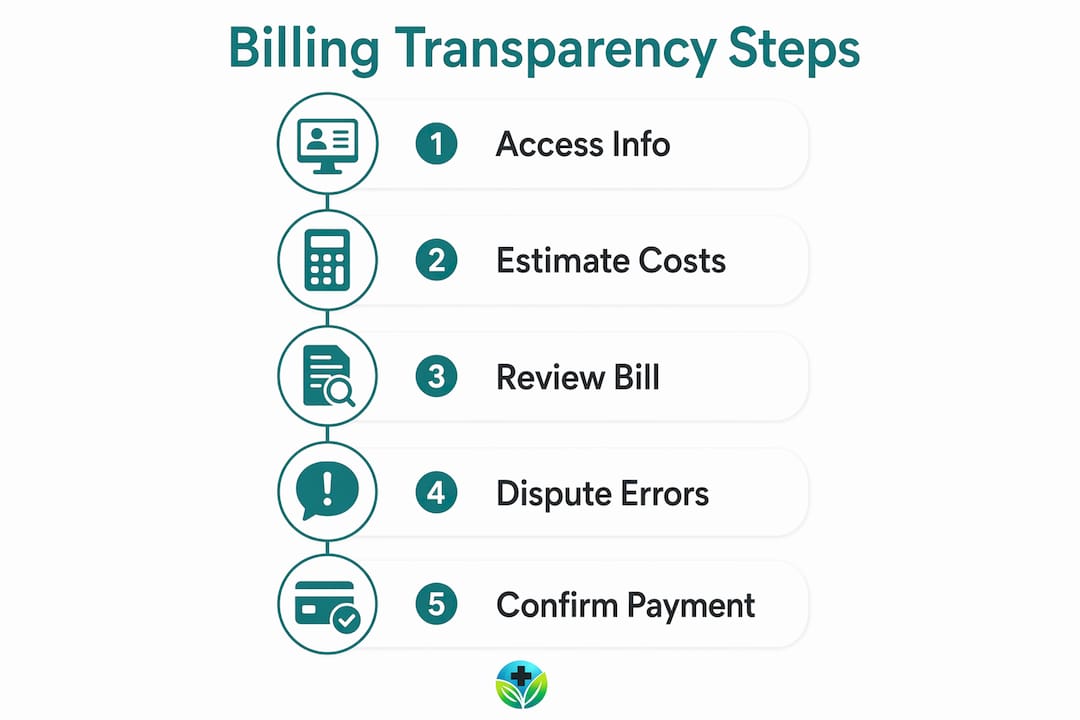
Here is how to reconcile the two documents step by step:
- Receive your EOB first. Your insurer sends this after processing the claim. Review the "patient responsibility" line, which shows your deductible, coinsurance, or copay amount.
- Wait for the provider bill. The provider's bill should arrive after the EOB and should match the "patient responsibility" figure on your EOB.
- Compare the two numbers. If the provider is billing you more than your EOB shows as your responsibility, contact the provider's billing department immediately and request an itemized bill.
- Check the allowed amount. The EOB lists the insurer's "allowed amount," which is the maximum the insurer will pay for a service. Charges above this amount are typically not your responsibility if the provider is in-network.
- Document every discrepancy. Keep both documents together and note the date, claim number, and the specific line item in question before calling either party.
Reconciling your EOB and provider bill is the single most effective way to avoid overpayment. Patients who skip this step often pay more than they legally owe, simply because the numbers on two separate documents were never compared.
Pro Tip: Request an itemized bill from every provider, not just a summary statement. An itemized bill lists every charge by service date and procedure code, making it far easier to spot errors or duplicate charges.
What are the key components and codes in a medical bill?
A transparent medical bill contains specific data fields that, once you know how to read them, tell a complete story about what was done, why it was done, and what it costs. The main components are:
- Date of service: The specific date each procedure or service was performed.
- Description of service: A plain-language label for the procedure or item billed.
- CPT codes (Current Procedural Terminology): Five-digit numeric codes assigned by the American Medical Association that identify specific medical procedures. For example, CPT 99213 represents a standard office visit.
- ICD-10 codes (International Classification of Diseases, 10th Revision): Alphanumeric codes that identify the diagnosis or medical condition justifying the service. These codes establish medical necessity.
- HCPCS codes (Healthcare Common Procedure Coding System): Used primarily for Medicare and Medicaid billing, covering supplies, equipment, and services not captured by CPT codes.
- Units and unit charges: How many times a service was performed and the cost per unit.
- Charged amount vs. allowed amount: The charged amount is what the provider originally billed. The allowed amount is what the insurer agreed to pay under the negotiated contract.
Verifying CPT and ICD-10 codes helps you detect billing errors like upcoding, where a provider bills for a more expensive procedure than was performed, and unbundling, where services that should be billed together are split into separate charges to increase revenue.
One detail many patients miss is the difference between facility fees and provider fees. When you receive care at a hospital outpatient department, you may receive two separate bills: one from the hospital for facility use and one from the physician for professional services. Both are legitimate, but both should appear on your EOB, and both should be verified against what you actually received.
| Bill component | What it tells you |
|---|---|
| CPT code | Identifies the exact procedure performed for verification |
| ICD-10 code | Confirms the diagnosis that justified the service |
| Allowed amount | Shows the insurer's contracted rate, not the inflated list price |
| Patient responsibility | The amount you actually owe after insurance processes the claim |
| Facility vs. provider fee | Explains why two separate bills may arrive for one visit |
Why transparent billing protects you from hidden fees
Transparent billing transfers power to the patient from a system that has historically favored providers and insurers. When you understand what you are being charged and why, you can dispute errors, negotiate costs, and make informed choices about where to receive care.
The No Surprises Act, which took effect in January 2022, is a direct product of the push for billing transparency. It prohibits out-of-network providers from billing patients more than in-network cost-sharing amounts in emergency situations and certain non-emergency cases. Providers are also required to issue good faith estimates to uninsured or self-pay patients before scheduled services, giving you a written cost projection before you commit to treatment.
Practical steps to protect yourself from hidden fees:
- Always request a good faith estimate before any scheduled procedure, especially if you are uninsured or paying out of pocket.
- Confirm network status before every appointment. A hospital may be in-network while an individual physician practicing there is not, which creates unexpected out-of-network charges.
- Review your Explanation of Benefits within 30 days of any service and flag discrepancies before paying the provider bill.
- Ask for a payment plan or financial assistance if a bill seems unmanageable. Most hospitals have charity care programs that are rarely advertised but widely available.
- Know your deductible status. Bills that arrive early in the calendar year often reflect deductible charges you may have forgotten to account for.
Billing information often arrives late and is poorly integrated into the patient experience, which means you need to be proactive rather than reactive. Waiting for a bill to arrive and paying it without review is the most common and most costly mistake patients make.
Pro Tip: If you receive a bill that seems higher than expected, call the provider's billing department and ask specifically: "Can you walk me through the EOB for this claim?" That question signals you know the process and often prompts a more careful review of the charges.
Key takeaways
Transparent healthcare billing gives patients the pricing information they need to verify charges, dispute errors, and avoid paying more than they legally owe.
| Point | Details |
|---|---|
| CMS mandates price disclosure | Hospitals and health plans must post negotiated rates and patient cost data publicly. |
| EOB is not a bill | Your insurer's EOB shows what you owe; only the provider's bill requests payment. |
| CPT and ICD-10 codes matter | Verifying these codes helps you catch upcoding, unbundling, and duplicate charges. |
| Good faith estimates protect you | Uninsured patients have a legal right to written cost estimates before scheduled care. |
| Reconciliation prevents overpayment | Comparing your EOB and provider bill is the most direct way to avoid paying too much. |
Why I think most patients are still leaving money on the table
After years of writing about healthcare finance, the pattern I keep seeing is this: patients understand that billing is complicated, so they assume they cannot understand it. That assumption is exactly what keeps the system opaque.
The tools now exist to engage with your bills meaningfully. CMS has published price transparency requirements that give you legal access to real negotiated rates. The No Surprises Act gives you enforceable protections. Good faith estimates are your right, not a favor. The 2026 rule updates requiring median allowed amounts mean hospital pricing data is becoming statistically grounded rather than aspirational.
What I have found is that the patients who take 20 minutes to compare their EOB against their provider bill, and who call the billing department with one specific question rather than a vague complaint, consistently resolve disputes in their favor. The system is not designed to make this easy, but it is designed to respond when you ask the right questions. Patience and specificity matter more than medical expertise. You do not need to understand pharmacology to notice that a bill charges for a service on a date you were not in the office.
The remaining challenge is timing. Billing information arrives late in the patient journey, often weeks after the emotional and physical experience of care has passed. By then, many patients just want to close the loop and move on. That impulse is understandable and expensive. Treat every bill as a document worth 20 minutes of your attention, because the errors that slip through unchallenged are rarely small.
— Raymond
How Renewmd makes healthcare pricing clear from the start
Renewmd is built around the principle that you should know exactly what you are paying before treatment begins, not after. The platform offers all-inclusive weight management plans that cover provider consultations, medication delivery, lab testing, and coaching under a single transparent price, with no hidden fees or surprise charges. For patients exploring GLP-1 therapies like Semaglutide or Tirzepatide, Renewmd provides clear plan pricing comparisons so you can evaluate costs before committing. The digital intake process is fully documented, giving you a written record of what is included at every step. If you want a healthcare experience where billing transparency is the default rather than the exception, explore Renewmd's digital tools for weight care today.
FAQ
What is transparent healthcare billing?
Transparent healthcare billing is the practice of disclosing medical service costs to patients before and after care, including negotiated rates, allowed amounts, and patient financial responsibility. CMS mandates this disclosure through the Hospital Price Transparency rule and Transparency in Coverage regulations.
What is the difference between a medical bill and an EOB?
A medical bill is a payment request from your provider. An Explanation of Benefits is a summary from your insurer showing how a claim was processed. The EOB is not a bill and does not require payment on its own.
What are CPT codes and why do they matter on my bill?
CPT codes are five-digit numbers assigned by the American Medical Association that identify specific medical procedures. Verifying these codes on your bill helps you confirm that what was billed matches what was actually performed and catch errors like upcoding.
What is a good faith estimate?
A good faith estimate is a written cost projection that providers are required to give uninsured or self-pay patients before scheduled services under the No Surprises Act. It allows you to understand expected charges before committing to care.
How do I dispute a medical bill error?
Request an itemized bill and compare it line by line against your EOB. If the amounts do not match, contact the provider's billing department with the specific claim number and the discrepancy you identified. Document every conversation in writing.