
Many people sign up for telemedicine weight care and expect to receive a prescription quickly, without realizing that the process begins with something more structured. Clinical intake is the first formal step in any medically supervised treatment, and for GLP-1 receptor agonist therapies like Semaglutide and Tirzepatide, it is not a formality. It is the foundation upon which your entire care plan is built. This article walks you through what clinical intake actually involves, why it matters for your safety, and how to approach it so your treatment starts on the right footing.
Table of Contents
- What is a clinical intake? Why it matters for weight care
- Step-by-step: The clinical intake process in telemedicine
- Digital tools, compliance, and what sets a quality intake apart
- How intake results shape your personalized weight care plan
- What most telemedicine patients (and even providers) miss about intake
- Take the next step with confidence: Get started with RenewMD
- Frequently asked questions
Key Takeaways
| Point | Details |
|---|---|
| Clinical intake definition | Clinical intake is the structured collection of your health information before starting care. |
| Telemedicine steps | Telehealth intake involves digital forms, screening, virtual visits, and usually lab tests. |
| Quality matters | A thorough, compliant intake protects your safety and leads to better outcomes. |
| Personalized care planning | Your intake data customizes your weight care and GLP-1 treatment plan. |
| Honesty speeds care | Providing complete and accurate information during intake helps your journey go smoothly. |
What is a clinical intake? Why it matters for weight care
Clinical intake is the initial phase in any healthcare relationship, and it goes well beyond filling out a form with your name and date of birth. According to an overview of intake in healthcare, the process sets the tone for how care is delivered and monitored. Specifically, a clinical intake is the process where providers collect comprehensive patient information, including demographics, medical history, current symptoms, medications, and personal treatment goals, to assess suitability for treatment, establish a baseline, and create a personalized care plan.
In the context of telemedicine weight management, clinical intake carries additional weight. GLP-1 receptor agonists, which work by mimicking a hormone that regulates appetite and blood sugar signaling, are powerful medications. They are not appropriate for everyone, and the intake process is specifically designed to identify who is a strong candidate and who may need additional screening or a different approach.
Here is what a typical clinical intake collects in telehealth weight care:
- Demographics and contact information: Name, age, sex, location, and insurance or payment details
- Full medical history: Chronic conditions, past surgeries, hospitalizations, and family health history
- Current medications and supplements: Including over-the-counter products that may interact with GLP-1 agents
- Symptoms and chief concerns: What you're experiencing now and what you hope to resolve
- Lifestyle factors: Diet, physical activity level, sleep patterns, and stress
- Treatment goals: How much weight you want to lose, your timeline, and what success looks like for you
"Clinical intake lays the groundwork for everything that follows. When this step is skipped or rushed, providers lose the information they need to personalize care and avoid harm."
Each of these data points contributes directly to your care plan. For example, a patient with a personal or family history of medullary thyroid carcinoma would be flagged during intake as someone who should not use certain GLP-1 medications. Without that intake, that contraindication might be missed.
Now that you've seen why you shouldn't overlook clinical intake, let's explore exactly how the process unfolds in telehealth weight management.
Step-by-step: The clinical intake process in telemedicine
Telemedicine has changed how clinical intake is delivered, but it has not reduced its rigor. Digital tools allow the process to happen remotely and efficiently, and for many patients, the experience is actually more thorough than a rushed in-person appointment. Understanding the telehealth consultation steps in advance helps you show up prepared and confident.

The mechanics of modern telehealth intake include pre-visit digital forms for demographics, consents, and insurance; an initial screening call or asynchronous review; a 20 to 90 minute assessment session via video covering history, risk assessment, and goals; HIPAA-compliant documentation; and a treatment planning phase.
Here is how that process typically plays out, step by step:
- Sign-up and pre-visit forms. You create a secure account and complete digital intake forms that capture your medical history, current medications, symptoms, and goals. This step typically takes 15 to 30 minutes and is done at your own pace.
- Initial screening. Your responses are reviewed asynchronously by a care coordinator or clinician. Some platforms use automated tools to flag responses that need closer review before scheduling your consultation.
- Lab requirements. Most telemedicine providers require recent lab results, such as a basic metabolic panel (BMP) and hemoglobin A1C, before initiating GLP-1 therapy. Labs may be ordered through the platform or submitted from a recent draw.
- Virtual clinical assessment. A licensed provider meets with you via secure video. This session typically lasts 20 to 60 minutes and covers your health history in detail, your weight loss goals, any risks or contraindications, and answers to your questions. This is also when discussing GLP-1 with a provider becomes most productive.
- Documentation and compliance review. All notes, consents, and clinical findings are documented in a HIPAA-compliant electronic health record. This protects both you and your provider.
- Individualized treatment plan. Once the provider has reviewed all intake data and lab results, they develop a personalized plan that includes medication selection, starting dose, titration schedule, dietary guidance, and follow-up timing.
The full process from signup to prescription typically spans 24 to 72 hours for straightforward cases. More complex medical histories may require additional review time.
Comparison: Telemedicine intake vs. traditional in-person intake
| Feature | Telemedicine intake | In-person intake |
|---|---|---|
| Location | Anywhere with secure internet | Clinic or hospital |
| Form completion | Digital, before visit | Paper or digital, at the office |
| Lab coordination | Often ordered remotely | Usually done at the facility |
| Visit length | 20 to 60 minutes via video | Varies, often shorter due to time pressure |
| Documentation | Automated, HIPAA-compliant | Manual or EHR-based |
| Turnaround to prescription | 24 to 72 hours | Days to weeks |
| Follow-up scheduling | Integrated into platform | Requires separate scheduling |
Knowing where telehealth weight care red flags appear in the process also helps you choose platforms that take intake seriously rather than rushing patients to a prescription.
Pro Tip: Fill out your intake forms as thoroughly as possible. Vague or incomplete answers can delay your care or lead to a plan that doesn't fully account for your health history. Think of it as your opportunity to be your own advocate.
Digital tools, compliance, and what sets a quality intake apart
After going through the practical steps, it's important to see what distinguishes a truly patient-centered intake from a check-the-box process. Not all telemedicine platforms are equal, and the quality of their intake process is one of the clearest signals of overall care quality.
Digital intake tools, when properly implemented, reduce errors vs. paper forms, speed up the process, and provide more consistent documentation. They also improve privacy by encrypting data and limiting access to authorized clinicians. However, the technology itself is only part of the equation. What separates a quality intake from a superficial one is the clinical judgment applied to the data collected.
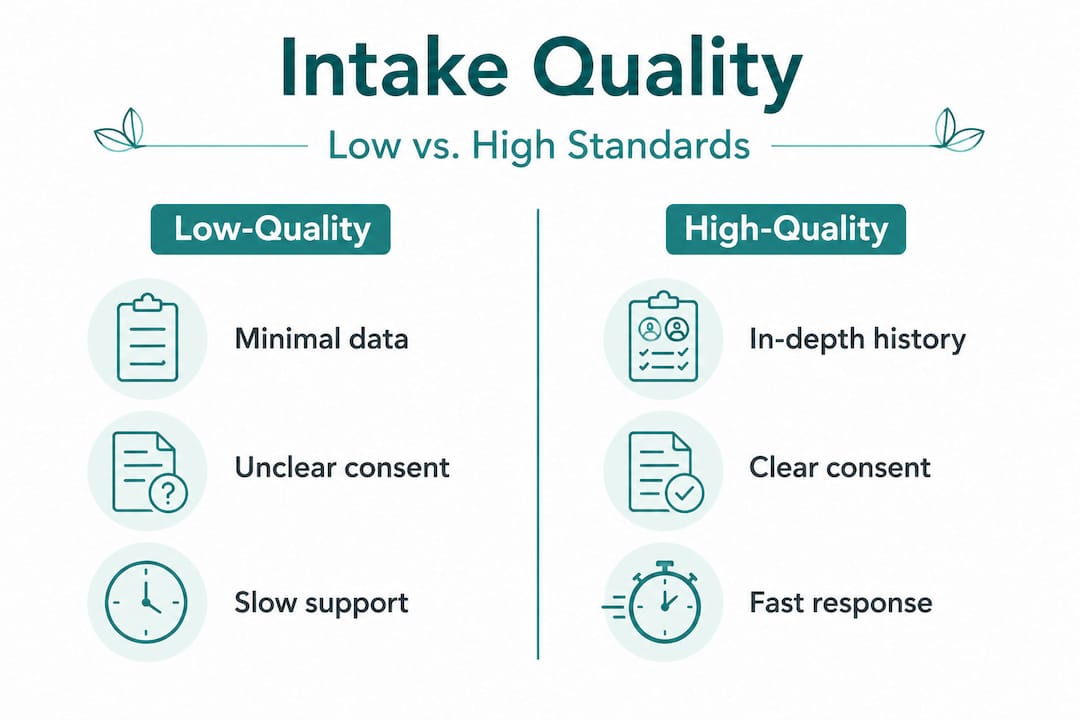
Comparison: Low-quality vs. high-quality telehealth intake
| Characteristic | Low-quality intake | High-quality intake |
|---|---|---|
| Form depth | Basic demographics only | Detailed history, medications, goals, lifestyle |
| Informed consent | Generic or absent | Specific to GLP-1 risks, benefits, side effects |
| Lab requirements | None requested | BMP, A1C, and relevant panels required |
| HIPAA compliance | Unclear data practices | Explicit, documented data security policies |
| Provider review | Automated approval only | Licensed clinician reviews all responses |
| Follow-up plan | No structured check-ins | Scheduled titration reviews and monitoring |
| Patient fit assessment | Not considered | Explicitly evaluated before treatment begins |
Understanding telehealth regulatory compliance matters here. Platforms operating with proper licensure and regulatory oversight are more likely to conduct thorough intakes because they are accountable to state medical boards and federal standards. For patients in rural or underserved areas, telehealth care access through quality platforms can make a significant difference in both safety and outcomes.
Informed consent is a particularly important element of quality intake. You should receive clear, written information about the medication being prescribed, its mechanism of action, known side effects, contraindications, and what to do if you experience an adverse reaction. If a platform offers GLP-1 therapy without reviewing these specifics with you first, that is a meaningful warning sign.
Pro Tip: Ask directly how your personal health information is stored, who has access to it, and whether it is ever shared with third parties. A reputable telehealth provider will answer these questions clearly and without hesitation.
How intake results shape your personalized weight care plan
So how do all those intake details actually influence your treatment and results? Here's what happens next.
The data collected during intake does not sit in a file. It actively shapes the clinical decisions that follow. A personalized GLP-1 dosing plan depends directly on what the provider learned about you during intake. Starting dose, titration speed, dietary recommendations, and monitoring frequency are all calibrated based on your specific profile.
Here is how intake information maps to each stage of your care:
- Medication selection: Your history with diabetes, kidney function, cardiovascular status, and prior weight loss attempts all inform whether Semaglutide or Tirzepatide is more appropriate, and in what form.
- Starting dose: Patients with sensitive gastrointestinal histories may begin at lower doses to reduce the risk of nausea or vomiting. Intake flags this before the prescription is written.
- Titration schedule: The pace at which your dose is increased depends on how your body responds. Intake establishes the baseline against which those responses are measured.
- Monitoring requirements: If intake reveals elevated blood pressure, pre-diabetes, or other metabolic concerns, more frequent follow-up visits and lab checks are built into the plan.
- Red flag identification: Certain responses during intake, such as a history of pancreatitis or thyroid cancer, trigger immediate clinical review. This is where intake functions as your primary safety screen.
"Standardized intake tools consistently improve outcomes in weight care. Patients whose care begins with thorough intake are more likely to remain on therapy safely and less likely to experience avoidable complications."
The future of telemedicine care increasingly relies on structured intake data to power more personalized, adaptive treatment pathways. As platforms integrate more sophisticated data tools, the initial intake becomes even more central to long-term success. You can also explore resources on personal care plan creation to understand how individualized planning works across different healthcare contexts. Ongoing follow-ups are essential for titration and for catching any issues before they become serious problems.
What most telemedicine patients (and even providers) miss about intake
With everything we've covered, here's an honest view of what really matters most in the intake process.
There is a tendency to treat clinical intake as a gate to pass through on the way to a prescription. That framing is understandable. When someone is motivated to start treatment, paperwork can feel like a delay. But thinking of intake that way misses its actual function.
Intake is your safety net. It is the one moment in the care process where everything about your health is laid out together in one place. A well-conducted intake does something that no single follow-up appointment can replicate. It gives the clinical team a complete picture before any medication enters your body.
Patients who rush through intake forms or provide vague answers often experience one of two outcomes: their care is delayed because the provider needs more information, or they receive a plan that is not optimally tailored to their situation. Neither outcome serves you well. We have observed that the patients who take the most time on their intake forms tend to have the smoothest treatment experiences. That is not a coincidence.
On the provider side, the risk is treating intake as routine. When a clinician reviews intake responses without genuine attention, subtle but important signals get missed. A patient who mentions mild heartburn in passing might actually be describing early gastrointestinal distress that warrants a modified starting dose. Patient fit, which refers to whether this specific treatment is genuinely appropriate for this specific person, should be assessed explicitly, not assumed.
The takeaway here is simple but important. A thorough, honest intake is not a bureaucratic obstacle. It is the single most protective step in your weight care journey. Treat your telehealth consultation experience as a true clinical encounter, not a screening to clear. Bring your questions, your medication bottles, your recent lab results if you have them, and your honest answers. That preparation pays forward into every step of your care.
Pro Tip: Treat your intake the way you would a first appointment with a specialist you have waited months to see. Bring documentation, prepare your questions, and give your provider everything they need to help you.
Take the next step with confidence: Get started with RenewMD
Ready to use what you've learned and start your journey? At RenewMD.clinic, the clinical intake process is built around patient safety, regulatory compliance, and genuine personalization. Every patient who starts with RenewMD goes through a thorough digital intake, a licensed clinician review, and lab coordination before any GLP-1 prescription is written. You can explore telehealth weight management to understand the full scope of what the program includes. If you want to know exactly how the prescription side works, the online prescription process page walks you through each step. No hidden fees, no shortcuts on safety. Just a structured, evidence-based path to a care plan that is actually built around you.
Frequently asked questions
How long does a telehealth clinical intake usually take?
The intake session for telemedicine weight care typically lasts 20 to 60 minutes, with the total process taking 24 to 72 hours from signup to prescription for most straightforward cases.
What medical information is collected during clinical intake?
Providers gather demographics, medical history, current symptoms, medications, and personal treatment goals to fully assess whether a given therapy is appropriate for you.
Are labs always required for GLP-1 weight care intake?
Most telemedicine providers require BMP and A1C lab results before initiating GLP-1 therapy, as these values reveal metabolic and kidney health that directly affects medication safety and dosing.
What safeguards protect my privacy during the clinical intake?
Reputable platforms use digital forms with HIPAA compliance, informed consent documentation, and encrypted data storage to protect every piece of personal health information you share.
Why is honesty so important during intake?
Complete and truthful responses help providers establish an accurate baseline for your care, identify contraindications early, and design a treatment plan that is both safe and effective for your specific health profile.