
Licensed U.S. clinicians are defined as healthcare professionals who hold state-issued authorization to assess, diagnose, treat, and prescribe within a regulated scope of practice. The role of licensed US clinicians in telehealth and weight management is not simply administrative. It is the legal and clinical foundation that makes medically supervised care possible at all. Without valid state licensure, a clinician cannot legally evaluate a patient, issue a prescription for GLP-1 medications like Semaglutide or Tirzepatide, or bill a payer for services rendered. Understanding what these professionals do, and why their credentials matter, is the first step toward choosing a telehealth program you can trust.
What defines the role of licensed US clinicians in healthcare?
The role of U.S. licensed clinicians spans four core functions: assessment, diagnosis, treatment, and prescribing. These are not interchangeable tasks. Each requires a specific credential, and each is governed by state law. A licensed physician (MD or DO) holds the broadest scope of practice. Certified Registered Nurse Practitioners (CRNPs) and Physician Assistants (PAs) operate within defined collaborative or supervisory agreements that vary by state. This distinction matters enormously in telehealth, where a clinician in one state may be serving a patient in another.
Licensure is the legal authority that constrains and enables interstate telehealth practice, according to the Federation of State Medical Boards. That means your clinician's credentials are not just a formality on a profile page. They are the mechanism through which accountability, complaint pathways, and standard-of-care expectations are enforced.
Licensed clinicians operate across hospitals, outpatient clinics, and telehealth platforms delivering care remotely. In weight management specifically, their duties of healthcare practitioners include conducting clinical intake evaluations, reviewing lab results, determining medication eligibility, and monitoring patient response to treatment over time.

Pro Tip: When evaluating any telehealth weight management program, ask specifically which licensed professional type will conduct your consultation. A CRNP may be fully qualified in your state, but the answer tells you whether the program has thought carefully about scope-of-practice compliance.
The licensed healthcare professional roles most commonly seen in telehealth weight management include:
- MD or DO: Full prescribing authority, medical director oversight, and final clinical accountability
- CRNP: Independent or collaborative prescribing depending on state rules, often the primary point of patient contact
- PA: Prescribing under physician supervision, with scope defined by state medical board regulations
- Registered Dietitian (RD): Nutritional counseling and behavioral support, not prescribing authority
Each role carries distinct legal weight. Misassigning clinical tasks to the wrong credential type is a scope-of-practice violation, not just a paperwork error.
How does state licensure govern telehealth practices?
State licensure is the single most consequential regulatory variable in telehealth. The governing rule is straightforward: telehealth clinicians must be licensed in the state where the patient is physically located at the time of the visit. Colorado's Uniform Telehealth Act makes this explicit. An out-of-state credential alone is insufficient. This means a clinician licensed only in Florida cannot legally treat a patient sitting in Ohio, regardless of the platform they use.
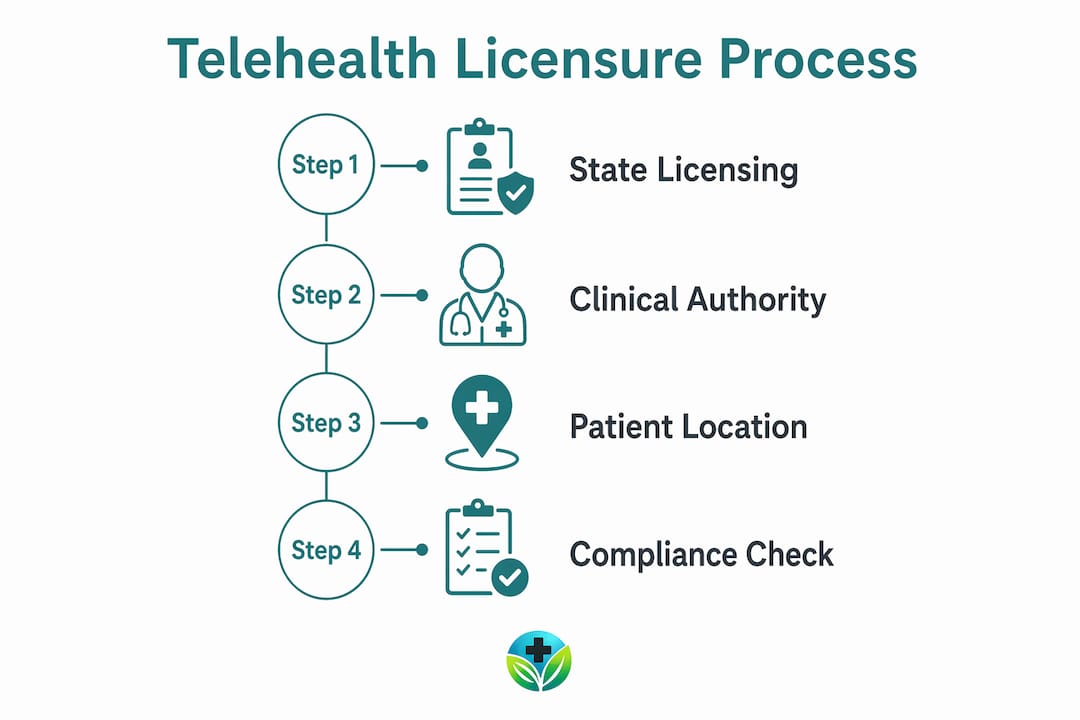
This jurisdiction rule has direct implications for how telehealth programs are structured. A program serving patients across 20 states must either employ clinicians licensed in each of those states or use a compact licensure mechanism. The Interstate Medical Licensure Compact (IMLC) allows eligible physicians to obtain licenses in multiple states more efficiently, but it does not eliminate the requirement. It accelerates the process.
The compliance obligations that flow from state licensure in telehealth include:
- Patient location documentation: The patient's physical location must be confirmed and recorded at every session, not just at enrollment.
- Prescribing authority verification: The clinician must hold prescribing rights in the patient's state, which may differ from their home state license.
- Privacy and documentation standards: State-specific rules on record retention, consent, and data handling apply based on patient location.
- Billing jurisdiction alignment: Claims submitted to Medicare or private payers must reflect a clinician licensed for the service in the relevant state.
- Supervision agreement compliance: CRNPs and PAs must operate under supervision or collaboration agreements that meet the patient's state requirements, not the clinician's home state.
A common and costly telehealth pitfall is the assumption that a clinician's home state license covers patients who have recently relocated or are traveling. Patient location at the time of service dictates jurisdiction, and that location must be documented meticulously at each encounter to avoid regulatory risk.
For patients, this structure provides meaningful protection. Licensed clinicians provide assurance of regulated standards and a clear recourse pathway if care falls below acceptable levels. That accountability does not exist with unlicensed or out-of-jurisdiction providers.
What is the role of licensed clinicians in telehealth weight management?
In telehealth weight management programs, the licensed physician serving as medical director is the clinical anchor of the entire operation. This is not a ceremonial title. Pennsylvania requires a state-licensed MD or DO exercising real, documented oversight in telehealth weight-loss clinics. That standard reflects a broader national expectation: medical directors must conduct chart reviews, establish clinical protocols, and maintain escalation pathways for complex or deteriorating cases.
The table below compares the clinical oversight responsibilities across the primary licensed roles in a telehealth weight management program:
| Role | Primary responsibility | Prescribing authority | Oversight requirement |
|---|---|---|---|
| MD / DO (Medical Director) | Clinical protocols, chart review, escalation | Full, independent | Accountable for program-wide compliance |
| CRNP | Patient consultations, medication management | Independent or collaborative (state-dependent) | May require physician collaboration agreement |
| PA | Patient consultations, follow-up care | Supervised prescribing | Requires physician supervision agreement |
| Registered Dietitian | Nutritional counseling, behavioral coaching | None | Licensed independently, no prescribing |
Medical directors in telehealth weight-loss clinics must provide more than nominal oversight. Their responsibilities include continuous case review, protocol adherence monitoring, and documented mechanisms for remote clinical escalation. This is the standard that separates a compliant program from one operating on paper compliance alone.
For GLP-1 therapies specifically, the prescribing clinician must evaluate contraindications, review relevant labs, and confirm that the patient's BMI and comorbidity profile meet clinical criteria. The telehealth consultation process for weight management is structured to fulfill these requirements before any prescription is issued. Skipping this step is not just a regulatory violation. It is a patient safety failure.
Pro Tip: Before starting any GLP-1 program through telehealth, confirm that the platform employs a licensed medical director who reviews clinical protocols, not just a clinician who signs off on individual prescriptions. The distinction reflects the depth of oversight you will receive throughout your treatment.
How does licensure affect telehealth billing and operational compliance?
Licensure is a prerequisite for reimbursement, not just a clinical credential. Medicare requires clinicians billing telehealth services to hold valid state licenses for the specific service being billed. CMS enforces this through licensure verification tied to payment eligibility, covering services from pharmacologic management to behavioral health. An unlicensed or out-of-jurisdiction provider submitting a claim risks denial and potential fraud liability.
The operational implications for multi-state telehealth programs are significant. Licensing verification must be integrated into both the clinical intake workflow and the revenue cycle process. This is not a one-time credentialing check. It is an ongoing operational function. Telehealth organizations must verify licensing and assign clinical roles consistent with payer and state regulations at the point of each patient encounter.
Key operational compliance requirements for licensed telehealth clinicians include:
- Credentialing alignment: Each clinician's license must be verified against the patient's state before a visit is scheduled or a claim is filed.
- Scope-of-practice mapping: Billing codes must match the clinical role of the provider. A PA billing under a physician's NPI without proper supervision documentation creates both legal and financial exposure.
- Ongoing license monitoring: State licenses expire and can be suspended. Programs need automated monitoring to catch lapses before they affect patient care or billing.
- Payer-specific rules: Private payers often impose additional credentialing requirements beyond state licensure. These must be tracked separately from Medicare compliance.
Billing denial risks arise directly when clinicians lack appropriate state authorization, linking licensing compliance to financial operations in a concrete way. For patients, this matters because a program with poor licensure management may face service interruptions, billing errors, or gaps in care coverage that affect you directly. You can learn more about how state licensing affects GLP-1 access across different telehealth programs.
Key takeaways
Licensed U.S. clinicians are the legal and clinical foundation of telehealth weight management, with state licensure governing every aspect of prescribing authority, patient safety, and billing eligibility.
| Point | Details |
|---|---|
| Licensure defines clinical authority | MDs, DOs, CRNPs, and PAs each hold distinct, state-regulated scopes of practice that determine what care they can legally provide. |
| Patient location governs jurisdiction | The patient's physical location at the time of service determines which state's licensure rules apply, not the clinician's home state. |
| Medical directors carry real accountability | In weight management telehealth, licensed physician medical directors must conduct chart reviews, set protocols, and manage escalation pathways. |
| Licensure directly affects billing | Medicare and private payers require valid state licensure for reimbursement; unlicensed providers face claim denials and legal exposure. |
| Compliance is an ongoing operation | Licensure verification must be integrated into intake and revenue cycle workflows, not treated as a one-time credentialing step. |
Why licensure in telehealth weight management deserves more scrutiny than it gets
I have spent considerable time reviewing how telehealth weight management platforms present their clinical credentials to prospective patients. The pattern I see most often is this: a platform lists "licensed clinicians" as a feature, as if the phrase itself is sufficient reassurance. It is not. The licensed clinician importance in this context lies not in the credential existing, but in how it is operationalized across every patient interaction.
What concerns me most is the gap between nominal compliance and genuine clinical oversight. A medical director who reviews a protocol document once a year and signs off on a template is technically licensed. That is not the same as a physician who conducts regular chart reviews, monitors adverse event patterns, and maintains a real escalation pathway for patients on Semaglutide or Tirzepatide who develop complications. These are different levels of care, and patients deserve to know which one they are receiving.
The multi-state complexity of telehealth also creates quiet risks that most patients never think to ask about. If your clinician is licensed in Texas and you are visiting family in New York when you need a follow-up, the jurisdictional picture changes. Programs that have not built licensure verification into their operational workflows will either serve you out of compliance or leave you without care at a critical moment. Neither outcome is acceptable.
What I find encouraging is that platforms designed from the ground up with compliance as a structural priority, rather than a checkbox, are raising the standard. The regulatory compliance framework for telehealth weight care is maturing, and patients who ask the right questions will find programs that meet it.
— Raymond
How RenewMD delivers licensed clinician oversight for weight management
RenewMD is built on the principle that licensed clinician oversight is not a feature. It is the baseline. Every patient who begins a weight management program through RenewMD is evaluated by a licensed U.S. clinician operating within the appropriate state jurisdiction. Medical directors provide documented oversight of clinical protocols, and prescribing of GLP-1 medications like Semaglutide and Tirzepatide follows evidence-based criteria verified at intake. Licensure verification is integrated into the platform's operational workflow, not handled as an afterthought. If you are ready to begin medically supervised weight management with transparent, compliant clinical oversight, start your program with RenewMD today.
FAQ
What does a licensed US clinician do in a telehealth visit?
A licensed U.S. clinician conducts a clinical assessment, reviews your health history and labs, diagnoses relevant conditions, and prescribes treatment within their state-authorized scope of practice. In telehealth weight management, this typically includes evaluating GLP-1 medication eligibility and monitoring your response to treatment.
Why does the patient's location matter for telehealth licensure?
Telehealth clinicians must be licensed in the state where the patient is physically located at the time of the visit. A clinician's home state license does not extend to patients in other states, so your physical location at each session determines which licensure rules apply.
Can a nurse practitioner prescribe weight loss medications through telehealth?
Yes, in most states a Certified Registered Nurse Practitioner can prescribe GLP-1 medications like Semaglutide or Tirzepatide, either independently or under a physician collaboration agreement depending on state law. The specific authority varies by state, so the program you choose must verify the CRNP's prescribing rights in your state.
How does clinician licensure affect Medicare telehealth billing?
Medicare requires valid state licensure for every telehealth service billed, and CMS enforces this through licensure verification tied to payment eligibility. Clinicians without proper state authorization face claim denials and potential compliance liability.
What is a medical director's role in a telehealth weight management program?
A licensed physician medical director provides clinical oversight for the entire program, including establishing treatment protocols, conducting chart reviews, and maintaining escalation pathways for complex cases. This role goes beyond signing prescriptions and is a regulatory requirement in states like Pennsylvania for telehealth weight-loss clinics.