
Most people assume a telehealth prescription works exactly like one written in a doctor's office. That assumption is mostly right, but the details matter more than you might expect. Explaining telehealth prescriptions clearly means confronting a patchwork of federal law, state-level rules, medication categories, and technology requirements that shape whether a remote provider can legally prescribe to you at all. This guide covers the full picture, from how the telehealth prescription process actually works to which medications require an in-person visit first, to the safety considerations every patient should understand before their next virtual appointment.
Table of Contents
- Key takeaways
- How telehealth prescriptions work
- Legal and regulatory framework
- Eligibility and medications commonly prescribed via telehealth
- Safety and practical tips for patients
- Telehealth vs. traditional prescriptions
- My perspective on what patients consistently misunderstand
- How Renewmd approaches telehealth prescriptions for weight care
- FAQ
Key takeaways
| Point | Details |
|---|---|
| Telehealth prescriptions are legally valid | Remote prescriptions carry the same legal weight as in-person ones when the provider meets licensing and documentation requirements. |
| Controlled substances have extra rules | The Ryan Haight Act generally requires at least one in-person evaluation before a provider can prescribe Schedule II-V medications remotely. |
| Provider licensing is state-specific | Your telehealth provider must hold an active license in the state where you are physically located at the time of the visit. |
| E-prescriptions reach pharmacies fast | Over 95% of U.S. pharmacies accept electronic prescriptions, with most processed within 15 to 30 minutes. |
| Questionnaires alone are not enough | Most states require a live audio or video encounter, not just an online form, to establish a valid prescribing relationship. |
How telehealth prescriptions work
Understanding telehealth prescriptions starts with what actually happens during a virtual visit. The process is more structured than many people expect.
A typical telehealth encounter begins with a scheduled appointment through a platform's secure portal. You connect with a licensed provider using a video call, though audio-only visits are permitted for Medicare patients who cannot or choose not to use video, under specific conditions that took effect January 1, 2025. During the visit, your provider reviews your symptoms, medical history, current medications, and any relevant lab results you have submitted in advance.

Once the provider completes their clinical evaluation, they make a prescribing decision. If a prescription is appropriate, they transmit it electronically, directly to your chosen pharmacy. This is called electronic prescribing, or e-prescribing, and it bypasses paper entirely. The pharmacy receives the order in minutes and begins processing.
Here is what the standard telehealth prescription process looks like from start to finish:
- Schedule and intake: You complete a clinical intake form before your appointment, providing your health history, allergies, and current medications.
- Synchronous consultation: A live audio or video encounter with a licensed provider takes place. This step is legally required in most states for a valid prescribing relationship.
- Clinical evaluation: The provider assesses your condition and determines whether a prescription is medically appropriate.
- Electronic transmission: The prescription is sent directly to the pharmacy of your choice using a secure e-prescribing system.
- Pharmacy processing: Most pharmacies process telehealth e-prescriptions within 15 to 30 minutes, meaning you can often pick up your medication within the hour.
The key difference from an in-person workflow is the absence of a physical handoff. There is no paper prescription, no waiting room, and no driving to a clinic. The clinical rigor, however, is expected to match what an in-person provider would apply.
Legal and regulatory framework
The legal side of telemedicine prescriptions explained simply: federal law sets a baseline, and each state builds on top of it. Some states are more permissive. Others are significantly stricter.
At the federal level, the Ryan Haight Act governs how controlled substances can be prescribed via telehealth. The law requires at least one in-person evaluation before a practitioner can prescribe Schedule II through Schedule V controlled substances remotely. Schedule II medications include opioids and stimulants like amphetamines. Schedule III through V include medications like buprenorphine and certain benzodiazepines. The act was designed to prevent so-called "pill mills" from operating purely online, and it remains the central federal constraint on remote prescribing.
There are seven federal exceptions that allow controlled substance prescribing without an in-person visit. These include prescribing within a DEA-registered hospital or clinic, treatment of a patient in a long-term care facility, and situations where the prescribing practitioner is physically present with the patient regardless of technology. Importantly, the COVID-era waivers that temporarily suspended the in-person requirement for controlled substances expired in 2023. The DEA's proposed Special Registration process, which would have allowed broader remote prescribing of controlled substances, remains unpublished as of April 2026. That regulatory uncertainty is real and affects many patients and providers today.
| Medication Type | In-Person Requirement | Notes |
|---|---|---|
| Non-controlled medications | Not federally required | State laws may still apply |
| Schedule II (e.g., stimulants, opioids) | Yes, at least once | Ryan Haight Act applies |
| Schedule III-V (e.g., buprenorphine) | Yes, with limited exceptions | Exceptions are narrowly defined |
| Mental health medications (non-controlled) | Generally not required | Synchronous visit still needed |
Beyond the federal layer, telehealth prescribing rules vary significantly by the patient's physical location, the medication category, and the prescriber's state licensure. A provider licensed only in Texas cannot prescribe to a patient located in Ohio, even if the consultation is conducted entirely online. Most states also require that providers check the Prescription Drug Monitoring Program (PDMP) database before issuing any controlled substance, regardless of whether the visit was virtual or in person. PDMP checks are a critical safety layer designed to prevent duplicate prescriptions across multiple providers.
Pro Tip: Before scheduling any telehealth visit, confirm that your provider holds an active, unrestricted license in the state where you will physically be at the time of the appointment. This is a legal requirement, not just a formality.
Eligibility and medications commonly prescribed via telehealth
Telehealth is not a one-size-fits-all prescribing channel. Whether a medication can be prescribed remotely depends heavily on its classification and the clinical circumstances.
Non-controlled medications are the most straightforward. Antibiotics, blood pressure medications, thyroid treatments, GLP-1 receptor agonists like Semaglutide and Tirzepatide, and many chronic disease medications can all be prescribed via telehealth after a valid synchronous consultation. These prescriptions face no federal controlled substance barriers, though the provider still must conduct a proper clinical evaluation.
Controlled substances require more safeguards:
- Opioids (Schedule II): Require an initial in-person evaluation under the Ryan Haight Act. Once that threshold is met, ongoing telehealth management of the same patient by the same practitioner is generally permitted.
- Stimulants (Schedule II): Medications like Adderall and Ritalin fall under the same in-person requirement. Platforms that advertise ADHD treatment via telehealth must comply with these rules.
- Buprenorphine (Schedule III): Used for opioid use disorder, buprenorphine has its own regulatory framework. While pandemic-era flexibility allowed remote initiation, those rules have largely been wound back as of 2023.
- Benzodiazepines (Schedule IV): Anti-anxiety medications like alprazolam are subject to both the Ryan Haight Act and state-level prescribing restrictions.
Mental health care is a useful example of where telehealth is highly effective for medication management and building patient-provider trust, but where non-controlled medications such as SSRIs, SNRIs, and antipsychotics are significantly easier to prescribe remotely than stimulants or sedatives. A psychiatrist can initiate Sertraline via telehealth with a valid synchronous evaluation. Starting Adderall requires a prior in-person visit.
Dermatology is one field that uses asynchronous prescribing extensively. Patients submit photos of skin conditions, and a dermatologist reviews them without a live encounter, then sends a prescription. Most states permit this for appropriate non-controlled topical medications.
Safety and practical tips for patients
Navigating telehealth prescriptions safely comes down to preparation and knowing what to verify before and after your visit.
- Verify your provider's license. Check that the telehealth provider holds an active license in your state. Many states have online license lookup tools through their medical board websites.
- Prepare your medical history in advance. Bring a current list of all medications, including over-the-counter supplements, known allergies, and any recent lab results. Providers can prepare more effectively when intake information is complete.
- Confirm pharmacy acceptance. While most U.S. pharmacies accept e-prescriptions from telehealth providers, call ahead if your medication is specialized or if you use a small independent pharmacy.
- Avoid platforms that rely on questionnaires alone. Most states do not consider an online form sufficient to establish a prescribing relationship. If there is no live encounter, the prescription may not be legally valid.
- Understand limitations for complex conditions. Telehealth cannot replace care that requires a physical examination, such as diagnosing a fracture, performing a pelvic exam, or conducting a neurological assessment.
Pro Tip: Ask your telehealth provider directly whether they will conduct a PDMP check before issuing any controlled substance. A provider who is unaware of or unwilling to perform this check is a red flag for regulatory compliance.
Telehealth vs. traditional prescriptions
Understanding the benefits of telehealth prescriptions means honestly comparing them with what in-person care offers. The differences are meaningful, but not always in the direction people assume.
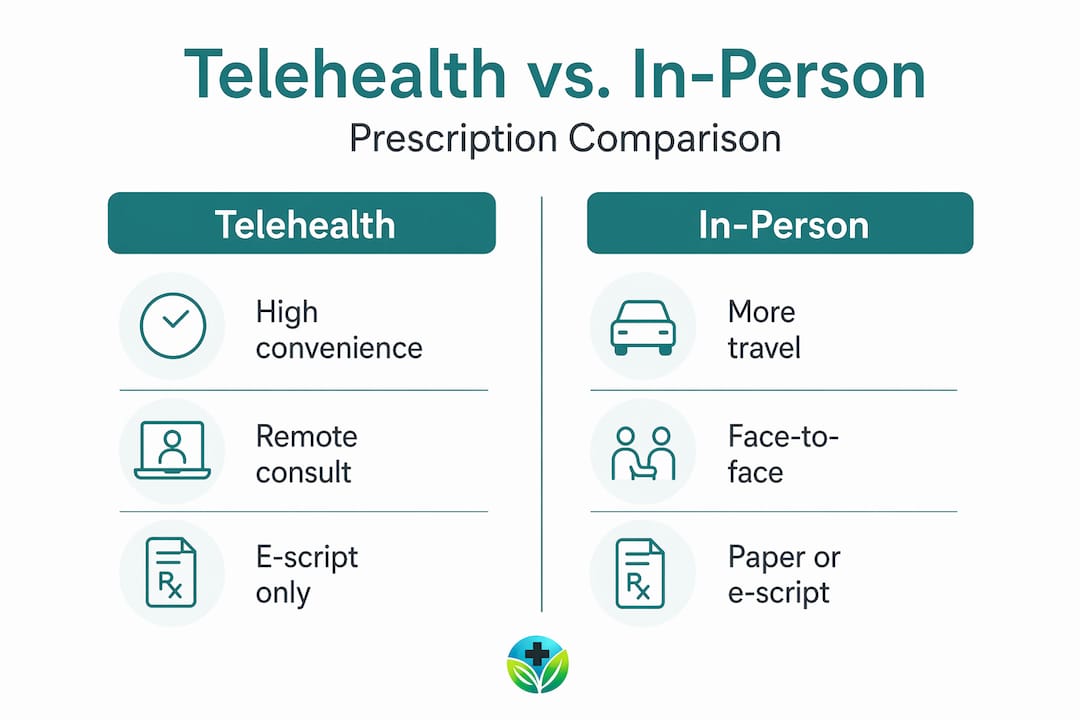
| Factor | Telehealth Prescribing | In-Person Prescribing |
|---|---|---|
| Convenience | High, no travel required | Lower, requires physical visit |
| Controlled substance access | Restricted by Ryan Haight Act | No federal telehealth restriction |
| Prescription speed | E-prescription in minutes | Paper or e-prescription at visit |
| Provider-patient relationship | Built over time via video | Established in person from first visit |
| Geographic access | Broad, including rural areas | Limited by local provider availability |
| Asynchronous prescribing | Possible for some conditions | Not applicable |
The accessibility advantage of telehealth is particularly significant for patients in rural or underserved areas. Many regions have limited numbers of specialists, and telehealth access to dermatologists, psychiatrists, and endocrinologists can make a measurable difference in patient outcomes. GLP-1 telehealth access has opened weight management care to patients who previously had no local access to a specialized program.
The main limitations are legal, not technological. The Ryan Haight Act's restrictions on controlled substances, state-specific licensing walls, and the requirement for synchronous encounters all create real friction. When in-person care is legally required or clinically necessary, telehealth is not a substitute. It is a complement.
My perspective on what patients consistently misunderstand
I've spent considerable time working through how telemedicine regulations apply in clinical practice, and one pattern stands out clearly. Patients and even some providers treat the Ryan Haight Act's in-person requirement as a bureaucratic inconvenience rather than as a genuine patient safety standard with real legal teeth. That framing is a mistake.
What I've found is that the confusion runs deeper than the law itself. Many people arrive at a telehealth appointment expecting the same frictionless experience they get when ordering a product online. When a provider declines to prescribe a controlled substance remotely because no prior in-person visit has occurred, patients often assume the provider is being overly cautious. In reality, that provider is following federal law correctly.
The regulatory environment is also still evolving in ways patients should track. The DEA's Special Registration framework has been in discussion for years and remains unavailable. Any platform currently advertising unlimited remote controlled substance prescribing without an in-person threshold deserves close scrutiny. The safest approach is to understand your specific state's rules and choose providers who document their compliance clearly.
What patients can do is straightforward: ask questions, verify credentials, and treat a telehealth consultation with the same seriousness as an office visit. The convenience is real. So is the responsibility to use it carefully.
— Raymond
How Renewmd approaches telehealth prescriptions for weight care
Renewmd operates at the intersection of telehealth access and evidence-based weight management, with licensed U.S. clinicians prescribing GLP-1 medications including Semaglutide and Tirzepatide through a fully compliant, all-digital process. Every step from clinical intake and provider consultation to lab testing and pharmacy delivery is designed to meet state and federal prescribing standards without hidden fees or complicated billing. If you are considering medically supervised weight care through telehealth, Renewmd's weight loss telemedicine program offers a transparent, regulated path. You can also start your assessment directly to see whether you are eligible for a GLP-1 prescription through a telehealth provider licensed in your state.
FAQ
How does a telehealth prescription get sent to the pharmacy?
After a valid virtual consultation, the provider transmits the prescription electronically to your chosen pharmacy using a secure e-prescribing system. Over 95% of U.S. pharmacies accept e-prescriptions, and most process them within 15 to 30 minutes.
Can a telehealth provider prescribe controlled substances?
A telehealth provider can prescribe controlled substances, but the Ryan Haight Act requires at least one prior in-person evaluation for Schedule II through V medications unless a specific federal exception applies. Once that threshold is met, ongoing remote management is generally allowed.
Does my telehealth provider need to be licensed in my state?
Yes. Providers must hold an active, unrestricted license in the state where you are physically located at the time of the telehealth visit. A provider licensed in a different state cannot legally prescribe to you.
Is an online questionnaire enough for a telehealth prescription?
No. Most states require a synchronous audio or audio-visual encounter to establish a valid patient-provider relationship for prescribing. A questionnaire alone does not meet the legal standard in most jurisdictions.
What medications are easiest to get via telehealth?
Non-controlled medications, including antibiotics, blood pressure drugs, GLP-1 receptor agonists, and many mental health medications like SSRIs, are generally straightforward to prescribe via telehealth after a live consultation, as they are not subject to the Ryan Haight Act's in-person requirements.