

Many people assume that getting a GLP-1 prescription through a telehealth provider is a purely digital experience, disconnected from the pharmacies they already know and trust. That assumption is increasingly outdated. Major U.S. pharmacy chains like Walgreens and CVS now integrate telehealth directly into their weight management services, offering virtual clinician visits, GLP-1 prescriptions, and seamless pharmacy fulfillment all in one connected system. Understanding how this integration actually works, and why it matters for your safety and results, can fundamentally change how you approach medically supervised weight loss.
Table of Contents
- How pharmacies integrate with telehealth for weight management
- The pharmacist's expanding role: Care, titration, and safety
- Why pharmacy-telehealth programs offer safer, more accessible GLP-1 care
- Real results: Telehealth-pharmacy programs improve outcomes
- What most articles miss about pharmacies in telehealth
- Start your pharmacy-integrated telehealth weight journey
- Frequently asked questions
Key Takeaways
| Point | Details |
|---|---|
| Pharmacies central to telehealth | Large pharmacy chains now power telehealth weight care from prescription to delivery. |
| Pharmacists improve safety | Pharmacists provide ongoing titration, monitoring, and support for GLP-1 medications. |
| Choose licensed providers | Using regulated pharmacies lowers your risk compared to unlicensed compounded telehealth sources. |
| Integrated care boosts results | Pairing pharmacy fulfillment and behavioral support via telehealth leads to more sustained weight loss outcomes. |
How pharmacies integrate with telehealth for weight management
The modern telehealth-pharmacy workflow is simpler than most people expect, and far more connected than it used to be. When you use an integrated platform, you are not bouncing between separate systems. You are moving through a single, coordinated care experience.
Here is what that workflow typically looks like in practice:
- Schedule a virtual visit online or through an app, often same-day.
- Meet with a licensed clinician via video, who reviews your health history and goals.
- Receive a GLP-1 prescription (such as Semaglutide or Tirzepatide) sent electronically.
- Choose your fulfillment method: in-store pickup or home delivery through your preferred pharmacy.
- Begin treatment with access to ongoing provider follow-up and pharmacist support.
Walgreens and CVS now offer this type of integrated weight management service, pairing virtual clinician visits with GLP-1 prescriptions and pharmacy delivery. The Walgreens weight management program, for example, offers $49 video visits with no subscription required, and prescriptions can be sent to any pharmacy, including Walgreens itself, for pickup or delivery, available in most states for self-pay adults aged 18 to 64.
Key benefits of this integrated model include:
- Convenience of virtual visits without leaving home
- Transparent, no-surprise pricing on consultations
- Access to regulated, name-brand or licensed medications
- Flexible pharmacy options (mail-order or local pickup)
- Self-pay access where employer insurance coverage for GLP-1s remains limited
| Feature | Integrated pharmacy-telehealth | Standalone telehealth |
|---|---|---|
| Prescription fulfillment | Seamless, in-system | Manual, separate steps |
| Pharmacist access | Built-in | Limited |
| Medication verification | On-site regulatory oversight | Variable |
| Self-pay options | $49 visits widely available | Varies by provider |
| Delivery options | Mail-order and pickup | Mail-order only (often) |
The self-pay model is particularly meaningful. Employer-sponsored insurance plans cover GLP-1 medications at surprisingly low rates, making out-of-pocket access through pharmacy-telehealth programs a practical option for many adults. These programs also expand access to virtual weight management programs for people who live far from obesity medicine specialists or who simply cannot take time off work for in-person visits.
Pro Tip: When starting any telehealth weight management program, ask your provider directly whether they can send your prescription to your preferred pharmacy. Most integrated platforms are flexible, and knowing your options upfront prevents delays in starting treatment.
The pharmacist's expanding role: Care, titration, and safety
Having seen how pharmacies fit into the telehealth workflow, let's spotlight what pharmacists themselves bring to modern weight care. The pharmacist's role has quietly become one of the most clinically important in GLP-1 treatment. Yet most patients never fully use it.
Pharmacists on integrated telehealth platforms are not simply dispensing medication and sending you on your way. They are actively involved in titration (the process of gradually adjusting your dose to the level that works best for your body while minimizing side effects), ongoing monitoring, and patient education. This is especially important with GLP-1 receptor agonists, which require careful dose escalation protocols over weeks or months.
Pharmacist-led titration has measurable clinical impact. In a primary care study with 120 participants, pharmacist-led GLP-1 titration reduced HbA1c (a marker of blood sugar control) by 1.8% and produced an average weight reduction of 8.1 kilograms. These are not trivial numbers. They represent real clinical improvement driven directly by pharmacist involvement in ongoing care, not just initial dispensing.
Here is how pharmacist support typically unfolds from prescription to follow-up:
- Prescription review: The pharmacist verifies the prescribed GLP-1 medication, confirms appropriate dosing for the patient's health profile, and checks for drug interactions.
- Patient education: The pharmacist explains injection technique (for injectable options like Semaglutide), storage requirements, and what side effects to expect during the initial weeks.
- Titration monitoring: At scheduled intervals (often every 4 weeks), the pharmacist or clinical team reviews how the patient is tolerating the current dose and whether escalation is appropriate.
- Side effect management: If nausea, fatigue, or gastrointestinal discomfort arises, the pharmacist can advise on dietary adjustments or flag the need for a provider consultation.
- Adherence support: Regular pharmacist check-ins reduce the likelihood that patients will stop medication prematurely due to manageable side effects.
"Pharmacist-led GLP-1 titration in a collaborative primary care setting reduced HbA1c by 1.8% and weight by 8.1 kg over the treatment period, underscoring the clinical value of pharmacist involvement beyond medication dispensing." — Published findings on pharmacist-led titration
If you are in the process of talking to your provider about GLP-1 options, it is worth asking specifically about pharmacist collaboration in your care plan. Not every platform offers this level of integration, but the ones that do tend to produce meaningfully better outcomes.
Pro Tip: Ask your telehealth-partnered pharmacy if one-on-one pharmacist consultations are available, either by phone, video, or secure messaging. Many pharmacies offer this at no additional cost, and it can significantly improve your experience during the early weeks of GLP-1 therapy when side effects are most common.
Why pharmacy-telehealth programs offer safer, more accessible GLP-1 care
Pharmacists provide clinical depth, but not all telehealth solutions are equal. Let's compare pharmacy-based programs to compounded and online alternatives so you can make a genuinely informed decision.
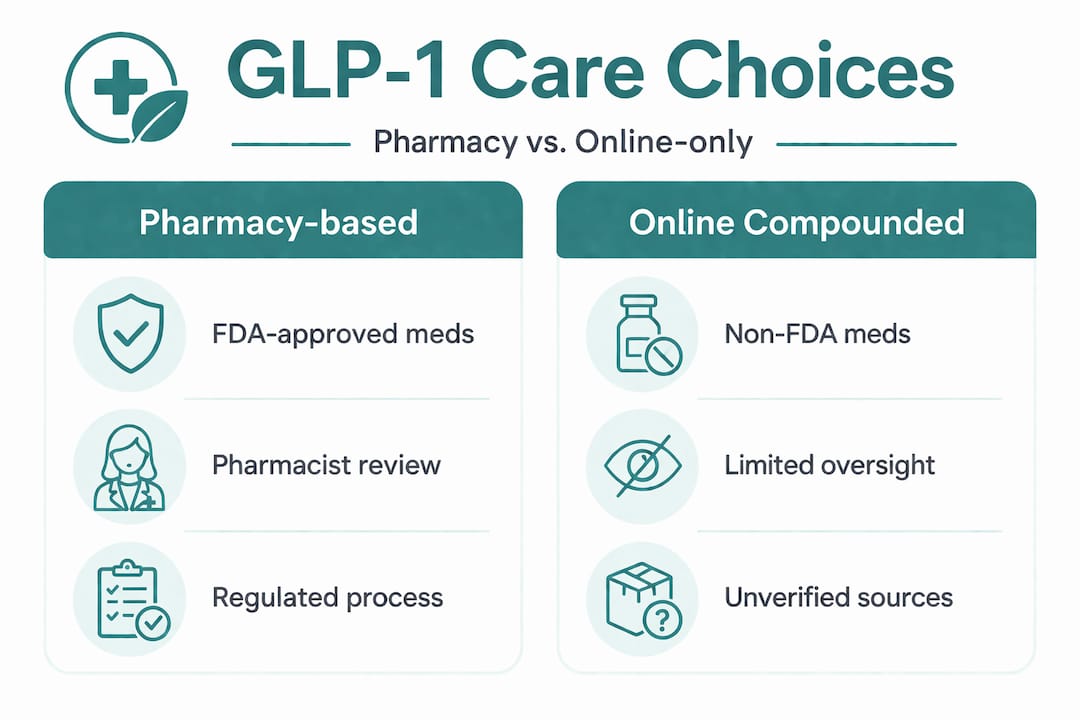
The market for GLP-1 medications has grown rapidly, and with that growth has come a wave of online-only telehealth services offering compounded versions of Semaglutide and Tirzepatide. These compounded medications are not FDA-approved formulations. They are copies produced by compounding pharmacies, and the quality and safety standards can vary significantly from one provider to the next.
Compounded GLP-1s from some telehealth providers carry real risks when sourced from unlicensed or inadequately regulated compounding pharmacies, including contamination and dosing inconsistencies. This is not a theoretical concern. It has been flagged repeatedly by patient safety advocates and regulatory bodies.
Safety checklist: What to verify before starting any online GLP-1 program
- Confirm the pharmacy holds a current state pharmacy license
- Verify sterile compounding credentials if compounded medications are offered
- Check that a licensed U.S. clinician (not just an automated system) reviews your intake
- Confirm there is a real clinical escalation pathway if side effects develop
- Look for transparent pricing with no hidden subscription fees
- Ensure the provider has a clear protocol for medication shortages or formula changes
| Factor | Regulated pharmacy-telehealth | Online-only compounded provider |
|---|---|---|
| Medication source | FDA-approved formulations | Compounded copies (variable quality) |
| Pharmacy oversight | State and federal regulation | Variable; some unlicensed |
| Clinician involvement | Licensed U.S. providers | Variable; sometimes algorithm-driven |
| Pharmacist access | Yes, in-person or virtual | Rare or absent |
| Subscription fees | Often none ($49 visits) | Frequently bundled in subscriptions |
| Side effect support | Structured follow-up | Often limited |
Pharmacy chains operating integrated telehealth programs are positioned as more regulated, more transparent options compared to many compounded-only services. They do not require subscriptions, they operate under extended hours, and they involve real human clinical contact at every stage.
If you are considering getting GLP-1 prescribed online, understanding the distinction between regulated pharmacy-integrated programs and lower-oversight alternatives is critical. Similarly, if a provider offers compounded medications, reviewing compounded medication quality standards before agreeing to treatment is a step worth taking.
Real results: Telehealth-pharmacy programs improve outcomes
Why does integration matter? Because well-designed pharmacy-telehealth solutions actually drive better results. Here's what the numbers show.
The clinical evidence supporting pharmacy-integrated telehealth programs for weight management has grown substantially over the past two years. What stands out most clearly is that combining GLP-1 prescriptions with structured behavioral support and pharmacist involvement produces results that significantly exceed what medication alone typically achieves.
Telehealth GLP-1 programs with behavioral support produced an average weight loss of 12.3% at 6 months, with over two-thirds of participants losing more than 10% of their body weight. Systolic blood pressure (the top number in a blood pressure reading) dropped by an average of 11.17 mmHg, a clinically meaningful reduction that lowers cardiovascular risk.
"At 6 months, patients enrolled in a telehealth GLP-1 program with integrated behavioral support achieved an average 12.3% reduction in body weight and an 11.17 mmHg drop in systolic blood pressure, with more than two-thirds of participants losing over 10% of total body weight." — Presented at ADA 2025
What these outcomes mean for you in practical terms:
- Sustained weight loss: A 12.3% reduction for a 220-pound person equals roughly 27 pounds at 6 months, a result rarely achieved without both medication and behavioral accountability.
- Improved blood pressure: Dropping systolic BP by over 11 points moves many patients out of hypertension risk categories without requiring additional medication.
- Higher program completion rates: Integrated support structures keep patients engaged longer, reducing the early dropout that is common when people manage GLP-1 therapy without adequate clinical backing.
- Better adherence: Regular pharmacist and provider contact makes it more likely patients follow through on titration schedules and address side effects before they become reasons to quit.
- Whole-health improvement: Weight loss of this magnitude tends to improve sleep, mobility, joint pain, and metabolic markers beyond blood sugar alone.
| Outcome metric | Telehealth GLP-1 with behavioral support | Medication alone (typical) |
|---|---|---|
| Average weight loss at 6 months | 12.3% | 6 to 8% |
| Patients losing >10% body weight | >66% | ~30 to 40% |
| Systolic BP reduction | 11.17 mmHg | Modest/variable |
| Adherence at 6 months | High (integrated follow-up) | Lower without support |
Reviewing evidence-based telehealth weight care approaches alongside these outcome data points makes a clear case: the structure matters as much as the medication. More information on telehealth weight management outcomes confirms that programs with ongoing clinical contact consistently outperform one-time prescription models.
What most articles miss about pharmacies in telehealth
Most coverage of telehealth weight management focuses on speed and convenience. "Get a GLP-1 prescription in 24 hours." "No in-person visits required." That framing is not wrong, but it tells only part of the story. And the part that gets left out is often the part that determines whether you actually succeed.
The real value of pharmacy integration is not the convenience of home delivery. It is the clinical safety net that a well-integrated pharmacy creates. When a licensed pharmacist is actively involved in your titration schedule, they catch problems early. They notice when a dose escalation is too aggressive. They ask how you are tolerating the medication at week 4, before you have decided quietly to stop because the side effects felt unmanageable.
Pharmacies bridge telehealth gaps through integrated virtual prescribing, fulfillment, delivery, and pharmacist-led monitoring and titration for sustained weight management. That bridging function is what online-only compounded GLP-1 providers often cannot match. They can ship medication quickly. What they frequently lack is the structured clinical oversight that turns a prescription into a sustained outcome.
The uncomfortable reality is that GLP-1 therapy without adequate follow-up has a high discontinuation rate. Studies suggest that a significant portion of patients stop these medications within the first few months, often because of side effects that could have been managed with better clinical support. The providers who minimize follow-up to reduce cost are, in effect, reducing your chances of long-term success.
Our perspective: do not evaluate telehealth weight care programs based primarily on price per visit or speed of prescription. Ask how pharmacist involvement is structured. Ask what happens when you experience side effects at week 3. Ask whether your titration schedule is reviewed by a human clinician or generated automatically. The answers to those questions will tell you far more about your likely outcomes than the price tag will.
For additional perspective on integrated GLP-1 care insights and the full picture of what effective GLP-1 management involves, reviewing evidence-based educational resources is a practical first step.
Pro Tip: Before committing to any telehealth weight program, ask directly: "Who reviews my medication response between visits, and how?" If the answer is vague or automated, that is meaningful information about the level of care you can expect.
Start your pharmacy-integrated telehealth weight journey
If you are seeking effective, medically supervised weight management, the quality of your pharmacy partnership matters as much as the medication itself. RenewMD partners with licensed U.S. pharmacies to ensure that every step of your care, from clinical intake to medication delivery, is connected, regulated, and backed by real human oversight. There are no hidden fees, no disconnected prescription handoffs, and no gaps in clinical support. Explore the medical weight loss telemedicine guide to understand exactly what a well-structured program looks like, or learn more about telehealth and virtual weight management options available through RenewMD to take your next step with confidence.
Frequently asked questions
Can I choose which pharmacy fills my telehealth-prescribed weight loss medication?
Yes, most telehealth weight management programs let you select your preferred pharmacy for pickup or delivery after your provider sends the prescription. For example, Walgreens telehealth prescriptions can be sent to any pharmacy, including Walgreens, for convenient pickup or home delivery.
Are compounded GLP-1 medications safe through telehealth?
Compounded GLP-1s from some telehealth providers carry risks if the pharmacy is unlicensed. Compounded GLP-1 safety concerns include contamination and dosing inconsistencies, so always verify proper sterile compounding credentials before starting treatment.
Do I need insurance to use pharmacy-integrated telehealth programs for weight management?
No, self-pay options are widely available and make pharmacy-telehealth accessible even without insurance coverage. Programs like Walgreens offer $49 per visit with no subscription required, which is particularly valuable given that fewer than 25% of employers currently cover GLP-1 medications.
What advantages do pharmacies offer over online-only telehealth medication services?
Pharmacies offer regulatory oversight, face-to-face or virtual pharmacist counseling, and safer prescription fulfillment. Pharmacy chains like Walgreens and CVS are positioned as more regulated options compared to compounded telehealth services, with no subscription fees, extended hours, and genuine clinical contact built into the process.