

Telemedicine has not simplified the licensing requirements for clinicians. If anything, it has made them more layered. Many healthcare professionals and policy makers assume that delivering care virtually reduces regulatory complexity, but the role of licensed clinicians in telemedicine is governed by the same legal and clinical standards as in-person practice, with additional obligations layered on top. This article covers what those obligations actually look like in practice: from jurisdictional licensure and prescribing rules to clinical governance, informed consent, and patient rights in virtual care settings.
Table of Contents
- Key takeaways
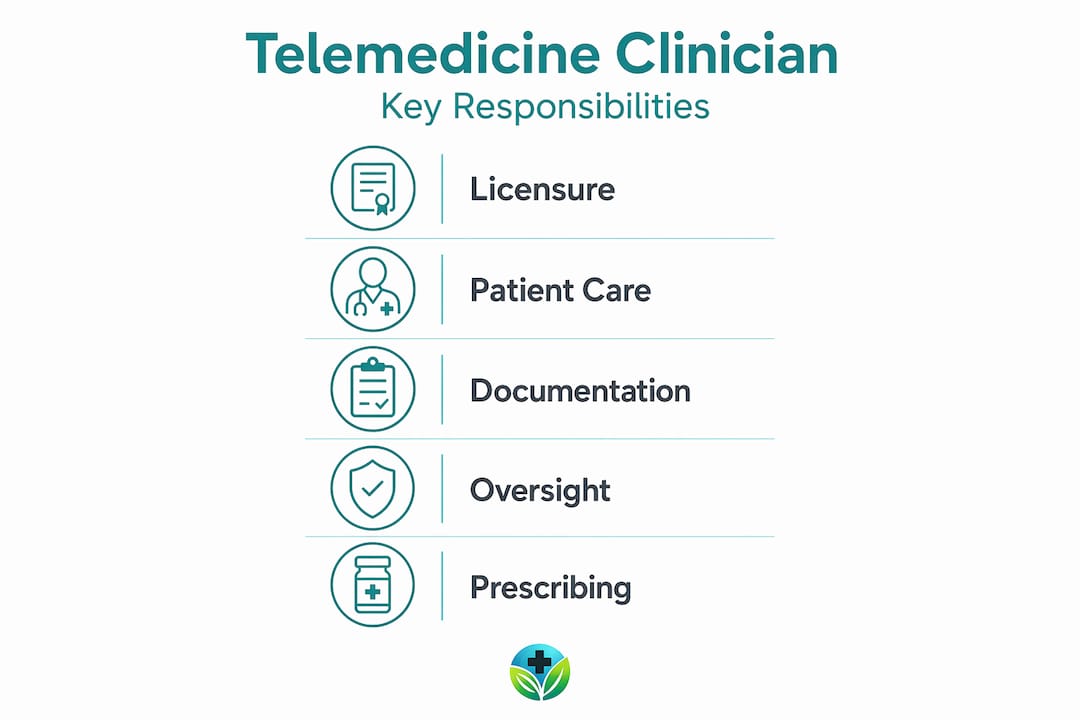
- The role of licensed clinicians in telemedicine starts with licensure
- Clinical responsibilities that go beyond the technology
- Governance and oversight in telehealth programs
- Prescribing responsibilities and controlled substances
- Patient rights and clinician ethical duties
- My perspective on the clinician's operational reality
- How Renewmd supports compliant telehealth care
- FAQ
Key takeaways
| Point | Details |
|---|---|
| Licensure follows the patient | Clinicians must hold an active license in the state where the patient is physically located at the time of the visit. |
| Consent must be modality-specific | Telehealth informed consent must address technology limitations, privacy risks, and alternatives, not just the nature of the service. |
| Prescribing has a dual compliance layer | Clinicians must simultaneously satisfy federal flexibilities and state-specific prescribing laws, which are often stricter. |
| Governance is a documented discipline | Chart review cadence, protocols, and documentation standards are the primary evidence of clinical compliance in telehealth programs. |
| Patient rights extend to virtual care | Nondiscrimination, data security, and emergency management obligations apply fully in telemedicine encounters. |
The role of licensed clinicians in telemedicine starts with licensure
The foundational rule of telemedicine licensure is straightforward: care is considered rendered where the patient is physically located. That means a clinician licensed only in California cannot legally treat a patient who happens to be sitting in Texas during a video visit. Cross-state licensure requirements follow this logic without exception, with narrow allowances for contiguous-state agreements or temporary registration pathways in specific circumstances.
For clinicians practicing across multiple states, this creates a significant administrative burden. The Interstate Medical Licensure Compact (IMLC) offers an expedited pathway for physicians to obtain licenses in member states, but it does not eliminate the requirement. Nurses and other licensed healthcare providers in telehealth have their own interstate compacts, such as the Nurse Licensure Compact (NLC), but participation varies by state and profession.
Medicare adds another layer. Clinicians billing Medicare for telehealth services must hold the appropriate state license where the patient is located and meet all applicable Medicare enrollment requirements. DEA registration, relevant for any clinician who prescribes controlled substances, must also reflect the states where the clinician actively practices.
- Clinicians must verify patient location at the start of every telehealth encounter
- Temporary practice allowances granted during the COVID-19 public health emergency have largely expired or been phased out
- Some states offer a special telehealth registration that is less burdensome than full licensure, but these are state-specific and often restricted to certain visit types
Pro Tip: If your program serves patients in more than three states, consider building a licensure tracker tied to your credentialing system. Tracking expiration dates manually is a high-risk approach at scale.
Clinical responsibilities that go beyond the technology
The equivalency principle is well-established in telehealth policy: the standard of care must be the same whether the clinician is across the room or across the country. That principle sounds simple, but it carries real operational weight for telemedicine clinician responsibilities at every stage of the encounter.

Informed consent is one of the clearest examples. In traditional practice, consent forms are largely standardized. In telehealth, consent must cover four distinct areas: the nature of the service being delivered remotely, the limitations of the technology being used, privacy and security considerations, and the patient's rights and available alternatives. Best practice is to obtain this consent before the visit begins, not during it.
HIPAA compliance applies fully to all telehealth platforms. Clinicians cannot use standard consumer video conferencing tools unless those tools meet HIPAA security requirements and the vendor has signed a Business Associate Agreement. Platforms without BAAs are not compliant, regardless of how convenient they may be. Documentation of the BAA itself becomes part of the compliance record.
- Confirm the patient's physical location and identity at the start of every visit
- Obtain modality-specific informed consent before clinical assessment begins
- Use only HIPAA-compliant platforms with current Business Associate Agreements
- Document any technology limitations that affected the quality of the clinical assessment
- Establish contingency protocols for situations where a complete assessment cannot be conducted virtually
Pro Tip: Build technology failure language directly into your clinical documentation templates. If the connection dropped for three minutes or the audio was intermittent, that belongs in the chart. It's both accurate and protective.
Governance and oversight in telehealth programs
In organized telehealth programs, particularly those operating at scale, governance is where the role of licensed clinicians becomes most complex and most consequential. The telehealth medical director sits at the center of this structure. This is a licensed physician responsible for overseeing the clinical integrity of the entire program, not just their own patient encounters.
The responsibilities of a telehealth medical director typically include:
- Developing and maintaining clinical protocols and standing orders
- Credentialing all clinicians and monitoring scope-of-practice adherence
- Conducting or overseeing regular chart audits with documented review cadence
- Managing HIPAA compliance at the program level, including BAA oversight
- Overseeing the consent process and responding to adverse events
The chart audit function is particularly telling. Documented protocols and consistent chart review are the primary mechanism through which telehealth programs demonstrate they are meeting the standard of care. In litigation or regulatory review, the absence of a structured audit process is one of the fastest ways a program's clinical credibility unravels.
| Governance function | Responsible party | Frequency |
|---|---|---|
| Chart review and audit | Medical director or designee | Minimum quarterly |
| Protocol review and update | Medical director with clinical team | Annually or upon regulatory change |
| Credentialing verification | Medical director or compliance officer | At hire and at each license renewal |
| Adverse event review | Medical director | Within 72 hours of occurrence |
| Consent process audit | Medical director or compliance team | Semiannually |
Prescribing responsibilities and controlled substances
Prescribing via telemedicine sits at the intersection of federal and state authority, and clinicians must satisfy both simultaneously. The DEA's temporary flexibilities for controlled substance prescribing via telemedicine have been extended through December 31, 2026. These flexibilities allow prescribing without a prior in-person visit under specific conditions, but they do not override state law.
This is where many clinicians encounter compliance gaps. Federal flexibility does not mean blanket permission. Dual tracking of federal telemedicine rules and state-specific prescribing laws is required, and many states impose requirements that are stricter than the federal baseline. A clinician who follows only federal guidance may still be out of compliance in a given state.
- Determine whether the prescribed substance is controlled at the federal or state level, or both
- Confirm that your state of licensure permits telemedicine prescribing for that substance without a prior in-person encounter
- Document the patient-provider relationship, including identity verification and modality-appropriate assessment
- Review state-specific rules about prescription format, quantity limits, and refill restrictions for telemedicine prescriptions
- Monitor for updated DEA special registration rules, which are expected to introduce a more structured pathway beyond the temporary extensions
The Ryan Haight Online Pharmacy Consumer Protection Act remains the underlying federal framework for controlled substance prescribing via telemedicine. Clinicians prescribing through platforms offering GLP-1 medications or other specialty drugs should review state-by-state telehealth access rules to confirm prescribing compliance at every encounter.
Pro Tip: When a patient relocates mid-treatment, that is a prescribing event, not just an administrative one. Confirm updated state laws before continuing any controlled substance prescription.
Patient rights and clinician ethical duties
The impact of licensed professionals on telehealth is measured, in part, by how well they protect patient rights in a medium that introduces new vulnerabilities. Virtual care by licensed providers triggers all existing patient rights obligations, plus some that are specific to the modality itself.
Patient rights in telehealth include nondiscrimination and accessibility protections under Section 1557 of the Affordable Care Act. This means clinicians and platforms must account for patients with limited English proficiency, disabilities affecting technology use, and other access barriers. Selecting a telehealth platform is not a purely technical decision. It carries civil rights implications.
Key clinician obligations in this area include:
- Providing informed consent in language the patient can understand, with interpreter access when needed
- Protecting electronic health records and granting patients timely access to their records
- Maintaining emergency management protocols, including procedures for contacting local emergency services when a patient in another state is in crisis
- Documenting all jurisdictional variations in patient protections that could affect care decisions
The duty-to-warn and duty-to-protect obligations are especially complex in specialty telehealth care, particularly mental health. Managing a high-acuity patient remotely requires more than good clinical judgment. It requires documented escalation pathways, pre-established relationships with local crisis resources, and careful risk stratification built into the intake process.
My perspective on the clinician's operational reality
I've reviewed enough telehealth compliance programs to say with confidence that licensure management is the issue that trips up otherwise well-run organizations. Most clinicians understand their clinical obligations. What surprises them is the administrative machinery required to stay compliant across even three or four states. The multi-jurisdictional compliance burden is not a side task. It is a core operational function that needs dedicated resourcing.
What I've learned from working with telehealth programs is that documentation separates programs that survive scrutiny from those that don't. A clinician's clinical judgment may have been sound, but if the chart doesn't reflect it, that judgment is effectively invisible. Specialty care, especially mental health, demands an even higher bar. Psychiatrists in particular report significantly higher concern about licensing complexity and managing high-acuity patients remotely than other clinicians. That concern is not anxiety. It's professional calibration.
Telemedicine is an opportunity, not just a regulatory problem to manage. But the clinicians who thrive in it are the ones who treat compliance as a clinical discipline, not a checkbox. Policy makers designing telehealth frameworks would do well to ask clinicians what they actually encounter operationally before setting standards from above.
— Raymond
How Renewmd supports compliant telehealth care
Renewmd is built around the principle that clinical quality and regulatory compliance are not in tension. Every licensed clinician operating through the Renewmd platform practices within a structured governance framework that addresses state-specific licensure requirements, HIPAA-compliant technology, and documented clinical protocols from intake to follow-up. For patients seeking GLP-1 therapies like Semaglutide and Tirzepatide, this means care delivered through licensed U.S. providers who are accountable to both federal and state standards. Renewmd's educational resources also support clinicians and patients in understanding telehealth prescribing obligations and what compliant virtual care actually looks like. If you are a clinician or policy maker looking to understand how a well-structured telehealth weight management program operates, start with Renewmd to see how licensing, governance, and clinical accountability are built in from the beginning.
FAQ
What license does a clinician need for telemedicine?
A clinician must hold an active license in the state where the patient is physically located during the telehealth visit. Some states offer expedited telehealth-specific registrations, but these are exceptions rather than the rule.
What is the role of a medical director in a telehealth program?
A telehealth medical director is a licensed physician responsible for clinical governance, protocol development, chart audits, credentialing oversight, and HIPAA compliance across the program.
Can clinicians prescribe controlled substances via telemedicine in 2026?
Yes, under federal temporary flexibilities extended through December 31, 2026, but clinicians must also comply with individual state prescribing laws, which may be stricter than the federal baseline.
What informed consent is required for telehealth encounters?
Telehealth informed consent must cover the nature of the remote service, technology limitations, privacy and security considerations, and the patient's rights and available alternatives, obtained before the encounter begins.
How does patient location affect telemedicine compliance?
Patient location determines which state's laws apply to the encounter, including licensure requirements, prescribing rules, and patient rights protections. Clinicians must verify patient location at the start of every visit.