
Digital healthcare privacy is defined as the protection of personal medical and health information collected, stored, and transmitted through digital systems, including electronic health records, telemedicine platforms, and mobile health applications. The formal industry term is health information privacy, governed primarily by the Health Insurance Portability and Accountability Act (HIPAA) and an expanding set of state laws. Understanding what is digital healthcare privacy matters now more than ever. The U.S. healthcare sector suffered 460 ransomware attacks in 2025 alone, and over 574 million individuals have been affected by hacking incidents since 2020. Your health data is one of the most sensitive categories of personal information in existence, and knowing how it is protected gives you real power over your own care.
What is digital healthcare privacy and why does it matter?
Digital healthcare privacy refers to your right to control who sees, uses, and shares your health information in digital environments. This includes data held by hospitals, insurers, telehealth providers, and increasingly, consumer apps that track your steps, sleep, or weight. The core principle is confidentiality: your medical history, diagnoses, prescriptions, and lab results should only reach people you authorize.
The stakes are high because health data is uniquely personal. A leaked credit card number can be replaced. A leaked HIV diagnosis, mental health record, or medication history cannot be taken back. Patient trust is the foundation on which digital health adoption rests, and every breach erodes that foundation.
Privacy in digital health also connects directly to safety. When a hospital's systems go offline during a cyberattack, care delays follow. Digital privacy is not an abstract legal concept. It is a practical condition for receiving safe, uninterrupted medical care.

What legal frameworks protect your health data?
HIPAA: the federal baseline
The HIPAA Privacy Rule establishes federal minimum standards for protecting Protected Health Information (PHI). It applies to covered entities, specifically hospitals, clinics, health insurers, and their business associates such as billing companies and cloud storage vendors. Under HIPAA, you have the right to access your records, request corrections, and receive an accounting of who has seen your data.
HIPAA's protections are meaningful but bounded. The law covers clinical settings and their direct partners. It does not automatically cover every app on your phone.
Where HIPAA falls short
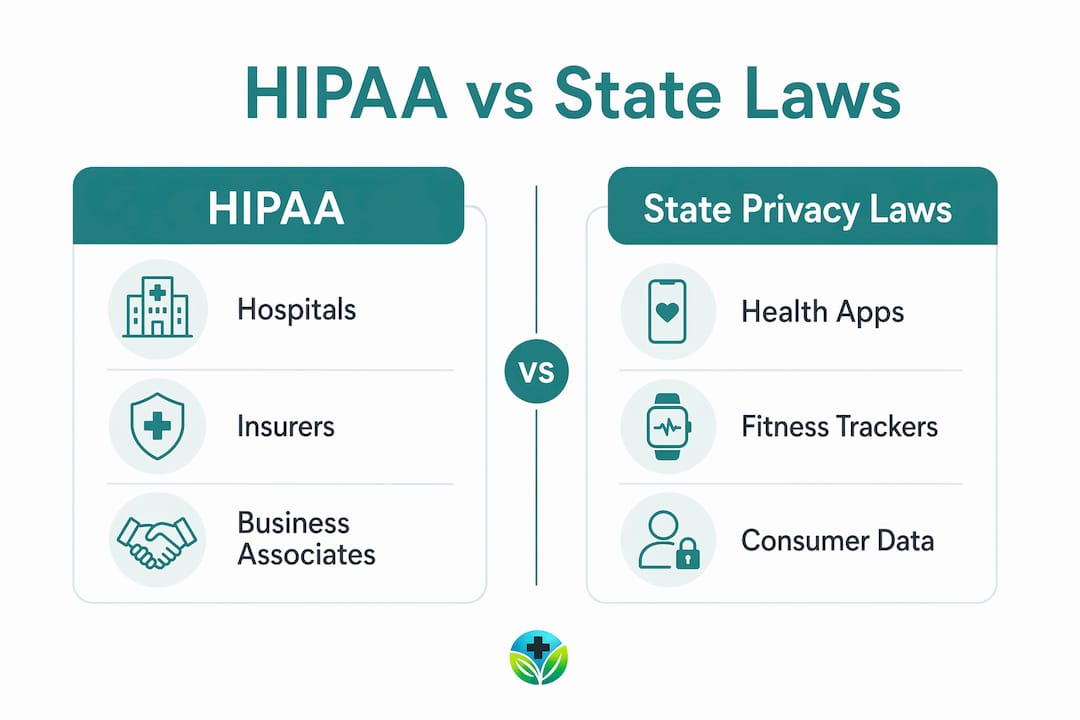
HIPAA applies only to covered entities like hospitals and insurers. Many commercial health apps, fitness trackers, and wellness platforms fall entirely outside its scope. Those apps can legally collect and sell your health data unless their own privacy policies prohibit it. This gap surprises most people who assume all health data receives equal federal protection.
State laws filling the gap
Consumer health data created outside clinical settings is increasingly protected by state privacy laws requiring opt-in consent before data can be shared or sold. Washington State's My Health MY Data Act and similar laws in Nevada and Connecticut specifically target health data collected by non-HIPAA entities. This means your state of residence significantly affects how well your data is protected.
HIPAA vs. state privacy laws: a quick comparison
| Feature | HIPAA | State Privacy Laws |
|---|---|---|
| Who it covers | Hospitals, insurers, business associates | Consumer apps, wellness platforms, data brokers |
| Consent model | Opt-out for treatment purposes | Opt-in required for data sale or sharing |
| Patient rights | Access, correction, accounting of disclosures | Deletion, portability, opt-out of sale |
| Enforcement | Federal HHS Office for Civil Rights | State attorneys general |
| Geographic scope | National | Varies by state |
What are the biggest cyber threats to healthcare privacy?
Healthcare is the most targeted sector for ransomware in the United States. The scale is not abstract. Over 3,200 hacking incidents since 2020 have affected 574 million individuals. That number exceeds the entire U.S. population, meaning many Americans have had their health data exposed more than once.
The threat profile has grown more complex. Here are the primary risks patients face:
- Ransomware with double extortion: Criminals lock a hospital's systems and simultaneously steal patient data. They then demand payment twice: once to restore access and once to prevent public release of the stolen records. Double extortion ransomware is now the dominant attack model in healthcare.
- Third-party vendor breaches: A single attack on a health technology vendor can trigger a "ransomware blast radius," disrupting dozens of hospitals and millions of patients simultaneously. The 2024 Change Healthcare attack illustrated this precisely, taking down claims processing for hundreds of providers nationwide.
- Phishing and credential theft: Most breaches begin with a single employee clicking a malicious link. Stolen login credentials give attackers direct access to electronic health record systems.
- Insider threats: Employees with legitimate access occasionally misuse it, whether for financial gain or personal curiosity about a patient's records.
The risk goes beyond identity theft. When ransomware takes hospital systems offline, surgeries are postponed, medication orders are delayed, and ambulances are diverted. Digital healthcare privacy failures are not just financial events. They are patient safety events.
Pro Tip: Before using any health app, search the company name alongside "data breach" and "privacy policy." If the app has no clear policy on selling your data, treat it as a platform that will.
How do technology and organizational practices protect health data?
Legal compliance sets the floor. Strong privacy programs build well above it. The most effective approach combines technical controls with organizational culture, because technology alone cannot compensate for human error.
Technical safeguards that matter
Data minimization is the principle of collecting only the information strictly necessary for a specific purpose. A weight management platform does not need your full psychiatric history. Limiting data collection directly limits breach exposure.
Encryption protects data in transit and at rest, making stolen files unreadable without the correct decryption key. Access controls restrict which staff members can view which records, reducing insider risk. Zero-trust architecture treats every access request as potentially hostile, requiring continuous verification rather than assuming internal network traffic is safe. This model has become the recommended standard for healthcare IT security in 2026.
For AI-driven health platforms, differential privacy and federated learning allow systems to learn from patient data without exposing individual records. Federated learning trains AI models locally on each device, sending only statistical summaries to a central server. No raw patient data ever leaves the device. Patients should ask whether platforms they use apply these techniques before sharing sensitive health information with AI tools.
The human side of privacy
Workforce training and zero-trust architectures together reduce breaches caused by human error and inside attackers. Technical controls fail when staff bypass them out of convenience. Organizations that treat privacy as a shared cultural value, not just an IT checklist, consistently outperform those that do not. Regular phishing simulations, clear escalation procedures, and privacy-aware hiring practices all contribute to a stronger defense. You can read more about how these principles apply in virtual care settings specifically.
What practical steps can you take to protect your health information?
You have more control over your health data than most people realize. These steps are concrete and immediately applicable.
- Read privacy policies before downloading health apps. Look specifically for language about data sale, third-party sharing, and advertising use. If the policy is vague or absent, that is a red flag.
- Check app affiliations. Apps connected to hospitals or insurers are more likely to fall under HIPAA. Standalone wellness apps generally are not. The distinction determines your legal protections.
- Enable multifactor authentication (MFA) on every health platform. MFA requires a second verification step beyond your password, blocking most credential-based attacks even when your password is compromised.
- Exercise your legal rights. Under HIPAA and other laws, you can request access to your records, correct inaccuracies, and ask for a list of everyone who has accessed your file. Many patients never use these rights, but they exist and are enforceable.
- Audit your app permissions. Health apps often request access to your camera, microphone, location, and contacts. Grant only what is necessary for the app's core function.
- Delete accounts you no longer use. Dormant health app accounts still hold your data and remain vulnerable to breach. Closing them removes the exposure.
Pro Tip: State laws in Washington, Nevada, and Connecticut give you the right to opt out of health data sales by consumer apps. Check your state's attorney general website to see what rights apply to you specifically.
Key takeaways
Digital healthcare privacy requires legal protections, technical safeguards, and individual action working together, because no single layer is sufficient on its own.
| Point | Details |
|---|---|
| HIPAA has real limits | Commercial health apps often fall outside HIPAA, leaving your data legally unprotected without state law coverage. |
| Cyberattacks affect patient safety | Ransomware disrupts care delivery, not just data confidentiality, making privacy a direct safety issue. |
| Data minimization reduces risk | Platforms that collect less data expose less data; choose services with clear minimization policies. |
| State laws expand your rights | Depending on your state, you may have the right to opt out of data sales and request deletion from consumer apps. |
| Individual action matters | Enabling MFA, auditing app permissions, and exercising HIPAA access rights meaningfully reduce your personal exposure. |
Privacy is not a feature. it is a foundation.
After years of watching digital health evolve, one pattern stands out clearly. Organizations that treat privacy as a compliance checkbox consistently underperform those that treat it as a patient relationship commitment. The difference shows up in breach rates, in patient retention, and in how quickly trust collapses when something goes wrong.
The uncomfortable reality is that most people share health data with apps they have never scrutinized, on platforms they assume are regulated, under laws that may not apply to them. The gap between perceived protection and actual protection is wide. Closing that gap requires both better industry standards and more informed patients.
Privacy in digital health is not a one-time configuration. It is a continuous, multi-layered effort that requires providers, technology vendors, regulators, and patients to each carry their share. The patients who fare best are those who ask questions, read policies, and use the legal rights already available to them. That is not paranoia. That is informed participation in your own care.
— Raymond
How Renewmd approaches privacy in digital weight care
Renewmd operates as a fully licensed U.S. telemedicine platform, and patient data protection is built into every step of the clinical process. From your initial intake through provider consultations, lab testing, and medication delivery, Renewmd uses a sealed digital process designed to limit data exposure and maintain healthcare information confidentiality. If you are considering a medically supervised weight management program and want to understand how your health information is handled in a virtual care setting, the medical weight care telemedicine guide explains the full process, including privacy safeguards. You can also explore how Renewmd works to see exactly what data is collected and why.
FAQ
What is digital healthcare privacy in simple terms?
Digital healthcare privacy is the right to control who can access, use, and share your personal health information stored or transmitted through digital systems. It is protected by laws like HIPAA and, increasingly, by state-level regulations covering consumer health apps.
Does HIPAA protect my fitness app data?
HIPAA does not protect data collected by most fitness and wellness apps because they are not covered entities under the law. Those apps can legally share or sell your data unless state law or their own privacy policy prohibits it.
What should i do if my health data is breached?
Request a copy of your health records to verify what was exposed, place a fraud alert with the major credit bureaus, and contact your state attorney general's office if a consumer app was involved. Under HIPAA, covered entities must notify you of breaches affecting your PHI.
How do telemedicine platforms protect my health information?
Reputable telemedicine platforms use encryption, access controls, and HIPAA-compliant data handling to protect your records. Platforms affiliated with licensed U.S. clinicians and pharmacies are subject to federal and state privacy requirements that consumer apps are not.
What are my rights under HIPAA regarding my health data?
Under the HIPAA Privacy Rule, you have the right to access your medical records, request corrections to inaccurate information, receive a list of disclosures, and request restrictions on certain uses of your data. These rights apply to covered entities, not to commercial health apps outside HIPAA's scope.