
You've heard about GLP-1 receptor agonists like Semaglutide and Tirzepatide, you meet the general criteria, and you're ready to explore medically supervised weight management. Then you open a telehealth platform and the intake process feels like a maze of forms, eligibility questions, and unfamiliar technology. That friction is common, and it keeps many eligible adults from accessing care they could genuinely benefit from. This guide walks you through every phase of telehealth enrollment for GLP-1 weight management, from checking your eligibility and gathering documents to completing your signup, troubleshooting snags, and knowing exactly what comes next.
Table of Contents
- Who is eligible for GLP-1 telehealth weight care?
- Enrollment checklist: What you need before starting
- Step-by-step: Signing up for telehealth GLP-1 weight care
- Troubleshooting and common mistakes
- What to expect after enrollment
- Our perspective: What most guides miss about telehealth weight care onboarding
- Ready to start with telehealth GLP-1 weight care?
- Frequently asked questions
Key Takeaways
| Point | Details |
|---|---|
| Eligibility first | Check both FDA and provider-specific eligibility before starting enrollment to avoid wasted time. |
| Prepare all materials | Having forms, IDs, and a working device ready speeds up telehealth onboarding significantly. |
| Follow guided steps | A structured, stepwise approach makes telehealth sign-up clear even for digital newcomers. |
| Expect quick scheduling | Most platforms can confirm your appointment for GLP-1 weight care within days of enrollment. |
| Support is available | Ask for technical or access help—telehealth providers are equipped to assist with onboarding difficulties. |
Who is eligible for GLP-1 telehealth weight care?
Now that you understand why enrolling matters, start by confirming whether you qualify for GLP-1 telehealth weight management. Eligibility criteria exist at two levels: the FDA's labeled indications and the individual program requirements set by each telehealth provider.
The FDA's approved parameters for GLP-1 weight-loss medications like Wegovy (Semaglutide) and Zepbound (Tirzepatide) are relatively clear. According to GLP-1 eligibility guidelines, FDA-labeled eligibility allows a BMI of 30 or higher, or a BMI of 27 or higher when at least one weight-related health condition is present. Telehealth providers may apply stricter thresholds, so it pays to verify before you invest time filling out forms.
You can review GLP-1 BMI eligibility criteria to understand how different cutoffs are applied across programs.
Commonly accepted weight-related conditions that may support eligibility at BMI 27:
- Type 2 diabetes or prediabetes
- High blood pressure (hypertension)
- Obstructive sleep apnea
- High cholesterol or dyslipidemia
- Cardiovascular disease history
- Non-alcoholic fatty liver disease (NAFLD)
- Osteoarthritis related to excess body weight
Beyond BMI and comorbidities (conditions that exist alongside the primary concern), programs vary considerably in their structure. Some platforms offer a rapid prescription pathway after a single clinical review, while others build in multiple health consultations and lab testing before writing the first order. If you want guidance on choosing the right GLP-1 program for your situation, comparing these structures early saves time.
| Eligibility criterion | Standard threshold | Notes |
|---|---|---|
| BMI with no comorbidities | ≥30 | Applies to most FDA-approved GLP-1 indications |
| BMI with qualifying condition | ≥27 | At least one documented weight-related issue required |
| Age | 18+ (most programs) | Some programs 21+ |
| Active psychiatric conditions | May require review | Varies by provider |
| Current pregnancy or breastfeeding | Not eligible | Contraindicated for GLP-1 medications |
| Recent cardiac events | May require clearance | Provider dependent |
Pro Tip: Before completing a full intake form, look for a brief eligibility screener on the provider's website. Most platforms offer a short quiz that tells you within two minutes whether you likely qualify, saving you from entering detailed health data only to find you're outside their criteria.
Enrollment checklist: What you need before starting
If you're eligible, gathering your materials first streamlines the actual online enrollment process and prevents the frustration of stopping mid-form to hunt for a document.
A standard telehealth workflow in the U.S. typically starts with an online intake form, followed by insurance or payment review, and then scheduling your first virtual visit. Platforms handle these steps using secure, patient-completed electronic forms, and telehealth consent forms along with intake information are usually completed before the first appointment.
Being ready with the right materials on day one means your enrollment can move quickly instead of sitting in a pending state while a support team waits on your paperwork.
Documents and materials checklist:
- Government-issued photo ID (driver's license or passport, not expired)
- Insurance card (front and back), or a credit/debit card for self-pay
- A list of current medications, including doses
- Any recent lab results, especially blood glucose, lipid panels, or thyroid panels (if available)
- Primary care provider contact information (some programs request records)
- Documentation of diagnosed comorbidities if your BMI is between 27 and 29
Technology checklist for preparing for telehealth visits:
- Smartphone, tablet, or computer with a working camera and microphone
- Stable Wi-Fi or cellular data connection
- An active, regularly checked email address
- Access to a quiet, private space for your video visit
- PDF reader or basic document upload capability on your device
Review telehealth access by state if you are unsure whether a given provider is licensed to serve patients where you live, because licensure directly affects whether a prescription can be issued.
| Category | Required item | Optional but helpful |
|---|---|---|
| Identity | Government-issued photo ID | Secondary ID |
| Health history | Medication list | Prior provider notes |
| Lab work | None required at all platforms | Blood glucose, lipid panel |
| Payment | Insurance card or credit card | FSA/HSA card |
| Technology | Device with internet access | Backup phone for audio-only |
| Documentation | Signed consent form | Comorbidity records |
Pro Tip: Scan or photograph all documents together in one session and save them to a single folder on your phone or computer. When you reach the upload step in your intake form, you can attach everything in one pass instead of pausing to locate each file separately.
Step-by-step: Signing up for telehealth GLP-1 weight care
Now you have your materials. Here is how to move through the actual signup, step by step, so you know exactly what each phase involves.

A standard patient enrollment workflow includes intake, insurance or payment review, scheduling, and a first virtual visit. For Medicare patients and others with coverage questions, a checklist approach that confirms benefits and tests your tech before the appointment is strongly advised. The U.S. Department of Health and Human Services also notes that telehealth onboarding should include accommodations for patients with sensory limitations or lower digital literacy, so don't hesitate to ask for support.
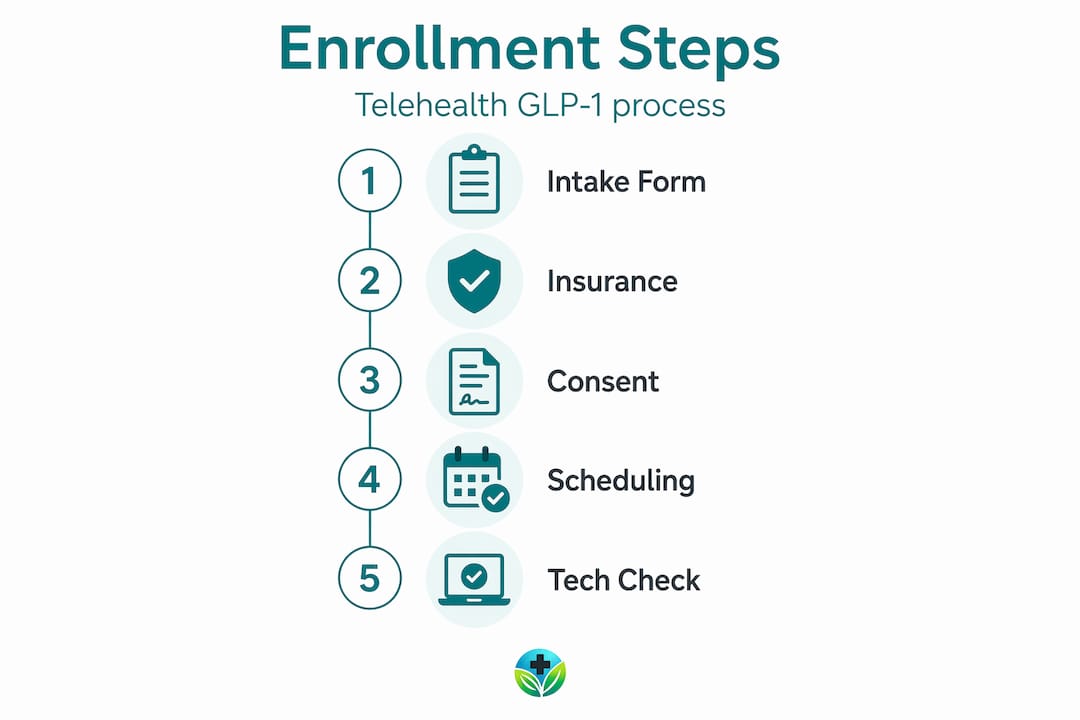
Step 1: Complete the online intake form. This is where you enter your health history, current medications, BMI-related information, and any diagnosed conditions. Be accurate and thorough. Incomplete or vague answers are one of the most common reasons enrollment stalls.
Step 2: Insurance and payment review. If you're using insurance, staff will verify your coverage. Self-pay patients confirm their payment method. This step often happens in the background while you proceed, but some platforms send a confirmation email before moving forward.
Step 3: E-sign consent forms and upload your ID. You'll receive a telehealth consent form and possibly a privacy acknowledgment. Read both before signing. Upload your photo ID and any requested documentation. Platforms use HIPAA-compliant (Health Insurance Portability and Accountability Act) secure portals for this step.
Step 4: Schedule your first virtual appointment. Most platforms offer a self-service scheduling calendar immediately after consent is confirmed. Choose a time when you'll be in a quiet, private location and can give the visit your full attention.
Step 5: Test your technology. Before the appointment, confirm your camera and microphone work, test your internet speed, and close any background apps. If you have limited tech experience, ask the platform's support team for a brief walkthrough.
Understand the GLP-1 prescription process online so you know what clinical criteria your provider will assess before prescribing.
| Standard onboarding flow | Accessible or alternative onboarding |
|---|---|
| Video appointment with full intake | Audio-only appointment option |
| Self-service scheduling portal | Staff-assisted scheduling by phone |
| Digital form upload | Fax or mail document submission |
| Video ID verification | Staff-reviewed ID upload |
| Automated email reminders | Phone call reminders on request |
Review how it works on RenewMD's platform for a clear picture of the full process from intake to prescription.
Important: Always use accurate personal information during enrollment. Inconsistencies between your ID, insurance card, and intake form can delay or halt prescription processing. Double-check that your name, date of birth, and address match exactly across all submitted documents.
Pro Tip: Schedule your appointment during a mid-morning or early afternoon window on a weekday. You're more likely to be alert, less likely to be interrupted, and provider availability tends to be better than during peak evening hours.
Troubleshooting and common mistakes
Mistakes happen, even with a clear guide. Here is how to handle snags like missing files or tech troubles before they stop your progress entirely.
HHS guidance on telehealth onboarding emphasizes the importance of accommodating patients with varying levels of digital comfort, meaning there are real support options available if you hit a wall.
Common enrollment issues and how to address them:
- Expired ID: If your driver's license is expired, use your passport or request an alternative ID verification process from support staff.
- Missing comorbidity documentation: If your BMI is between 27 and 29, you may need a letter or record from a prior provider confirming a diagnosis. Contact your primary care physician for a clinical summary.
- Poor internet connection: Move closer to your router, switch from Wi-Fi to mobile data, or call the platform's support line to request an audio-only visit.
- Form submission errors: Most platforms save your progress automatically. If a submission fails, refresh the page and check your email for an auto-save link before re-entering data.
- Insurance coverage confusion: Call your insurer's member services line to ask specifically about coverage for GLP-1 medications administered under telehealth before your appointment.
- Login or account access issues: Use the platform's "forgot password" function or contact tech support directly. Do not create a duplicate account, as this can create billing and records conflicts.
Review telehealth prep tips for additional steps to take before your appointment that reduce the likelihood of technical hiccups.
Remember: Most enrollment platforms have a dedicated support team for exactly these issues. Calling or messaging them when you're stuck is faster than trying to troubleshoot alone, and it keeps your enrollment moving forward rather than expiring due to inactivity.
What to expect after enrollment
Once you complete the signup, here is what typically happens and what you can prepare for next.
A completed telehealth workflow moves from enrollment confirmation through clinical review and into your first scheduled visit, all within a timeline that most patients find shorter than traditional in-office care.
Typical post-enrollment sequence:
- Confirmation: You'll receive an email or SMS confirmation with your appointment time, a link or dial-in number for the visit, and reminders as the date approaches.
- Pre-visit clinical review: Your provider reads your intake form before the appointment. They may send a message requesting clarification on a medication, a missing lab result, or a prior diagnosis.
- First virtual consultation: Your provider reviews your health history, discusses GLP-1 options, and assesses whether a prescription is appropriate. This visit usually runs 20 to 45 minutes depending on the platform.
- Prescription decision: If you meet clinical criteria, your GLP-1 prescription may be issued the same day or within a few days of the visit. It is sent directly to a pharmacy partner for fulfillment.
- Follow-up schedule: Most GLP-1 programs require ongoing check-ins, typically monthly, for safety monitoring, medication adjustments, and coaching support.
- Lab work: Some programs order baseline labs before or shortly after the first prescription. Results inform dose escalation and help identify any contraindications.
Understand what your first telehealth consultation will involve so you arrive prepared with relevant health history. You can also review the post-enrollment process to follow the prescription pathway from clinical approval to delivery.
Most patients move from initial enrollment to their first consultation within three to seven days when all materials are submitted correctly and promptly.
Our perspective: What most guides miss about telehealth weight care onboarding
The standard enrollment checklist tells you what to gather and where to click. It rarely tells you that the experience differs significantly from one platform to another, and that how you approach the process shapes your outcome as much as which platform you choose.
There is no single "standard" telehealth weight management onboarding. Some programs prioritize speed, moving patients from intake to prescription in under 48 hours with minimal clinical back-and-forth. Others are designed around safety layering, building in multiple touchpoints, lab reviews, and coaching check-ins before a prescription is written. Neither is categorically better. The right fit depends on what you want from the program and how much guidance you expect along the way.
What gets under-discussed is the role of self-advocacy. Patients who ask questions early, such as asking how often they will speak with a provider, what happens if a side effect appears, or what support exists between appointments, tend to report higher satisfaction and better outcomes. The act of asking signals that you are an engaged participant, and most platforms respond to that engagement positively.
Digital literacy also plays a more significant role than many guides acknowledge. If you are unfamiliar with electronic forms, video platforms, or document uploads, the enrollment process can feel intimidating. The solution is not to push through uncomfortably but to ask for guided support. Most platforms offer phone-based onboarding or staff-assisted form completion for exactly this reason. Using that support is not a workaround; it is the intended option.
Finally, when you evaluate programs, compare the depth of ongoing support, not just the sign-up experience. The enrollment process ends within a week. The clinical relationship that follows may last a year or longer. Use selecting the best weight management program as a framework for asking the questions that matter for long-term care, not just the initial signup.
Ready to start with telehealth GLP-1 weight care?
RenewMD.clinic guides you through a clear, medically supervised enrollment process designed to minimize confusion and prioritize your safety at every step. The platform connects you with licensed U.S. clinicians, handles prescription management, and provides educational resources so you understand your treatment from the start. Whether you're exploring options or ready to begin, you can learn about GLP-1 weight loss to build a solid clinical foundation before your first visit. Review how the process works to see the full pathway from intake to medication delivery, or go directly to get started with GLP-1 when you're ready to take the first step. Transparent pricing, integrated support, and evidence-based care are what set a program like this apart from a basic prescription service.
Frequently asked questions
Can I enroll in GLP-1 telehealth if I don't have a qualifying health condition but my BMI is 27?
Most providers require a BMI of 30 or higher, or a BMI of 27 with at least one documented weight-related condition, based on FDA-labeled GLP-1 eligibility criteria. A BMI of 27 without a qualifying condition typically does not meet current approval thresholds.
What technology do I need for a telehealth weight management visit?
A smartphone, tablet, or computer with internet access is sufficient for most platforms, and HHS guidance notes that providers should also offer audio-only or secure messaging alternatives for patients with limited tech access.
How long does the telehealth enrollment process usually take?
With all required materials ready, the intake and scheduling process often takes less than an hour, and a typical workflow moves most patients to their first virtual appointment within a few business days.
Is my personal information safe during telehealth sign-up?
Yes, reputable platforms use HIPAA-compliant, secure electronic forms to protect your personal and health data throughout the enrollment and consent process.
What if I need help during the enrollment process?
Most platforms provide dedicated tech support and can accommodate patients with varying digital literacy levels, and HHS advises providers to offer multiple communication and assistance options to support all patients through onboarding.