

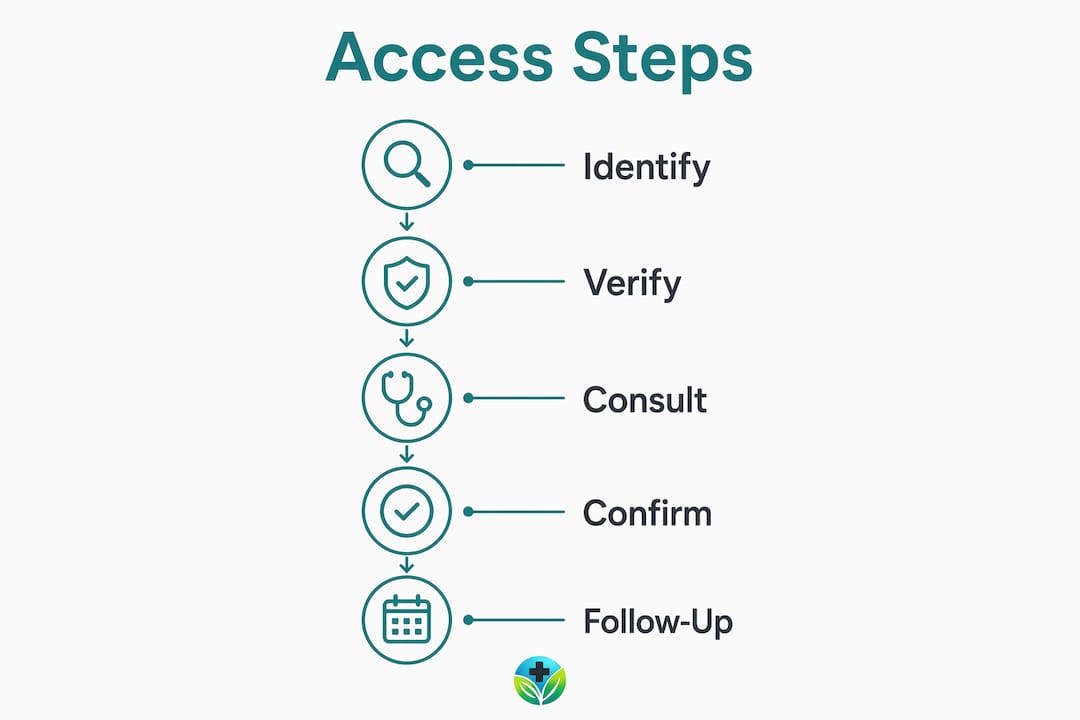
Accessing licensed clinicians is the process of connecting with credentialed healthcare professionals, including therapists, psychiatrists, and medical providers, who hold active state authorization to deliver care legally and safely. Whether you are seeking mental health support, medically supervised weight management, or general wellness guidance, the path to finding licensed healthcare professionals follows a clear sequence: identify your options, verify credentials, and confirm fit before scheduling. Tools like insurance provider directories, SAMHSA's FindTreatment.gov, state licensing board lookup portals, and telehealth platforms each serve a distinct role in that process. Understanding how to use them correctly protects you from unlicensed providers and avoidable care interruptions.
What are the main pathways to find licensed clinicians?
The most cost-effective starting point for finding licensed clinicians is your health insurance network. Most insurers provide an online directory of in-network providers, which you can filter by specialty, location, and availability. Using in-network providers reduces your out-of-pocket costs significantly, and your insurer's member services line can help you identify clinicians who accept your specific plan. A trusted insurance broker can also clarify which network tiers apply to mental health and medical providers under your current coverage.
Beyond insurance directories, several reputable third-party resources expand your search. Psychology Today's therapist finder, Therapy Expanded, and SAMHSA's FindTreatment.gov offer broad, searchable databases of licensed mental health and substance use treatment providers nationwide. These directories are useful for finding specialists outside your insurance network or in underserved areas. However, a 2025 HHS OIG audit found that 66 of 100 sampled facilities in SAMHSA's directory contained inaccurate information. That figure means directory data alone is not sufficient. Always confirm listings by phone before relying on them for care decisions.

Primary care referrals remain one of the most reliable pathways for accessing mental health providers. Your primary care physician has direct knowledge of your medical history and can match you with clinicians whose specialties align with your specific needs. This route also tends to produce faster appointment access because referral relationships between providers often carry scheduling priority.
Telehealth platforms represent a fourth pathway, and they have expanded licensed therapist access considerably for people in rural areas or those with limited mobility. Platforms that connect patients with licensed U.S. clinicians allow you to receive care from home, but they require additional scrutiny around licensure. The clinician's authorization must match your physical location at the time of each session, not just at enrollment.
| Pathway | Best for | Key consideration |
|---|---|---|
| Insurance directory | Cost-conscious access | Verify in-network status before booking |
| Psychology Today / Therapy Expanded | Specialty and niche searches | Cross-check credentials independently |
| SAMHSA FindTreatment.gov | Substance use and mental health facilities | Confirm listings by phone due to known inaccuracies |
| Primary care referral | Matched specialist access | Fastest route for complex or co-occurring conditions |
| Telehealth platforms | Remote or rural access | Confirm clinician is licensed in your current state |
Pro Tip: When using any online directory to find licensed therapists, call the provider's office directly to confirm they are accepting new patients. Directory listings frequently lag behind real-time availability by weeks or months.
How do you verify a clinician's license before starting care?
License verification is a non-negotiable step before booking any appointment, particularly for telehealth. The process requires four pieces of information: the clinician's full legal name, their license number, their license type (such as Licensed Clinical Social Worker, Licensed Professional Counselor, or Medical Doctor), and the state where you will be physically located during care. With those details, you can run a lookup on the relevant state licensing board's official website to confirm active status and check for any disciplinary actions.
The National Mental Health Authority advises that verified licensure should precede scheduling in all cases. This is especially relevant for telehealth, where the clinician's physical location is irrelevant. What matters legally is your location. A therapist licensed only in California cannot legally provide care to a patient sitting in Texas, regardless of how the session is delivered.
Therapy Expanded's guidance on license status confirmation reinforces that licensing status and disciplinary history are state-specific public records, available at no cost through official board websites. The Federation of State Medical Boards (FSMB) also maintains a centralized lookup tool for physicians. For mental health professionals, each state's Department of Health or professional licensing division hosts its own searchable database.
Key steps for verifying a clinician's credentials:
- Collect the clinician's full name, license number, and license type from their profile or intake documents
- Identify the correct state licensing board based on your physical location during sessions
- Run a real-time lookup on the board's official website, not a third-party aggregator
- Confirm the license is active, not expired or suspended
- Check for any formal disciplinary actions or restrictions on practice scope
Pro Tip: Licensure alone does not confirm expertise. Specialty and experience in your specific concern, such as anxiety, weight management, or trauma, must be confirmed separately during a consultation call.
What steps should you take after identifying a clinician?
Once you have verified a clinician's license and confirmed they practice in your area of need, the next step is a structured consultation call. Most therapists and many medical providers offer free 10 to 15 minute consultations to assess fit before committing to ongoing care. These calls are your opportunity to evaluate whether the clinician's approach, availability, and communication style match your expectations.
Use the consultation call to cover these points in order:
- Confirm their active caseload. Ask directly whether they are accepting new patients and what their current wait time is.
- Ask about their clinical approach. For mental health providers, ask which therapeutic modalities they use (such as cognitive behavioral therapy or motivational interviewing) and whether those methods apply to your specific concern.
- Clarify fees and insurance. Confirm whether they accept your insurance plan, what the co-pay or session rate is, and whether they offer sliding-scale fees.
- Discuss session frequency. Ask how often they typically meet with patients presenting your type of concern and what a standard treatment timeline looks like.
- State your physical location. For telehealth, explicitly tell the provider where you will be located during sessions. This is a regulatory requirement, not a formality.
After the consultation, verify that the information matches what you found in the directory and on the licensing board. Discrepancies in license numbers or specialty claims are a signal to look elsewhere. Prepare any referral documents or prior authorization forms your insurance requires before the first full appointment to avoid delays.
How does telehealth affect your access to licensed clinicians?
Telehealth has fundamentally changed licensed therapist access, but it has also introduced a layer of regulatory complexity that most patients do not anticipate. The governing rule is straightforward: clinicians must be licensed in the state where the patient is physically located at the time of the session. This is known as the "place-of-service" rule, and it applies regardless of where the clinician's office is based or where you enrolled in the platform.
The practical implication is significant. If you begin a telehealth series in New York and then travel to Florida for two weeks, your clinician must hold an active Florida license or a recognized authorization to continue your sessions legally. Moving states on the day of a session can invalidate the clinician's authorization entirely, creating a gap in care that neither party may notice until a billing or compliance issue surfaces.
Two interstate compacts address this challenge for certain professions. PSYPACT covers psychologists and currently includes more than 40 participating states. The Counseling Compact covers licensed counselors and is expanding its membership. These agreements allow clinicians to practice across state lines within participating states without obtaining a separate license in each state. However, not all states have joined either compact, and neither covers psychiatrists or medical doctors prescribing controlled substances.
Telehealth's rapid expansion has heightened the need for clients to understand multi-state licensing nuances to ensure legal and quality care, according to Psychology Today's analysis of cross-state mental health services.
Key considerations for telehealth care:
- Confirm your clinician holds an active license in your current state before each session if you travel frequently
- Ask whether your provider participates in PSYPACT or the Counseling Compact if you split time between states
- Understand that temporary telehealth licenses, issued during public health emergencies, may have expired or carry restrictions
- Review the telehealth compliance details for your specific care type before enrolling in any virtual platform
Pro Tip: If you plan to travel during an ongoing telehealth series, notify your provider at least one week in advance. Proactively re-verifying licensure status before traveling prevents care interruptions caused by out-of-state regulations.
Key takeaways
Connecting with licensed clinicians safely requires verifying credentials through official state licensing boards, confirming telehealth place-of-service rules, and using consultation calls to assess clinical fit before committing to care.
| Point | Details |
|---|---|
| Start with insurance directories | In-network providers reduce costs; confirm availability by phone before booking. |
| Verify licensure independently | Use official state board websites to confirm active status and check for disciplinary actions. |
| Telehealth follows your location | Clinicians must hold a license in the state where you are physically located during each session. |
| Use consultation calls strategically | Ask about methods, fees, insurance, and experience with your specific concern before scheduling. |
| Directory data can be inaccurate | A 2025 HHS OIG audit found 66% of sampled SAMHSA listings contained errors; always call to confirm. |
Why location verification is the most overlooked step in telehealth care
In my experience reviewing how patients engage with telehealth platforms, the single most common oversight is not checking whether the clinician holds an active license in the patient's current state. Most people assume that enrolling in a telehealth platform handles that automatically. It does not. Platforms screen clinicians at onboarding, but they rarely run real-time location checks at each session. The responsibility falls on you.
I have seen patients mid-treatment discover that their provider was not authorized to practice in the state they had relocated to, resulting in abrupt care interruptions and billing disputes. The fix is simple but requires a habit most people have not built: treat your physical location as a clinical variable, not background information. Tell your provider where you are before every session if you travel regularly.
The future of this problem is improving. Licensure portability initiatives like PSYPACT and the Counseling Compact are expanding, and federal telehealth policy discussions continue to push toward broader interstate authorization. But those changes are incremental. For now, proactive verification is the most reliable protection you have. Advocate for yourself by asking direct questions, reading the licensing details on your provider's profile, and never assuming a platform has done the compliance work for you.
— Raymond
How RenewMD connects you with licensed clinicians via telehealth
RenewMD is a telemedicine platform that connects patients with licensed U.S. clinicians for medically supervised weight management, including GLP-1 receptor agonist programs using Semaglutide and Tirzepatide. Every provider on the platform holds active state licensure, and the intake process confirms your physical location to meet place-of-service compliance requirements. If you are exploring medical weight care via telemedicine, RenewMD's all-inclusive model covers provider consultations, lab testing, medication delivery, and coaching without hidden fees. For a broader look at digital tools that support ongoing care, the weight management digital tools guide outlines how to integrate licensed clinician access with technology-supported health tracking. You can also review telehealth red flags to know what to look for when evaluating any virtual care provider.
FAQ
What does "licensed clinician" mean?
A licensed clinician is a healthcare professional who holds an active, state-issued credential authorizing them to provide a specific type of care, such as therapy, psychiatry, or medical treatment. Licensure requirements vary by profession and state but always include education, supervised practice hours, and a passing score on a standardized examination.
How do I verify a therapist's license online?
Visit the official licensing board website for the state where you will receive care, then search by the clinician's full name or license number. This lookup confirms active status, license type, and any disciplinary history at no cost.
Can a telehealth clinician treat me if I move to a different state?
Only if the clinician holds an active license in your new state or is authorized through an interstate compact like PSYPACT or the Counseling Compact. Place-of-service rules require clinician authorization to match your physical location at the time of each session.
Are online therapy directories reliable for finding licensed providers?
Directories like Psychology Today and Therapy Expanded are useful starting points, but a 2025 HHS OIG audit found that a majority of sampled SAMHSA facility listings contained inaccurate data. Always confirm provider details directly with the clinician's office and verify licensure through the state board.
What should I ask during a free consultation call with a clinician?
Ask about their clinical methods, experience with your specific concern, session frequency, fees, and insurance acceptance. For telehealth, confirm they are licensed in your current state and ask how they handle sessions if you travel.