
Building a weight loss plan is the process of designing a personalized, evidence-based approach to safely lose weight and maintain results over time. The most effective weight loss strategies combine goal-setting, a controlled caloric deficit, consistent self-monitoring, and structured support. According to current clinical guidance, a safe rate of loss is 0.5 to 2 pounds per week, achieved through a 500–1,000 calorie daily deficit. That range matters because it keeps your metabolism stable and preserves lean muscle. This guide walks you through every step to create a custom weight loss plan grounded in 2026 evidence and built to last.
How to build a weight loss plan: the core components
A successful weight loss plan rests on six pillars: goal-setting, calorie control, nutrition quality, physical activity, behavior change, and support infrastructure. Skipping any one of them is the most common reason plans stall within the first month.
Start with SMART goals. SMART stands for Specific, Measurable, Achievable, Relevant, and Time-bound. Research confirms that SMART goal-setting correlates strongly with early and sustained weight loss success. A goal like "lose 10 pounds in 12 weeks by reducing daily calories to 1,800" is SMART. "Lose weight" is not. Review and adjust your goals every four weeks as your body and circumstances change.

Control calories without eliminating food groups. A daily deficit of 500–1,000 calories produces the clinically recommended loss rate without triggering the aggressive metabolic slowdown that crash diets cause. Fad diets that eliminate entire macronutrient groups, such as zero-carb or very-low-fat protocols, tend to fail within 90 days because they are too restrictive to sustain.
Build physical activity into the plan from day one. The Cleveland Clinic recommends at least 150 minutes of moderate aerobic activity weekly, plus resistance training twice weekly. Resistance sessions should run at least 20 minutes each. This combination preserves muscle mass, which directly protects your resting metabolic rate during active fat loss.
Use a structured behavioral framework. The 5As model, used widely in clinical obesity management, stands for Assess, Advise, Agree, Assist, and Arrange. The American Academy of Family Physicians endorses this patient-centered framework because it treats weight loss as a collaborative process rather than a prescription. Applying it to a self-directed plan means honestly assessing your current habits, agreeing on realistic targets, and arranging regular check-ins with a coach, clinician, or accountability partner.
- Set one process goal (daily steps, weekly meal prep) alongside each outcome goal (pounds lost)
- Schedule weekly weigh-ins at the same time of day for consistent data
- Identify two or three high-risk situations (social events, late-night snacking) and write out a response plan in advance
- Build in a planned rest day from tracking to reduce burnout without losing accountability
Pro Tip: Write your SMART goal on paper and place it somewhere you see every morning. Studies on habit formation show that visual cues increase follow-through rates significantly compared to digital reminders alone.
How do you calculate calorie needs for weight loss?
Total Daily Energy Expenditure, or TDEE, is the number of calories your body burns in a 24-hour period including all activity. It is the starting number for any weight loss meal plan. Subtract 500–1,000 calories from your TDEE to set your daily intake target.
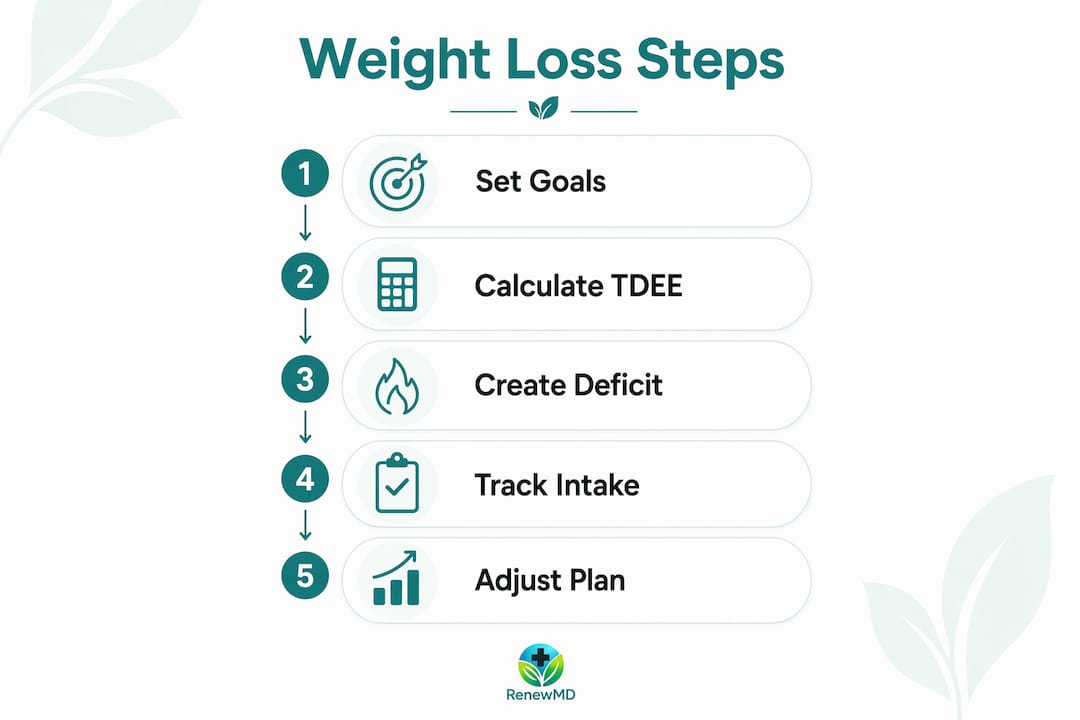
Estimate your TDEE by multiplying your Basal Metabolic Rate (BMR) by an activity multiplier. BMR is the energy your body needs at complete rest. The Mifflin-St Jeor equation, validated across multiple clinical populations, is the most accurate formula for most adults.
| Activity Level | Description | TDEE Multiplier |
|---|---|---|
| Sedentary | Desk job, little or no exercise | BMR × 1.2 |
| Lightly active | Light exercise 1–3 days per week | BMR × 1.375 |
| Moderately active | Moderate exercise 3–5 days per week | BMR × 1.55 |
| Very active | Hard exercise 6–7 days per week | BMR × 1.725 |
| Extra active | Physical job plus daily training | BMR × 1.9 |
Once you have your TDEE, structure your weight loss meal plan around whole foods: lean proteins, vegetables, legumes, whole grains, and healthy fats. Protein deserves special attention. Adequate protein intake, typically 0.7–1.0 grams per pound of body weight, reduces hunger and protects muscle during a caloric deficit. Meal timing matters less than total daily intake for most people, though distributing protein across three to four meals supports satiety better than concentrating it in one sitting.
For physical activity, the 2026 evidence hierarchy is clear: dietary adherence drives active fat loss, while exercise primarily supports weight maintenance. Start your aerobic program in week one, but do not expect the scale to move from exercise alone. The two work together, not as substitutes for each other.
Use accuracy-validated tracking tools to log both food intake and activity. Apps that have cleared peer-reviewed validation panels give you reliable feedback. Apps without that validation can undercount calories by 20–30%, which creates false confidence and stalls progress.
Pro Tip: Calculate your TDEE once, then recalculate every 10 pounds lost. Your BMR drops as your body weight decreases, so the same calorie target that produced results at 220 pounds may no longer create a deficit at 200 pounds.
What behavioral strategies improve long-term adherence?
Dietary self-monitoring is the single strongest behavioral predictor of sustained weight loss. People who track consistently are more than twice as likely to maintain their results compared to those who track intermittently. The mechanism is straightforward: tracking creates awareness, and awareness drives better decisions.
The frequency of professional contact also matters significantly. The U.S. Preventive Services Task Force (USPSTF) recommends 12–26 sessions for effective obesity management. Research confirms that programs with 14 or more sessions in six months produce significantly higher weight loss than programs with fewer touchpoints. If you are working with a clinician, dietitian, or behavioral coach, prioritize consistency of contact over intensity of any single session.
Multidisciplinary support, meaning a team that includes a registered dietitian, behavioral specialist, and medical provider, outperforms self-directed plans in both adherence and long-term outcomes. This is not a luxury. For people with more than 30 pounds to lose, the complexity of managing hunger hormones, metabolic adaptation, and psychological barriers typically exceeds what a single-provider or solo approach can address.
Common behavioral techniques that evidence supports:
- Stimulus control: Restructure your environment so healthy choices require less willpower (keep cut vegetables at eye level in the refrigerator, remove ultra-processed snacks from the home)
- Cognitive restructuring: Replace all-or-nothing thinking ("I ate pizza, the week is ruined") with flexible thinking ("One meal does not define the week")
- Problem-solving: When a barrier appears, write it down and generate three possible responses before acting
- Social support: Share your plan with at least one person who will check in with you weekly
Pro Tip: Choose a tracking app that has passed a peer-reviewed accuracy validation study. Apps clearing a six-app validation panel are recommended by practitioners over less-tested alternatives. Inaccurate tools create false feedback that stalls progress without any obvious explanation.
How do you handle plateaus and adjust your plan over time?
Weight loss plateaus are physiological adaptations, not personal failures. When you lose weight, your body reduces its energy expenditure to match the lower calorie intake. This is called metabolic adaptation. The scale stops moving not because your plan is broken, but because your body has recalibrated to your current deficit.
The science-backed response to a plateau is recalibration, not abandonment. Adjust either your calorie intake, your activity level, or both to reestablish the deficit. A reduction of 100–200 additional calories per day, or adding one extra 30-minute aerobic session per week, is usually sufficient to restart progress without causing further metabolic stress.
For deeper guidance on managing plateaus during medically supervised programs, Renewmd's resource on overcoming weight loss plateaus provides clinically informed strategies for recognizing and responding to stalled progress.
| Challenge | Likely Cause | Recommended Response |
|---|---|---|
| Scale stalled for 2+ weeks | Metabolic adaptation | Reduce daily intake by 100–200 calories or add one aerobic session |
| Hunger increasing sharply | Deficit too aggressive | Increase intake by 100–150 calories and reassess protein intake |
| Motivation declining | Unrealistic expectations or lack of variety | Review goals, introduce new recipes or activities, seek peer support |
| Regaining weight after loss | Insufficient maintenance plan | Shift focus to physical activity and structured meal planning for maintenance |
Psychological tools play an equally important role. Mindfulness-based eating practices reduce binge episodes and emotional eating. Support groups, whether in-person or virtual, provide accountability and normalize the non-linear nature of weight loss. Reframing a plateau as data rather than defeat keeps you in problem-solving mode rather than avoidance mode.
Regular monitoring and recalibration of your goals prevent plan abandonment during difficult phases and improve sustained outcomes. Build a formal review into your calendar every four weeks. Treat it like a clinical appointment with yourself.
Key takeaways
A sustainable weight loss plan requires a caloric deficit, SMART goals, consistent self-monitoring, and structured support to produce results that last beyond six months.
| Point | Details |
|---|---|
| Set a safe caloric deficit | Target 500–1,000 calories below your TDEE for 0.5–2 pounds of loss per week. |
| Use SMART goals | Specific, time-bound goals with regular reviews outperform vague intentions in clinical research. |
| Prioritize dietary tracking | Self-monitoring is the strongest predictor of sustained weight loss; use validated apps only. |
| Seek frequent support | Programs with 14 or more sessions in six months produce significantly better outcomes. |
| Recalibrate at plateaus | Plateaus are metabolic adaptations; adjust intake or activity rather than abandoning the plan. |
Why most weight loss plans fail before they should
After reviewing the research and working through the evidence, one pattern stands out clearly. Most people do not fail because they lack willpower. They fail because their plan was never built to accommodate reality.
Real weight loss is not linear. Your body adapts, your schedule changes, and your motivation fluctuates. A plan that has no built-in recalibration mechanism will break the first time life gets complicated. The people who succeed long-term treat their plan as a living document, not a fixed contract.
The second thing I see consistently underestimated is the role of accurate data. Using an unvalidated tracking app is like navigating with a broken compass. You feel like you are doing everything right, but the feedback is misleading you. Practitioners who work in this space are emphatic on this point: tool accuracy is not optional.
Finally, the expectation that weight loss should be fast is the single most damaging misconception I encounter. The clinical evidence is clear that meaningful, lasting change happens over months, not weeks. A 5–10% reduction in total body weight over six months is considered a clinically significant outcome. That is not a slow result. That is a result that your body can sustain.
If you are considering medically supervised options, the step-by-step safe weight loss workflow from Renewmd offers a clinically informed framework worth reviewing before you start.
— Raymond
How Renewmd supports your personalized weight loss plan
Renewmd is a telemedicine platform built specifically for adults who want medically supervised weight management without the complexity of traditional clinic visits. Every program includes provider consultations, lab testing, coaching, and medication delivery through licensed U.S. clinicians and pharmacies. For those whose plans include pharmacological support, Renewmd offers GLP-1 receptor agonist therapies including Semaglutide and Tirzepatide, with full clinical oversight from intake to ongoing monitoring. Explore Renewmd's validated digital weight care tools to find tracking and support resources that meet peer-reviewed accuracy standards. When you are ready to take the next step, start your clinical evaluation and get a plan built around your specific needs.
FAQ
What is the safest rate of weight loss per week?
The clinically recommended rate is 0.5 to 2 pounds per week. This is achieved through a daily caloric deficit of 500–1,000 calories and produces meaningful results without significant metabolic disruption.
How many calories should i cut to lose weight?
Subtract 500–1,000 calories from your Total Daily Energy Expenditure to create a deficit that supports safe fat loss. Recalculate your TDEE every 10 pounds lost, as your calorie needs decrease with body weight.
What is the best way to track food intake for weight loss?
Dietary self-monitoring using a peer-reviewed, accuracy-validated tracking app is the most effective method. Apps that have not passed validation testing can undercount calories significantly, which stalls progress without a clear explanation.
How do i know if i have hit a weight loss plateau?
A plateau is defined as no meaningful scale change over two or more consecutive weeks despite consistent adherence to your plan. It reflects metabolic adaptation and requires adjusting your calorie intake or activity level to reestablish a deficit.
Does exercise alone cause weight loss?
Physical activity contributes less to active fat loss than dietary adherence does. Exercise plays a dominant role in weight maintenance after loss. Start an exercise program early, but rely primarily on dietary control to drive the scale down during the active loss phase.