
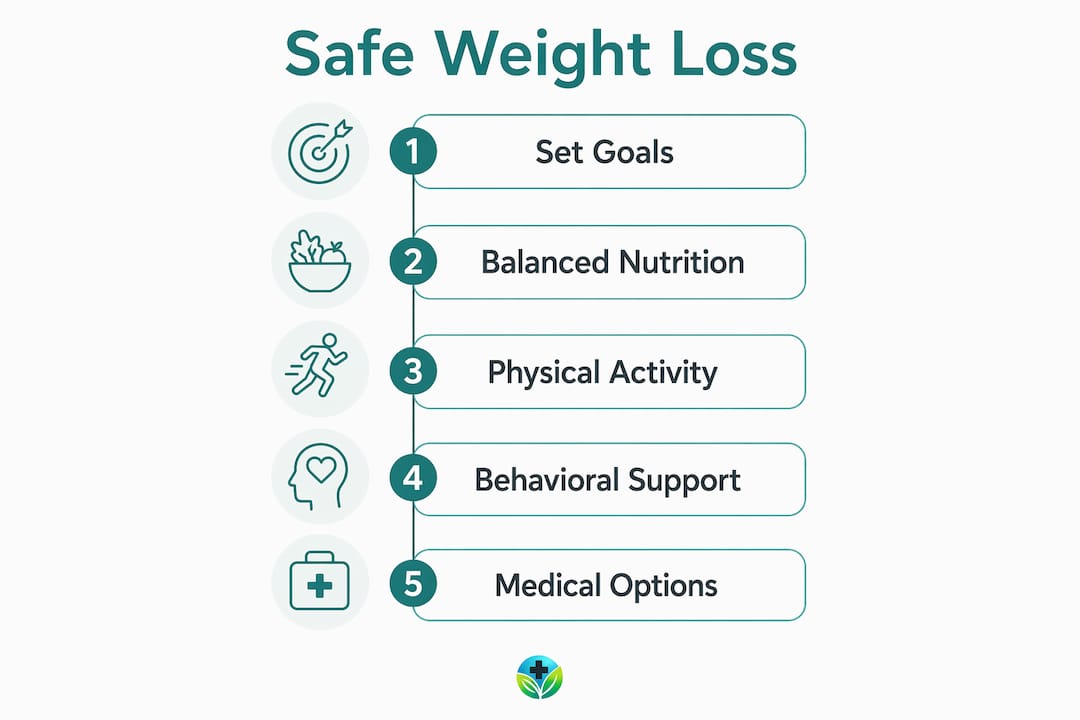
A safe weight loss workflow is a structured, evidence-based process that combines realistic goal setting, balanced nutrition, regular physical activity, behavioral support, and ongoing monitoring to promote gradual fat loss while protecting your overall health. This approach, recognized by the National Institute of Diabetes and Digestive and Kidney Diseases (NIDDK), the American Heart Association (AHA), and clinical resources like Endotext, differs fundamentally from crash diets or single-focus interventions. The core principle is that comprehensive lifestyle programs combining diet, physical activity, and behavioral therapy consistently outperform any single strategy for long-term weight management. Following this workflow means building habits your body and schedule can sustain, not chasing rapid results that fade within months.
What are realistic, evidence-based goals for safe weight loss?
Setting the right target is the foundation of any effective weight loss strategy. The NIDDK defines a clinically meaningful and safe outcome as losing 5% to 10% of your starting body weight within approximately six months. For a person weighing 200 pounds, that translates to a loss of 10 to 20 pounds. Even at the lower end of that range, this level of fat loss produces measurable improvements in blood pressure, blood sugar, and cholesterol.
The recommended pace to reach that target safely is about 1 to 2 pounds per week, as supported by the AHA. Faster loss typically involves extreme caloric restriction that strips muscle mass and increases the risk of nutrient deficiencies. Slower loss is not a failure. It often reflects a more sustainable caloric deficit that your body can maintain without triggering compensatory hunger responses.
The SMART framework, which stands for Specific, Measurable, Achievable, Relevant, and Time-bound, gives structure to goal setting in practice. Instead of "I want to lose weight," a SMART goal reads: "I will lose 10 pounds in 12 weeks by reducing my daily caloric intake by 500 calories and walking 30 minutes five days per week." Short-term goals create momentum. Long-term goals provide direction. Reassessment windows, typically every four to six weeks, allow you to adjust when progress stalls or life circumstances shift.
Key elements of a well-structured goal-setting phase:
- Set a primary target of 5% to 10% body weight loss over six months
- Aim for a pace of 1 to 2 pounds per week
- Use the SMART framework to write specific, time-bound goals
- Schedule reassessment checkpoints every four to six weeks
- Track both process goals (daily steps, meals logged) and outcome goals (weight, waist measurement)
Pro Tip: The NIH Body Weight Planner and apps like MyFitnessPal or Cronometer let you model different caloric scenarios and visualize your projected timeline before you start, which removes guesswork and sets realistic expectations from day one.
How to build a balanced nutrition plan for fat loss
Nutrition is the most powerful lever in a healthy weight loss plan, and the most commonly misused one. The core mechanism is a moderate caloric deficit: consuming fewer calories than your body expends. A deficit of 500 to 750 calories per day typically produces the target rate of 1 to 2 pounds of fat loss per week without triggering severe metabolic adaptation.
Dietary quality matters as much as quantity. The AHA and NIDDK both recommend limiting added sugars to less than 10% of total daily calories, keeping saturated fat below 10% of calories, and capping sodium intake at 2,300 mg per day. These thresholds are not arbitrary. Exceeding them consistently raises cardiovascular risk, which is already elevated in individuals carrying excess weight.
Meal composition and timing also influence adherence. High-fiber foods, including vegetables, legumes, and whole grains, slow gastric emptying and extend satiety. A nutritionally complete breakfast reduces total daily caloric intake for many people by preventing mid-morning energy crashes that lead to impulsive snacking. Working with a registered dietitian produces better outcomes than self-directed dieting alone, particularly for individuals managing conditions like type 2 diabetes or hypertension.
| Dietary component | Recommended limit or target |
|---|---|
| Added sugars | Less than 10% of total daily calories |
| Saturated fat | Less than 10% of total daily calories |
| Sodium | 2,300 mg per day or less |
| Fiber intake | 25 to 38 grams per day (age and sex dependent) |
| Caloric deficit | 500 to 750 calories below maintenance per day |
Tracking tools make adherence measurable. Apps like Lose It!, Cronometer, and MyFitnessPal allow you to log meals, scan barcodes, and monitor macronutrient distribution in real time. Logging consistently, even imperfectly, correlates with better weight loss outcomes than relying on memory or estimation alone.
Pro Tip: Avoid eliminating entire food groups. Extreme restriction creates a psychological scarcity response that increases cravings and raises the likelihood of binge episodes. Sustainable fat loss comes from modifying portions and improving food quality, not from deprivation.
What role does physical activity play in a safe weight loss workflow?
Physical activity supports fat loss, but its role is more nuanced than most people expect. Exercise alone, without dietary changes, produces modest weight loss for most individuals. Its true power lies in preserving lean muscle mass during a caloric deficit, improving metabolic health, and making long-term weight maintenance significantly more achievable.

The NIDDK recommends at least 150 minutes per week of moderate-intensity aerobic activity, such as brisk walking, cycling, or swimming, combined with muscle-strengthening exercises on two or more days per week. For individuals focused on maintaining weight loss after reaching their goal, the recommendation increases to 300 or more minutes per week of moderate activity. That higher volume reflects the metabolic reality that a body at a lower weight burns fewer calories at rest, requiring more movement to maintain the deficit.
Physical activity also delivers benefits entirely independent of fat loss. Regular exercise improves blood pressure and blood sugar control and supports mental health by reducing symptoms of anxiety and depression. These outcomes matter because psychological wellbeing directly influences adherence to a weight loss plan.
Accessible activity options for individuals starting out include:
- Brisk walking for 30 minutes, five days per week
- Low-impact dancing or aerobics classes
- Bodyweight resistance exercises such as squats, lunges, and push-ups
- Cycling, either outdoors or on a stationary bike
- Swimming or water aerobics, particularly for those with joint concerns
Anyone with cardiovascular disease, type 2 diabetes, or musculoskeletal conditions should consult a clinician before significantly increasing exercise intensity. Starting at a lower volume and progressing gradually reduces injury risk and builds the consistency that produces results over months, not weeks.
How behavioral support and monitoring enhance fat loss success
Behavioral science is the least glamorous component of a weight loss workflow and the one most responsible for long-term success. Comprehensive obesity management requires diet change, increased physical activity, and behavior therapy working together. Programs like the Diabetes Prevention Program (DPP) and the Look AHEAD trial demonstrated 5% to 10% weight loss linked with measurable improvements in diabetes and cardiovascular risk markers, precisely because they integrated all three components.
The core behavioral strategies used in evidence-based programs include:
- Self-monitoring: Logging food intake, physical activity, and body weight creates awareness and accountability. The AHA identifies tracking food intake as a foundational step in behavioral weight loss programs.
- Stimulus control: Modifying your environment to reduce exposure to high-calorie foods and increase access to healthy options. Keeping cut vegetables at eye level in the refrigerator is a simple example.
- Goal setting and problem solving: Identifying specific obstacles before they occur and planning responses in advance. If you know Thursday evenings are chaotic, pre-plan a quick, nutritious meal for that night.
- Social support: Group-based programs, individual counseling, and peer accountability networks all improve adherence and reduce dropout rates.
- Regular progress review: Weighing yourself weekly and reviewing behavioral targets monthly prevents small deviations from becoming entrenched habits.
Telehealth-delivered behavioral interventions produce clinically meaningful weight loss comparable to in-person programs when they are structured and comprehensive. This finding expands access for individuals who cannot attend clinic-based programs due to geography, work schedules, or mobility limitations.
Pro Tip: Schedule a 15-minute weekly review of your food log, activity data, and weight trend. Treat it like a standing appointment. Consistent review sessions catch drift early and allow you to recalibrate before a temporary setback becomes a prolonged plateau.
When and how to consider medical interventions in your plan
Prescription medications represent a legitimate and evidence-based component of a structured weight loss plan for individuals who meet clinical criteria, typically a body mass index of 30 or higher, or 27 or higher with a weight-related comorbidity. Medications do not replace lifestyle changes. They amplify the results of a program already built on sound nutrition, physical activity, and behavioral support.
Combined with lifestyle modification, weight-loss medications add approximately 3% to 12% additional weight loss after one year compared to lifestyle changes alone. Most of that additional loss occurs within the first six months of treatment. The NIDDK specifies a clear safety protocol: if a patient does not achieve at least 5% weight loss by 12 weeks at the full prescribed dose, the medication should be discontinued and the plan reassessed.
FDA-approved options currently include GLP-1 receptor agonists such as Semaglutide (Wegovy) and Tirzepatide (Zepbound), which work by mimicking gut hormones that signal satiety to the brain and slow gastric emptying. Other approved medications include Orlistat, Phentermine-Topiramate, and Naltrexone-Bupropion, each with distinct mechanisms, risk profiles, and contraindications.
| Medication type | Mechanism | Key consideration |
|---|---|---|
| GLP-1 receptor agonists (Semaglutide, Tirzepatide) | Mimics satiety hormones, slows gastric emptying | Requires injection or oral dosing; nausea common initially |
| Orlistat | Blocks dietary fat absorption | Gastrointestinal side effects; requires low-fat diet |
| Phentermine-Topiramate | Appetite suppression via CNS | Not suitable for cardiovascular disease or pregnancy |
| Naltrexone-Bupropion | Reduces food cravings via reward pathways | Contraindicated with opioid use or seizure history |
Bariatric surgery remains an option for individuals with severe obesity who have not responded to other interventions, but it carries surgical risks and requires lifelong dietary and behavioral commitment. Medical supervision throughout any pharmacological or surgical intervention is non-negotiable. Coordination with a licensed clinician protects against adverse effects and keeps the broader workflow on track.
Key takeaways
A safe weight loss workflow succeeds when it combines realistic targets, sound nutrition, consistent physical activity, behavioral accountability, and appropriate medical support into one structured plan.
| Point | Details |
|---|---|
| Set evidence-based targets | Aim for 5% to 10% body weight loss in six months at a pace of 1 to 2 pounds per week. |
| Build a moderate caloric deficit | Reduce intake by 500 to 750 calories daily while meeting fiber, protein, and micronutrient needs. |
| Move consistently | Meet the 150-minute weekly aerobic activity guideline plus two days of strength training. |
| Use behavioral tools | Self-monitoring, stimulus control, and weekly progress reviews prevent plateaus and improve adherence. |
| Consider medical support when appropriate | GLP-1 receptor agonists and other FDA-approved medications can add 3% to 12% additional loss when lifestyle changes alone are insufficient. |
What I've learned about following a safe weight loss workflow
After years of reviewing clinical programs and observing how people actually engage with weight loss plans, one pattern stands out clearly: the individuals who succeed long-term are not the ones who start the hardest. They are the ones who start the most honestly. They set targets their lives can accommodate, not targets that require perfect conditions.
The workflow described in this article is not a rigid protocol. It is a framework you adapt to your health status, schedule, and preferences. Someone managing hypothyroidism will adjust caloric targets differently than someone with no metabolic conditions. Someone recovering from a knee injury will build their activity plan around swimming rather than walking. Flexibility within structure is what separates a sustainable approach from one that collapses at the first disruption.
Digital tools and telehealth have genuinely changed what is possible for people who cannot access in-person programs. The evidence now confirms that remote behavioral interventions produce comparable outcomes to clinic-based ones when they are structured and comprehensive. That matters. It means geography and schedule are no longer valid reasons to delay starting. The safe weight loss practices that produce lasting results are available to more people than ever before.
My strongest recommendation is this: do not wait until you have the perfect plan to begin. Start with goal setting and food tracking this week. Add structured activity in week two. Introduce behavioral review sessions in week three. Build the workflow incrementally, and it will hold.
— Raymond
How Renewmd supports your weight loss workflow
Renewmd is a telemedicine platform built specifically for individuals who want medically supervised weight management without the friction of traditional clinic visits. Through Renewmd, you can access licensed U.S. clinicians who evaluate your health profile and, where appropriate, prescribe GLP-1 receptor agonists like Semaglutide and Tirzepatide as part of a fully integrated treatment plan. The platform covers provider consultations, lab testing, medication delivery, and ongoing coaching in one transparent program with no hidden fees. If you are ready to add medical support to your structured plan, you can start your program directly through the Renewmd platform and connect with a clinician who will guide your next steps.
FAQ
What is a safe weight loss workflow?
A safe weight loss workflow is a structured, evidence-based plan that combines goal setting, nutrition, physical activity, behavioral support, and monitoring to produce gradual, sustainable fat loss. The NIDDK defines the clinical target as 5% to 10% of starting body weight lost within six months.
How much weight is safe to lose per week?
The AHA and NIDDK both recommend a pace of 1 to 2 pounds per week as the safe and sustainable rate for most adults. Faster loss increases the risk of muscle loss, nutrient deficiencies, and weight regain.
Do I need medication to lose weight safely?
Medication is not required for safe weight loss, but it is a clinically validated option for individuals with a BMI of 30 or higher. When combined with lifestyle changes, FDA-approved medications can add 3% to 12% additional weight loss after one year.
How does behavioral support improve weight loss outcomes?
Behavioral strategies such as self-monitoring, stimulus control, and regular progress review improve adherence and reduce the likelihood of regaining lost weight. Programs like the DPP that integrate behavior therapy alongside diet and activity consistently produce the strongest long-term results.
Can telehealth replace in-person weight loss programs?
Research published in Endotext confirms that telehealth-delivered behavioral interventions produce clinically meaningful weight loss comparable to in-person programs when the program is structured and comprehensive. Remote delivery also improves access for individuals with geographic or scheduling barriers.