
Body mass index, or BMI, is a numerical measure of body fat based on your height and weight. Knowing how to track BMI for weight loss gives you a reliable, low-cost way to monitor your progress and set medically grounded goals. The standard BMI categories define a healthy range as 18.5 to 24.9, overweight as 25 to 29.9, and obesity as 30 or higher. Healthcare providers use BMI as a quick screening tool because it requires no special equipment and takes seconds to calculate. This guide walks you through the formulas, measurement habits, complementary metrics, and digital tools that make BMI tracking work in practice.
How do you calculate BMI for weight loss tracking?
BMI is calculated with one of two formulas depending on your unit system. In the metric system, divide your weight in kilograms by your height in meters squared. In the imperial system, multiply your weight in pounds by 703, then divide by your height in inches squared. Both formulas produce the same result when applied correctly.

Manual calculation vs. digital tools
| Method | How it works | Best for |
|---|---|---|
| Manual (imperial) | Weight (lbs) × 703 ÷ height² (inches) | One-time checks, no device needed |
| Manual (metric) | Weight (kg) ÷ height² (meters) | Clinical settings, metric users |
| BMI calculator app | Inputs weight and height, auto-calculates | Regular tracking with trend history |
| Smart scale integration | Syncs weight data automatically | Hands-free logging and charting |
Manual calculation works fine for a single reading. For ongoing weight loss monitoring, a BMI tracking app stores your history, draws trend lines, and removes the math entirely. The key rule for either method: pick one unit system and stick with it. Switching between pounds and kilograms mid-program introduces errors that distort your trend data.
Pro Tip: Record your height once and lock it in your app settings. Height rarely changes in adults, and re-entering it each time risks accidental errors that throw off every calculation.
Calculating BMI for weight loss is only useful when the inputs are consistent. Weigh yourself on the same scale, at the same time of day, wearing the same amount of clothing. Small variations in these conditions create noise that can make real progress invisible.
What is the best frequency for measuring BMI?
Weekly BMI checks under consistent conditions reduce noise from fluid fluctuations and psychological stress from daily weight changes. Daily weighing amplifies normal water weight swings, which can range by several pounds within a single day. That variability has nothing to do with fat loss. Seeing the number jump up on a Tuesday morning can feel discouraging even when you are making real progress.
Setting a weekly measurement ritual
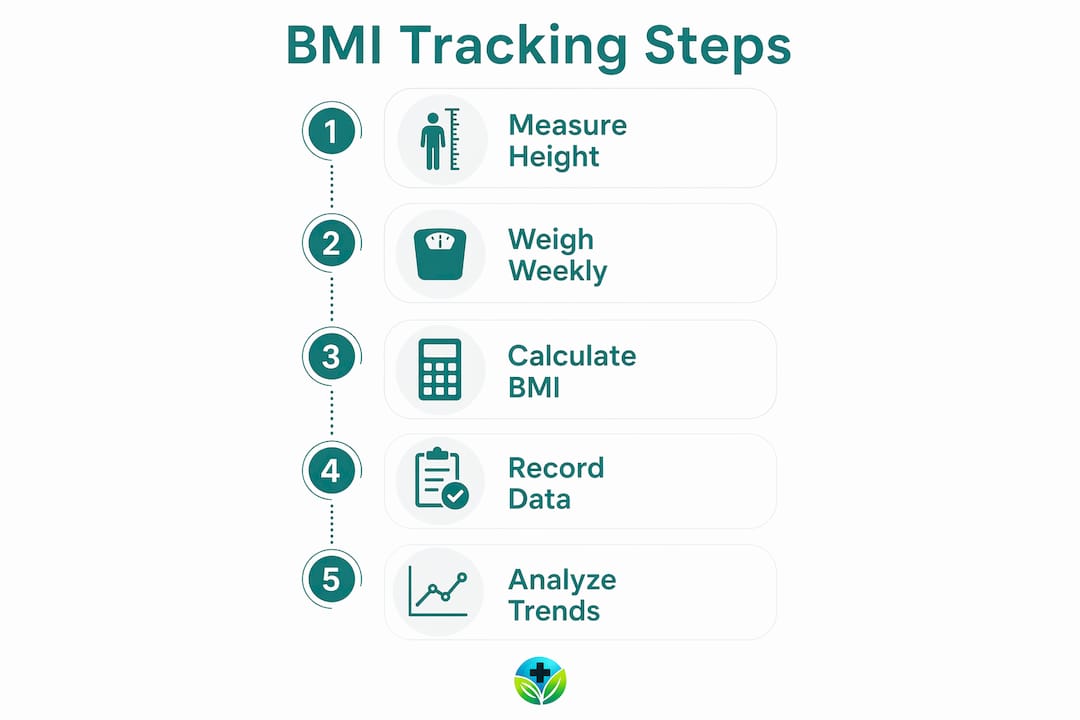
A structured weekly audit removes that emotional noise. Follow these steps each time:
- Weigh yourself on the same day each week, friday mornings work well for many people.
- Measure first thing in the morning, before eating or drinking.
- Use the same scale on the same surface, a hard floor gives more accurate readings than carpet.
- Wear the same type of clothing, or none at all, each time.
- Log the number immediately so you do not rely on memory.
Once you have four or more weekly readings, look at the direction of the trend rather than any single number. A 7-day rolling average smooths out the day-to-day variation and shows whether your BMI is genuinely moving downward over time. That trend line is the real signal.
Pro Tip: Set a recurring phone reminder for your weekly weigh-in. Consistency in timing matters more than the exact day you choose. Pick a day you can realistically maintain every week.
How can you complement BMI tracking with other measurements?
BMI is a screening tool, not a complete health picture. BMI cannot distinguish muscle from fat, which means a person with high muscle mass may show an "overweight" BMI despite low body fat. Visceral fat, the type stored around internal organs and most associated with metabolic risk, is invisible to BMI alone. Pairing BMI with additional measurements closes that gap.
Waist circumference
Waist circumference is the most practical complement to BMI. The American Heart Association recommends a waist circumference below 40 inches for men and below 35 inches for non-pregnant women. Abdominal fat carries more health risk than fat stored in other areas of the body. Measuring your waist gives you a direct read on that risk.
To measure correctly, stand upright and place a flexible tape measure around your bare abdomen at the level of the iliac crest, the top of your hip bone. The tape should be snug but not compressing the skin. Take the measurement at the end of a normal exhale. For people with a BMI between 25 and 35, tracking waist circumference alongside BMI is especially recommended.
Comparison of BMI and complementary metrics
| Metric | What it measures | Limitation |
|---|---|---|
| BMI | Overall weight relative to height | Cannot separate fat from muscle |
| Waist circumference | Abdominal fat accumulation | Does not reflect total body fat |
| Body fat percentage | Proportion of fat to total body mass | Requires special equipment or estimation |
| Clinical indicators | Blood pressure, cholesterol, blood glucose | Requires lab work or clinical visit |
Intensive weight loss interventions require monitoring body composition to preserve muscle mass, not just BMI or weight. Combining waist measurements with body fat percentage estimations produces a more accurate picture of what is actually changing in your body. Tracking baseline lab work alongside these physical metrics gives you the fullest possible view of your health progress.
What digital tools help with BMI tracking for weight loss?
Digital tools turn raw numbers into visible progress. A good BMI tracking app does more than calculate your score. It stores your measurement history, plots trend charts, and flags when your numbers cross clinical thresholds. That visual feedback is motivating in a way that a single number on a scale is not.
The most useful features to look for in a weight tracker app include:
- Trend charts that display your BMI over weeks and months, not just your last reading.
- 7-day rolling averages that filter out daily fluctuations and show your true direction of change.
- Multiple metric logging so you can record waist circumference and body weight in the same place.
- Goal setting anchored to clinical BMI ranges, such as targeting a BMI of 24.9 as your upper healthy limit.
- Data privacy controls so your health information stays protected and is not shared without your consent.
Setting a BMI goal anchored to the upper healthy limit of 24.9 is more effective than choosing an arbitrary weight number. A clinically grounded target adjusts naturally as your height stays constant, and it connects your goal to a recognized health standard rather than an aesthetic preference.
Pro Tip: Choose an app that logs body measurements beyond just weight. Apps that track waist circumference alongside BMI give you a much richer picture of your progress, especially during periods when the scale barely moves.
Privacy matters when choosing a digital tool. Look for apps that store data locally on your device or use encrypted cloud storage. Avoid tools that require social sharing as a default feature, since health data is personal and should remain under your control.
For people pursuing medically supervised weight loss, wearable technology can add another layer of tracking by monitoring activity levels and physiological signals that complement your BMI data.
Key Takeaways
Consistent, weekly BMI tracking paired with waist circumference measurement and a clinically anchored goal of 24.9 gives you the most reliable picture of weight loss progress.
| Point | Details |
|---|---|
| Use the correct formula | Multiply weight (lbs) by 703, then divide by height in inches squared for imperial calculation. |
| Track weekly, not daily | Weekly measurements under consistent conditions reduce noise and show real trends. |
| Pair BMI with waist size | Waist circumference below 40 inches (men) or 35 inches (women) adds critical context BMI misses. |
| Set a clinical goal | Target a BMI of 24.9 rather than an arbitrary weight number for a medically meaningful benchmark. |
| Use apps with trend charts | Rolling averages and multi-metric logging reveal progress that single readings hide. |
BMI tracking works best when you treat it as one signal, not the whole story
I have seen a lot of people fixate on their BMI number the way others fixate on the scale. They check it every day, feel great when it drops a tenth of a point, and feel defeated when it holds steady for two weeks. That relationship with the number is the problem, not the number itself.
BMI is a statistical classification, not a personalized diagnosis. It does not know whether you are a 45-year-old woman who just started strength training or a 30-year-old man who has been sedentary for a decade. It gives you a position on a population-level chart. That position is useful context. It is not a verdict.
What I have found actually works is treating BMI as one instrument in a small dashboard. You check it weekly. You also check your waist circumference. You note how your clothes fit. You look at your energy levels and your lab results if you have them. When several of those signals move in the right direction together, you have real evidence of progress. When only one of them moves, you investigate before drawing conclusions.
The other thing worth saying plainly: a "normal" BMI does not automatically mean you are healthy, and an "overweight" BMI does not automatically mean you are not. People with high muscle mass routinely show BMIs in the overweight range. People with normal BMIs can carry dangerous levels of visceral fat. The number is a starting point for a conversation with a clinician, not the end of one. Use it that way and it becomes genuinely useful. Use it as a daily verdict and it becomes a source of unnecessary stress.
— Raymond
Renewmd's approach to weight management and BMI monitoring
Renewmd is a telemedicine platform built for medically supervised weight loss, with programs designed for adults with a BMI of 27 or higher. The platform connects patients with licensed U.S. clinicians who use GLP-1 receptor agonists such as Semaglutide and Tirzepatide as part of fully integrated treatment plans. Each plan includes provider consultations, lab testing, medication delivery, and coaching, all without hidden fees. Renewmd also provides digital tools for weight tracking that help patients monitor BMI and body measurements alongside their clinical progress. For those ready to take a structured, evidence-based approach, getting started with Renewmd takes only a few minutes through a secure online intake process.
FAQ
What is a healthy BMI range for weight loss goals?
A healthy BMI falls between 18.5 and 24.9 according to standard clinical categories. Using 24.9 as your target gives you a medically grounded goal that adjusts as your weight changes.
How often should I measure my BMI?
Measure BMI once per week under consistent conditions, such as the same morning, same scale, and before eating. Weekly tracking reveals meaningful trends without the noise of daily fluid fluctuations.
Can BMI alone tell me if my weight loss is working?
BMI is a useful screening tool but cannot distinguish fat from muscle or detect visceral fat. Pair it with waist circumference and, when possible, body fat percentage for a complete picture.
What is the best BMI calculator method?
For ongoing tracking, a BMI tracking app with trend charts and rolling averages is more useful than manual calculation. Manual formulas work for one-time checks but do not show progress over time.
Does waist circumference matter more than BMI?
Both metrics serve different purposes. BMI reflects overall weight relative to height, while waist circumference directly measures abdominal fat, which carries higher metabolic risk. Tracking both together gives you the most accurate health assessment.