
Side effects are one of the most common reasons people stop taking medications that are actually working for them. If you're managing a chronic condition, you've likely felt the frustration of weighing a drug's benefits against the discomfort it causes. Learning how to manage medication side effects isn't just about comfort. It's about staying on track with your treatment, communicating clearly with your healthcare team, and making adjustments that improve your quality of life without abandoning therapies that are helping you.
Table of Contents
- Key takeaways
- How to manage medication side effects: getting prepared
- Monitoring and documenting side effects step by step
- Communicating side effects to your healthcare team
- Practical strategies to reduce common side effects
- When to escalate and what to avoid
- My perspective on what actually works
- How Renewmd supports your side effect management
- FAQ
Key takeaways
| Point | Details |
|---|---|
| Track before you report | Monitor symptoms for at least 3 days using a severity scale before contacting your provider. |
| Structured logs change outcomes | Written symptom records increase the chance providers will document adverse events by 63%. |
| Timing and dosing matter | Adjusting when and how you take a medication can reduce nausea and other side effects without stopping therapy. |
| Never stop abruptly | Discontinuing medication without medical supervision carries real risk; tapering is almost always safer. |
| Advocacy is part of treatment | Bringing organized, specific symptom data to appointments directly influences the care decisions your provider makes. |
How to manage medication side effects: getting prepared
Before you can manage side effects effectively, you need the right foundation. That starts with a complete, current picture of everything you're taking.
Gather the following before your next appointment or before symptoms escalate:
- Full medication list: Include prescription drugs, over-the-counter medications, vitamins, and supplements. Note the dose, brand name, generic name, and the time of day you take each one.
- Prescribing information: Most pharmacies provide a patient information leaflet with each medication. Read it. The listed side effects are there to set expectations, not to alarm you.
- Symptom tracking tools: A dedicated notebook works. So does a smartphone app built for health logging. The tool matters less than the consistency of use.
- Direct contact for your care team: Know whether your provider prefers messages through a patient portal, phone calls, or scheduled follow-ups for non-urgent symptom reports.
| Tracking method | Best for | Limitation |
|---|---|---|
| Paper notebook | Offline access, simplicity | Easy to lose; hard to search |
| Health app | Automatic reminders, graphs | Requires phone and app literacy |
| Patient portal messages | Direct provider communication | Response time varies |
| Printed symptom log | Appointments and records | Needs consistent updating |
Pro Tip: Ask your pharmacist to review your full medication list at least once a year. Community pharmacists are trained to detect drug-related problems early through sustained patient follow-up, and this review is usually free.
Setting up these basics gives you a platform from which every other strategy becomes more effective. You're not just reacting to discomfort. You're building a system.
Monitoring and documenting side effects step by step
Vague reporting produces vague results. When you tell your provider "I feel off," they have very little to work with. When you say "I've had a 6/10 nausea episode each morning for five days, typically 30 minutes after my dose," they have something clinical to act on. Numeric symptom scales improve the precision of what gets reported and what gets addressed.
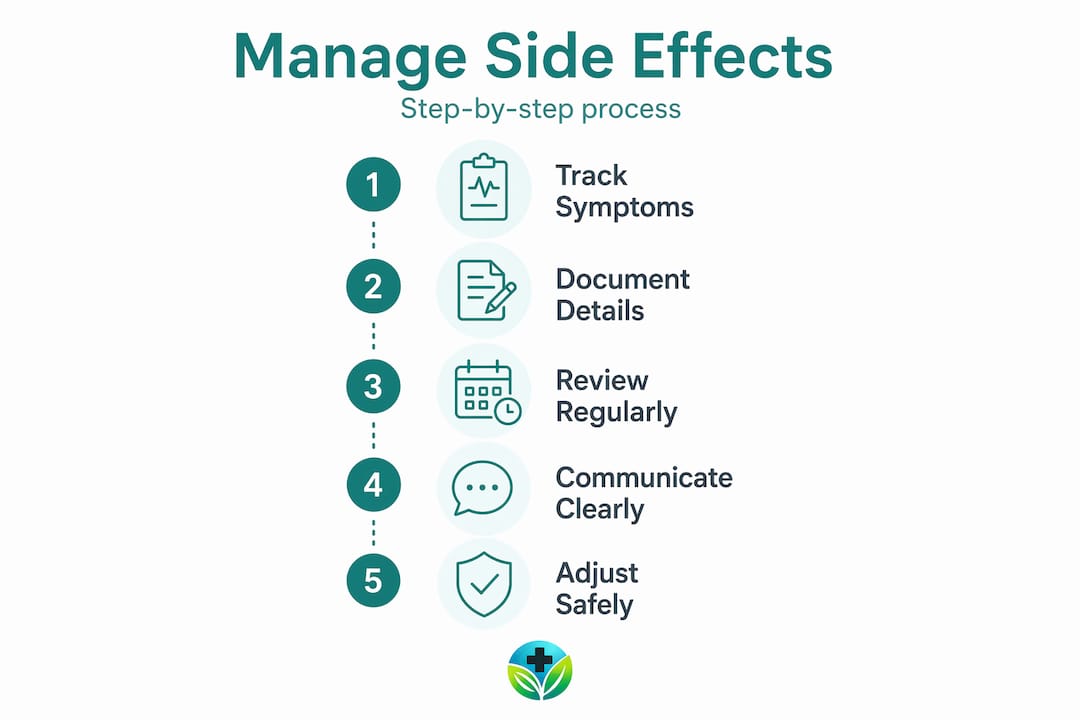
Here's a reliable process for systematic symptom documentation:
- Record the symptom immediately. Don't rely on memory at the end of the day. Note the time, the specific symptom, and where in your body you feel it.
- Rate severity on a 0 to 10 scale. Zero means no symptom. Ten means unbearable or disabling. This rating transforms a subjective experience into a trackable data point.
- Note the timing relative to your dose. Did the symptom appear within an hour of taking the medication? After eating? In the middle of the night? Timing patterns reveal a lot about mechanism and possible solutions.
- Log lifestyle factors. What did you eat that day? How much water did you drink? How many hours did you sleep? These variables often interact with medication in ways your provider needs to know about.
- Photograph visible reactions. Rashes, swelling, or discoloration can change quickly. Timestamped photographs increase the validation rate of reported side effects by 42%, giving your provider objective evidence rather than a description from memory.
- Track for a minimum of 3 days before reporting non-urgent symptoms. A single bad day may not be the medication. A pattern across at least 3 days with consistent timing and severity is far more clinically meaningful.
Pro Tip: Create a simple template in your notes app with fields for: symptom name, time of onset, severity rating, duration, dose timing, and any relevant food or activity. Filling it out takes less than two minutes and produces exactly the kind of record your provider can act on.
Structured recording transforms your subjective experiences into clinical records that can influence treatment plans and even regulatory safety updates. That's not a small thing.

Communicating side effects to your healthcare team
Documenting your symptoms is only half the process. The other half is turning that documentation into a productive clinical conversation. Many patients underreport or underexplain their side effects, partly out of concern about being dismissed and partly because they don't know how to frame the information.
A structured approach makes a measurable difference. Try organizing your report using the five W framework: what the symptom is, when it started, where it occurs, what makes it better or worse, and what impact it has on your daily function. This gives your provider a complete picture in a format they're trained to receive.
When you bring that information to an appointment, be specific about what you're asking for:
- Request documentation: Ask your provider to note the side effect in your medical record. Written symptom logs increase the likelihood of proper adverse event documentation by 63%, but only when you advocate for it.
- Ask about dose adjustment: Side effects are often dose-dependent. A lower dose or slower titration may resolve the issue without eliminating the benefit.
- Ask about timing or administration changes: Some side effects are linked to when or how a medication is taken, not the medication itself.
- Understand your options before discontinuing: Stopping abruptly can be dangerous, depending on the medication class. Supervised tapering is almost always the safer path.
If you feel dismissed or unheard, you have every right to ask for a second opinion or request a referral to a specialist. Your reported experience is valid clinical data, not a complaint.
Proactive collaboration with your healthcare team from the earliest signs of discomfort is one of the most effective forms of medication side effects management available. Providers can only respond to what you tell them. Give them the full picture.
Practical strategies to reduce common side effects
Medication adjustments aren't always the first move. Many side effects can be significantly reduced through targeted lifestyle changes and timing strategies. These approaches are especially relevant for people on GLP-1 receptor agonists like Semaglutide or Tirzepatide, where gastrointestinal symptoms are common but often manageable.
Dietary and timing adjustments
- Take medications that cause nausea with a small, low-fat meal unless your prescribing instructions specify otherwise. Some medications require a fasting state for proper absorption, so check your instructions first.
- Stay well hydrated throughout the day. Dehydration worsens many side effects, including headaches, dizziness, and constipation.
- Eat smaller, more frequent meals rather than large portions, particularly if your medication slows gastric emptying.
- Optimizing administration timing and separating medications that interact has been shown to reduce nausea and abdominal pain without stopping therapy.
Physical activity and sleep
Moderate physical activity supports digestion, reduces fatigue-related side effects, and improves overall medication tolerance. Sleep quality directly affects how your body processes medications. If your medication disrupts sleep, ask whether shifting your dose to morning would help.
Reviewing your full medication burden
| Strategy | Side effect targeted | Clinical evidence |
|---|---|---|
| Dose reduction with supervision | Nausea, dizziness, fatigue | Supported by pharmacological case studies |
| Adjusted administration timing | GI symptoms, sleep disruption | Shown to improve tolerability |
| Deprescribing unnecessary medications | Multiple overlapping side effects | Withdrawal of one drug improved safety and quality of life in polymedicated patients |
| Hydration and dietary adjustments | Nausea, constipation, headache | Standard clinical recommendation |
Deprescribing unnecessary medications under clinical supervision is particularly worth discussing if you take multiple drugs. Reducing your medication burden can eliminate side effects without touching your primary therapy.
Pro Tip: Use a digital tracking tool designed for medication and symptom management. These apps can send dose reminders, log your entries automatically, and generate reports you can share directly with your care team.
When to escalate and what to avoid
Most side effects are manageable. Some are not. Knowing the difference is one of the most critical skills in handling drug side effects responsibly.
Seek immediate medical attention if you experience any of the following:
- Difficulty breathing, chest tightness, or rapid heart rate
- Severe abdominal pain or persistent vomiting that prevents you from keeping fluids down
- Sudden swelling of the face, throat, or extremities
- Signs of an allergic reaction, including hives or widespread skin redness
- Confusion, vision changes, or loss of coordination
Early reporting matters. Medical experts warn that ignoring mild symptoms like isolated vomiting can allow a manageable problem to become a serious one. Report sooner, not later.
Beyond emergencies, there are several common mistakes that make side effect experiences worse. Stopping medication on your own, without guidance, is the most consequential. Self-discontinuation can cause rebound symptoms, withdrawal effects, or a rapid return of the condition you were treating. Always consult your provider first.
A second common mistake is normalizing gradual decline. When side effects appear slowly over weeks, patients often adapt to feeling worse rather than recognizing it as a problem worth reporting. Set a personal policy: if a symptom persists longer than 3 days or worsens over time, it gets logged and reported. If you feel your provider is not taking your concerns seriously, request a second opinion. That is not overreacting. That is good self-advocacy. You can find detailed guidance on when to call your provider about specific symptoms related to GLP-1 therapy.
My perspective on what actually works
I've watched patients with detailed symptom logs get faster, more specific responses from their providers than patients who arrived with nothing but frustration. The difference isn't that one group suffered more. It's that one group came prepared.
In my experience, the hardest part of coping with medication side effects isn't the symptoms themselves. It's the feeling that you have to tolerate them silently or risk seeming difficult. That belief costs people real quality of life. Your healthcare team cannot do their job without your data. Bringing a structured log to an appointment isn't being high-maintenance. It's being the kind of patient whose care actually gets optimized.
I've also learned that the binary thinking around medication, either take it as prescribed or stop, is where most people get stuck. There is almost always a middle path: a different dose, a different time of day, a dietary adjustment, or a complementary intervention. But finding that path requires you to speak up with specificity before your provider can act.
The patients who do best are not the ones with the fewest side effects. They're the ones who stay engaged, stay curious, and treat overcoming medication side effects as an ongoing conversation rather than a verdict.
— Raymond
How Renewmd supports your side effect management
Managing prescription side effects is easier when you have a care team that's built for ongoing, responsive support. Renewmd's GLP-1 program is designed exactly for this. Every plan includes licensed U.S. clinician consultations, regular follow-up visits to monitor side effects, and access to evidence-based guidance on adjusting your treatment as your needs change. Whether you're experiencing nausea from Semaglutide or fatigue from Tirzepatide, your Renewmd provider can help you find a manageable path forward without interrupting your progress. If you're ready for medically supervised weight care that takes your side effects seriously, start your consultation today.
FAQ
How long should I track side effects before telling my doctor?
Track symptoms for at least 3 days before reporting non-urgent side effects. This establishes a clear pattern and gives your provider the timing and severity data they need to make informed adjustments.
Can adjusting when I take my medication reduce side effects?
Yes. Adjusting dose timing and administration, such as taking a medication with food or at a different time of day, has been shown to reduce nausea and gastrointestinal discomfort without discontinuing therapy.
Is it safe to stop taking my medication if the side effects are bad?
Stopping medication abruptly is not recommended without medical supervision. Depending on the drug class, sudden discontinuation can cause withdrawal effects or a rapid return of your underlying condition. Speak with your provider about a supervised tapering plan first.
What side effects require emergency care?
Seek immediate care for difficulty breathing, severe abdominal pain, facial swelling, signs of allergic reaction, or sudden confusion. These symptoms can indicate serious adverse reactions that require prompt medical evaluation.
How do I get my doctor to take my side effects seriously?
Bring a written symptom log with specific dates, severity ratings, and timing relative to your dose. Structured records increase the likelihood that your provider will formally document adverse events and adjust your treatment plan accordingly.